Accessibility-Themed CAD Hackathon: A Complete Guide to the 3-Day Design Challenge
A 3-day online CAD hackathon challenges participants to design accessible assistive devices.
The CAD Challenge is an upcoming 3-day online hackathon focused on designing accessibility devices using CAD modeling tools. This article breaks down the competition details, explores why accessible design matters, and provides practical preparation tips including CAD tool recommendations, 3D printing design considerations, and presentation strategies for beginners and makers looking to participate.
A CAD Challenge Focused on Accessible Design
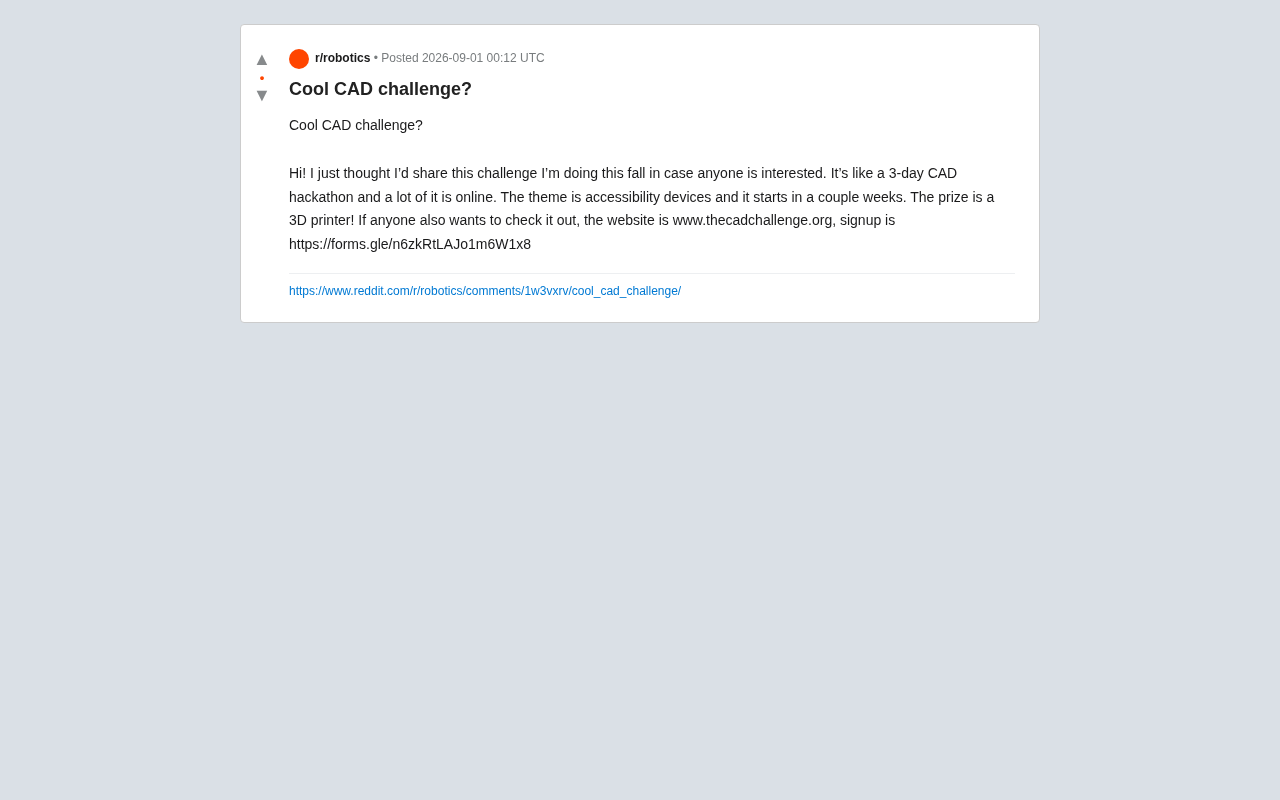
Recently, an online design competition called The CAD Challenge sparked discussion on Reddit. It's a 3-day CAD (Computer-Aided Design) hackathon set to officially launch this fall, conducted primarily online. Unlike typical coding hackathons, this competition focuses on industrial design and 3D modeling, with the theme of "accessibility devices."
CAD (Computer-Aided Design) technology originated in the 1960s, initially applied in aerospace and automotive industries. Today it has permeated nearly every manufacturing sector, including architecture, consumer electronics, and medical devices. Modern parametric CAD software allows designers to build 3D solid models driven by constraints and parameters, and can directly export file formats (such as STL and STEP) used for CNC machining or 3D printing. With the rise of cloud-based CAD tools (like Onshape) and free open-source solutions (like FreeCAD), the barrier to entry for CAD design has dropped dramatically, giving individual makers and students access to professional-grade design capabilities — which has also laid the groundwork for community-oriented design competitions like this one.
For enthusiasts interested in design, manufacturing, and socially beneficial technology, this is an event worth paying attention to. Participants must design viable assistive device solutions within a limited timeframe, centered around the real-world needs of people with disabilities or limited mobility. The winner will receive a 3D printer as a prize — an undeniably attractive and practical reward for any CAD designer.
Why Accessible Design Deserves Attention
Where Technology Meets Humanity
Setting the hackathon theme as "accessibility devices" inherently reflects a tech-for-good value orientation. According to the World Health Organization (WHO), approximately 1.3 billion people worldwide (about 16% of the global population) experience some form of significant disability, spanning visual, auditory, motor, and cognitive dimensions. Yet access to Assistive Technology is severely insufficient — the WHO estimates that only about 10% of those in need can actually obtain the assistive devices they require. Traditional assistive devices such as custom prosthetics, wheelchair accessories, and self-feeding utensils often require lengthy medical certification processes and costly custom manufacturing, with prices ranging from hundreds to tens of thousands of dollars. This supply-demand mismatch is particularly acute in low- and middle-income countries, creating an enormous unmet social need. Low-cost, rapidly iterable CAD design combined with 3D printing technology offers a fresh approach to addressing this pain point.
The reason 3D printing is so well-suited for accessibility devices comes down to three core advantages: First, low customization costs — the needs of people with disabilities are highly individualized, with each person's body parameters and usage scenarios being different. Traditional injection molds can cost tens of thousands of dollars to produce, while 3D printing requires no molds — just modify the parameters and reprint. Second, rapid iteration — from modifying a CAD model to obtaining a physical object, desktop FDM (Fused Deposition Modeling) printers typically need only a few hours, allowing designers to repeatedly test and improve solutions in short cycles. Third, distributed production — design files can be shared via the internet and produced locally anywhere in the world that has a printer, bypassing logistics and supply chain constraints.
In recent years, grassroots projects like "open-source prosthetics" and "printable grip aids" have become increasingly common. Global volunteer networks like e-NABLE use 3D printing to create low-cost mechanical hands for children. e-NABLE (full name: Enabling The Future) was founded in 2013 with the core philosophy of using desktop 3D printers to make free or low-cost mechanical hands and prosthetic devices for children and adults with upper limb differences. The organization's design files are completely open-source — anyone with a 3D printer can download, print, and assemble them. The material cost of an e-NABLE mechanical hand typically doesn't exceed $50, while commercially available prosthetics with similar functionality can cost thousands to tens of thousands of dollars. This model has inspired a broader open-source assistive technology movement, giving rise to projects like OpenBionics (open-source bionic hands) and Makers Making Change (a Canadian accessibility maker organization). Together, they demonstrate the enormous potential of distributed manufacturing and community collaboration in solving accessibility challenges. This CAD challenge aims to harness exactly this kind of grassroots creativity.
The Value of Short-Cycle Competitions
The 3-day window means this isn't a competition pursuing perfect engineering implementation, but rather a process of rapid concept validation and creative ideation. The word "Hackathon" combines "Hack" and "Marathon" and first appeared in 1999 at an OpenBSD developer event and a Sun Microsystems marketing event. Traditional hackathons focus primarily on software development, with participants forming teams to complete the entire journey from idea to prototype within 24-72 hours. In recent years, the scope of hackathons has expanded significantly to cover hardware design, biotechnology, social innovation, and many other fields. Research shows that the core value of hackathons lies not only in the output itself, but also in cross-disciplinary collaboration, rapid learning, and community building.
Participants need to complete the entire workflow — from needs analysis and sketching to 3D modeling — in a short period. Hackathons focused on CAD and physical product design are relatively rare, because the complexity of 3D modeling and engineering analysis is high. Three days is typically only enough to complete a concept-level model rather than an engineering-grade design, but this precisely tests participants' ability to make sound design trade-offs under constraints. While this high-pressure environment limits how polished solutions can be, it effectively sparks innovative thinking and gives newcomers the opportunity to hone their CAD skills through real practice.
Competition Details and Preparation Tips
How to Participate in This CAD Design Competition
According to the organizer's description, here are the key details:
- Format: Primarily online, 3-day CAD hackathon
- Theme: Accessible assistive device design
- Timing: Launches in fall (approximately two weeks from when the post was published)
- Prize: A 3D printer
- Website: www.thecadchallenge.org
Interested readers can visit the website for more details and to register. A word of caution: community-organized events like this may have limited transparency. Before participating, it's advisable to verify the organizer's background, judging criteria, and data privacy policies, and make a rational decision before committing your time.
CAD Modeling Preparation Tips for Beginners
If you're planning to participate, here's how to prepare:
-
Get familiar with a CAD tool: Whether it's Fusion 360, SolidWorks, or free options like FreeCAD or Onshape, master the basic modeling operations first. Fusion 360, developed by Autodesk, offers free licenses for personal and educational users, integrating parametric modeling, surface modeling, rendering, and CAM (Computer-Aided Manufacturing) capabilities — making it one of the most popular choices in the maker community. SolidWorks dominates the professional engineering space, with relatively affordable student versions. Onshape, as a fully browser-based cloud CAD platform, requires no software installation and is ideal for quick onboarding and remote collaboration.
-
Research real accessibility needs: Great accessible design stems from a deep understanding of users' pain points — take time to study relevant cases beforehand. Check out the "assistive technology" categories on 3D model sharing platforms like Thingiverse and Printables, or look at past winning projects from similar events like ATHack (MIT's assistive technology hackathon) to understand common design directions such as one-handed bottle openers, Braille label generators, wheelchair cup holders, and adaptive game controllers.
-
Consider 3D printing manufacturability: Since the prize is a 3D printer, judges will likely value whether designs are suitable for 3D printing production. Design with both structural strength and printing process constraints in mind. Design for Additive Manufacturing (DfAM) requires considering process constraints during the modeling phase: overhang angles generally shouldn't exceed 45 degrees to minimize support structure dependency; wall thickness should typically be no less than 1.2mm to ensure structural integrity; avoid designing large flat bridging areas; and plan the print orientation to optimize interlayer bonding strength and surface quality. For assistive devices specifically, pay special attention to filleting on body-contact surfaces (to prevent sharp edges from scratching skin), clearance design for moving hinges (typically 0.3-0.5mm), and snap-fit tolerances for detachable assembly structures.
-
Prepare clear project presentations: In short-cycle competitions, the ability to clearly convey your design intent through concise renderings and descriptions often determines success or failure. Learn basic CAD rendering techniques — use Fusion 360's built-in rendering features or external tools like KeyShot to generate high-quality visualizations, and prepare a concise design document covering problem definition, design rationale, key dimensions, and material selection.
A Niche Track with Enormous Value
Compared to AI coding marathons that attract thousands of participants, CAD design competitions may seem relatively niche. But the "digital design → physical manufacturing → social good" chain they connect holds remarkable potential. What makes this chain unique is that it transforms virtual creativity directly into tangible, usable physical products — and the accessibility space happens to be one of the most socially meaningful applications of this transformation. As desktop 3D printer prices have dropped to the $150-400 range, and commonly used printing materials like PLA and PETG can now meet the strength requirements of most non-load-bearing assistive devices, the cost of closing the loop from design to physical product continues to decline.
For students in engineering or industrial design, or makers passionate about the maker culture, an accessibility-themed challenge like this is both an opportunity to practice skills and an attempt to give back to society through technology. The competition experience can also enrich your personal portfolio, demonstrating your ability to solve real-world problems and your sense of social responsibility when applying for industrial design or product engineering positions.
Regardless of whether you ultimately win the 3D printer, the hands-on experience and deeper understanding of the needs of people with disabilities that you gain from participating is a reward well worth the effort.
Key Takeaways
Related articles

Chain of Thought Isn't Just for AI: How Humans Can Use CoT to Improve Thinking Quality
Chain of Thought isn't just a prompt trick for large models. Starting from a Hacker News discussion, this article analyzes why CoT works for human thinking too, breaks down actionable ways to transfer it, and highlights the key differences between human CoT and machine CoT.
Cloudflare Teams Up with OpenAI: Closi…
Cloudflare Teams Up with OpenAI: Closing the Loop from Vulnerability Discovery to Defense with AI
Cloudflare uses OpenAI Daybreak to investigate security vulnerabilities and generate reviewable remediation plans, while developers use Codex to boost coding efficiency and quality.

Orca Multi-Agent Orchestration in Practice: A Guide to Parallel Collaboration with Claude and Codex
Orca is Stable AI's free open-source agent workbench supporting 34 agents like Claude Code and Codex in parallel. Learn its Git worktree isolation, multi-model orchestration, and mobile management.