Activity Geometry of Discrete Generative Sampling: How MAFTC Reduces Trajectory Activity

The activity geometry framework characterizes discrete sampling coupling via expected transition cost and offers a training-free improvement scheme, MAFTC.
This paper proposes an activity geometry framework that uses expected transition cost between adjacent states (activity) to uniformly describe coupling in finite-step sampling of discrete diffusion and flow models. It proves activity decomposes into the marginal transport minimum plus a coupling excess, revealing that total activity may mask redundancy. Based on this, MAFTC achieves the prescribed marginal distribution with minimum activity without retraining or extra evaluations, reducing trajectory activity and improving lexical diversity in language generation.
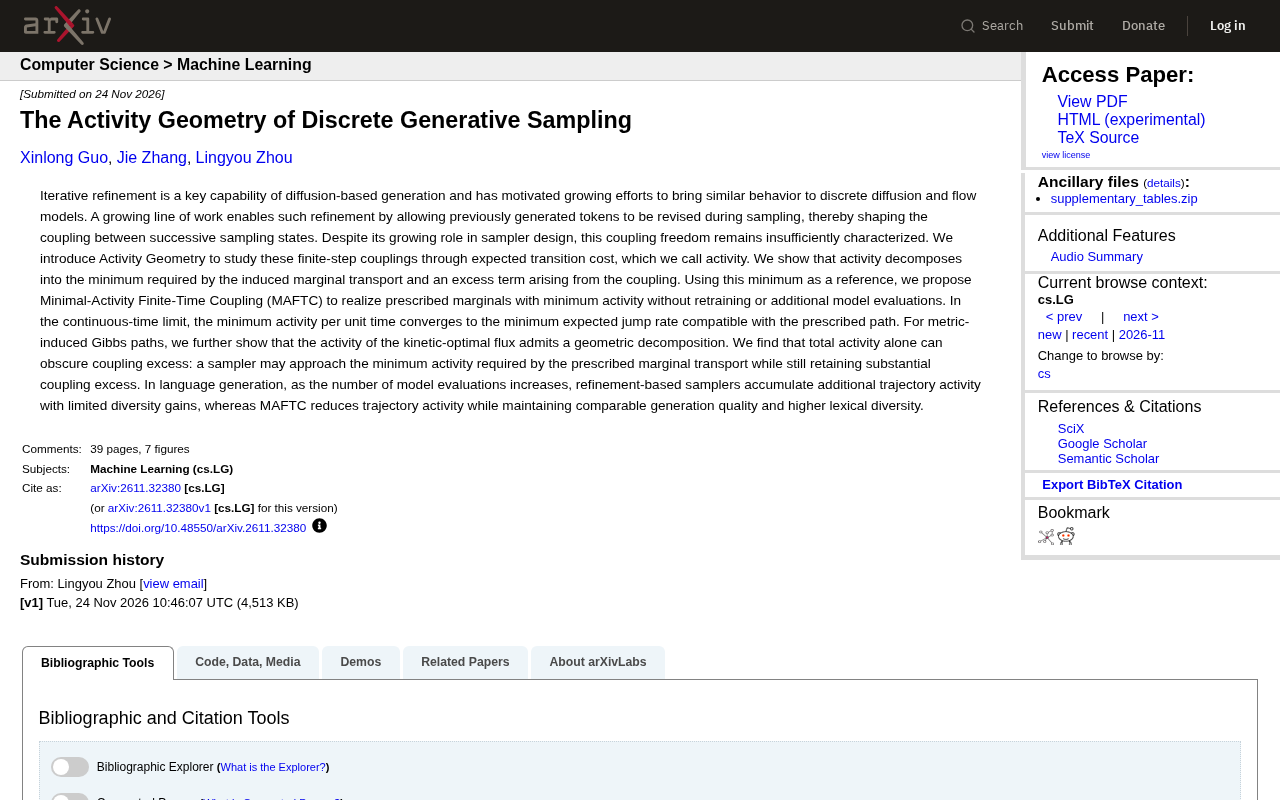
Diffusion models have shone in continuous data generation thanks to their iterative refinement capabilities, and researchers naturally hope to transfer this capability to discrete diffusion and flow models. However, the nature of the coupling degrees of freedom in discrete sampling—which allow already-generated tokens to be revised—has long lacked a clear characterization. A new paper proposes the Activity Geometry framework, which attempts to uniformly describe coupling behavior in finite-step sampling using expected transition cost, and offers an improvement scheme that does not rely on retraining.
Activity Geometry: Characterizing Coupling via Transition Cost
The core concept of the paper is activity—the expected transition cost between adjacent states during sampling. The authors prove that activity can be decomposed into two parts: the minimum required to induce the marginal transport, and an excess term arising from the coupling scheme. This decomposition reveals a neglected fact in sampler design: the total activity itself may mask the existence of coupling excess. A sampler may already be close to the minimum activity required by the prescribed marginal transport, yet still retain considerable coupling redundancy.
In the continuous-time limit, the minimum activity per unit time converges to the minimum expected jump rate compatible with the prescribed path. For metric-induced Gibbs paths, the authors further prove that the activity of the dynamics-optimal flux has a geometric decomposition structure. These theoretical results provide a rigorous mathematical language for understanding the coupling degrees of freedom in discrete sampling.
Difference between discrete and continuous diffusion models: Continuous diffusion models (such as DDPM) define forward and reverse Markov chains on real-valued spaces through the noising and denoising processes of Gaussian noise, with state transitions described by continuous probability density evolution. Discrete diffusion models, on the other hand, restrict the state space to a finite set (such as a vocabulary), with the forward process typically defined as a transition matrix applying random substitutions or masks to tokens, and the reverse process requiring learning discrete jump probabilities from the noise distribution back to the data distribution. This difference means that each state transition in discrete sampling is a "jump" rather than a continuous drift, making the expected transition cost between adjacent states (i.e., activity) a natural measure for characterizing the quality of the sampling path.
The role of coupling in sampling: In probability theory, coupling refers to simultaneously constructing two random variables so that each follows a specified marginal distribution while possessing mutual correlation in their joint distribution. In discrete diffusion sampling, given the current state and a prescribed marginal transport target (i.e., the token distribution that the next step should reach), there are multiple ways to "pair" the current token with the next-step token, and different pairing methods correspond to different couplings. The degrees of freedom in coupling do not affect the marginal distribution at each step, but they do affect the expected transition cost, diversity, and sample quality of the sampling trajectory. Activity geometry makes this implicit choice explicit: by decomposing total activity into the marginal transport minimum and the coupling excess term, researchers can quantitatively determine whether there is eliminable coupling redundancy in a sampler.
MAFTC: Minimum-Activity Finite-Time Coupling
Based on the above decomposition, the authors propose the Minimum-Activity Finite-Time Coupling (MAFTC) method, which aims to achieve the prescribed marginal distribution with minimum activity, without retraining the model or adding extra model evaluations. This directly addresses a pain point in practical deployment: improving sampling quality often means more computational overhead, and MAFTC attempts to optimize the sampling path without increasing forward passes.
MAFTC is built on the reference benchmark of activity decomposition—using the minimum activity of marginal transport as a lower bound and eliminating the excess by adjusting the coupling. Unlike schemes that require modifying model weights, this method acts on the sampling process itself and enjoys good generality.
Finite-time sampling and the infinite-step limit: Ideal sampling for discrete diffusion models requires infinitely many steps to precisely achieve the prescribed marginal transport, but practical deployment must be completed within a finite number of steps (e.g., tens to hundreds of model evaluations). The discretization error introduced by finite-step sampling alters the actually achieved marginal distribution while amplifying the impact of coupling choices. MAFTC targets precisely this finite-step scenario: at each step it solves for a coupling scheme that minimizes activity, making the expected transition cost of the sampling trajectory as close to the theoretical lower bound as possible given the number of steps. Unlike schemes that require retraining the model or increasing the number of forward passes, MAFTC only adjusts the coupling logic within the sampler, so it can be directly layered onto the sampling pipeline of existing discrete diffusion or flow models as a lightweight inference-time improvement.
Empirical Performance in Language Generation
The paper compares refinement-based samplers with MAFTC on language generation tasks. As the number of model evaluations increases, refinement-type samplers accumulate additional trajectory activity but yield limited diversity gains; MAFTC, in contrast, reduces trajectory activity while maintaining comparable generation quality and achieving higher lexical diversity. This result indicates that blindly increasing sampling steps does not necessarily lead to better generation; coupling design is the key variable.
From a practical standpoint, this offers a new perspective for sampling strategies of discrete generative models: rather than stacking up computation, it is better to examine the coupling structure between sampling states. The activity geometry framework formalizes this intuition and provides an actionable optimization objective.
Implications for Sampler Design
The value of activity geometry goes beyond proposing a new method. It makes the implicit coupling choices in sampler design explicit, enabling researchers to quantitatively compare different schemes in terms of activity and excess. For practitioners of discrete diffusion and flow models, this means an additional diagnostic tool—when generation quality stalls, one can check whether unnecessary trajectory activity has accumulated, rather than simply attributing it to model capacity or training data.
The paper also candidly acknowledges the boundaries of its current analysis: activity geometry focuses on the expected cost of finite-step coupling, and more complex path constraints and performance in actual large-scale deployment still require validation by future work. But as far as the theoretical characterization of discrete generative sampling is concerned, this work offers a noteworthy new perspective.
One-line Summary
The activity geometry framework characterizes discrete sampling coupling via expected transition cost and offers a training-free improvement scheme, MAFTC.
Paragraph Summary
This paper proposes the activity geometry framework, which uses the expected transition cost between adjacent states (activity) to uniformly describe coupling behavior in finite-step sampling of discrete diffusion and flow models. The authors prove that activity can be decomposed into the minimum required to induce marginal transport and an excess term arising from the coupling scheme, revealing that total activity may mask coupling redundancy. Based on this, they propose Minimum-Activity Finite-Time Coupling (MAFTC), which achieves the prescribed marginal distribution with minimum activity without retraining or additional model evaluations. Language generation experiments show that refinement-type samplers accumulate trajectory activity as evaluations increase but yield limited diversity gains, whereas MAFTC reduces activity and improves lexical diversity. This work makes the implicit coupling choices in sampler design explicit, providing a new theoretical language and diagnostic tool for discrete generative sampling.
Related articles

Xenon Flash Bug Returns: Radxa Dragon Q8B Affected
The Xenon flash bug resurfaces, this time on the Radxa Dragon Q8B board. This article reviews early Hacker News discussion and analyzes the potential impact and community concerns.

ChatGPT Plus Subscription Guide for Users in China: Official Top-Up Channel Walkthrough and Comparison
A complete guide to subscribing to ChatGPT Plus from China via official top-up platforms: plan selection, account login, copying account info, payment verification, plus a comparison of top-up, proxy, and self-supplied card channels.

The Complete Guide to Subscribing to ChatGPT Plus in China: Hands-On Walkthrough of Third-Party Top-Up Channels and Risk Analysis
How can users in China subscribe to ChatGPT Plus? This article breaks down the complete process of third-party top-up platforms, analyzes account security, renewal sustainability, and risk-control risks to help you decide which subscription option suits you better.