The Complete Guide to Subscribing to ChatGPT Plus in China: Hands-On Walkthrough of Third-Party Top-Up Channels and Risk Analysis

Breaking down the realistic paths for users in China to subscribe to ChatGPT Plus and the risks of top-up services.
The article centers on the real-world dilemma of users in China subscribing to ChatGPT Plus. Since OpenAI's official payment channel does not support bank cards issued in China, direct use of Visa/Mastercard often fails due to billing address mismatches or risk-control blocks, making third-party "official direct top-up" services a common alternative. The article breaks down the five-step top-up process in detail: select a plan, log in to the account to be topped up, copy the account identifier and paste it, verify and pay, and refresh to verify arrival—funds usually arrive within one to two minutes. It also points out the hidden costs of top-up services, including security risks from leaked account credentials, renewal interruptions caused by unstable payment channels, and the amplified risk-control probability from logins in unusual locations and abnormal payments. Finally, it offers selection advice: prioritize official subscriptions when you have overseas payment capabilities; otherwise, focus on the platform's customer service responsiveness, refund rules, and the scope of permissions requested, and emphasize that continuous use after subscribing is where the value lies.
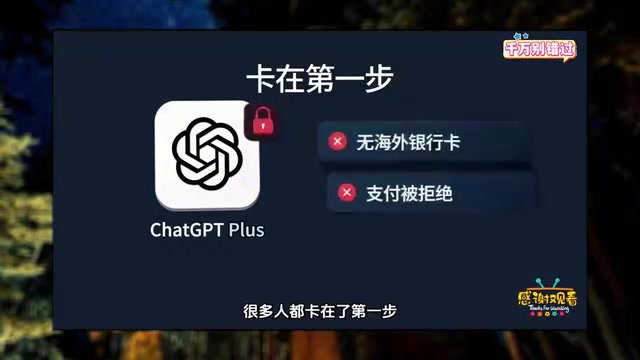
If you want an AI assistant on call 24/7 for the price of a meal, ChatGPT Plus is the go-to choice for many people. For a $20 monthly subscription, you get the ability to write copy, build PPTs, analyze data, and even use Codex to help write code and develop websites. But when it comes to actually subscribing, many people get stuck at the first step—no overseas bank card, and payment gets declined. This article breaks down the realistic paths for users in China to subscribe to ChatGPT Plus, along with the risks to watch out for.
Why Official Subscription Is So Difficult
OpenAI's official payment channel currently does not support bank cards issued in China, which is the first obstacle most users encounter. Visa/Mastercard being declined outright, billing address mismatches, and risk-control blocks are all common occurrences.
This has given rise to a category of third-party platforms offering "official direct top-up," whose logic is to use the platform's own payment channel to complete the subscription for you—you only need to provide the account information to be topped up. According to a demonstration by a Bilibili creator, the process on such platforms is roughly: enter the top-up page and select a plan, log in to your own ChatGPT account, copy the account email (including the content in parentheses), paste it into the input box on the top-up page, confirm the details are correct, and confirm payment; the funds typically arrive within one to two minutes.
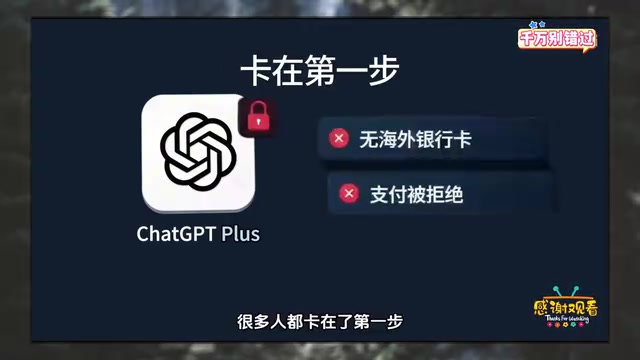
OpenAI's payment gateway is handled by international payment service providers such as Stripe, and risk control during transactions comprehensively verifies whether the card's issuing country, billing address (AVS), IP location, and account registration location are consistent. Visa/Mastercard cards issued in China belong to domestic card network channels; even if the card bears an international logo, they are often judged as cross-border high-risk transactions and declined outright. In addition, a ChatGPT Plus subscription is a recurring authorization; a small pre-authorization verification is performed on the first charge, and address mismatches or inability to complete 3DS verification will both lead to failure. This is also why simply switching to another card often doesn't solve the problem—because what's being blocked isn't just the card itself, but the consistency of the entire payment chain.
The Complete Operating Process for Third-Party Top-Up
Taking the Plus plan as an example, the whole process can be broken down into several key steps.
Step 1: Select the product and plan. After entering the platform's top-up page, you can see the full product list; select Plus or another plan as needed.
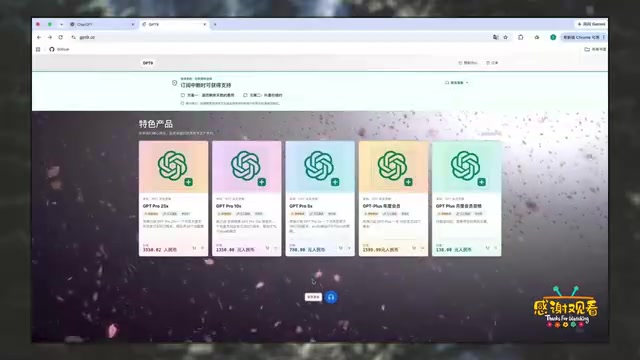
Step 2: Log in to the account to be topped up. On the top-up page, click to log in to ChatGPT and sign in to the account you want to top up. After logging in, the bottom-left corner will show that you are currently on the free version—this is an intuitive way to verify the account status.
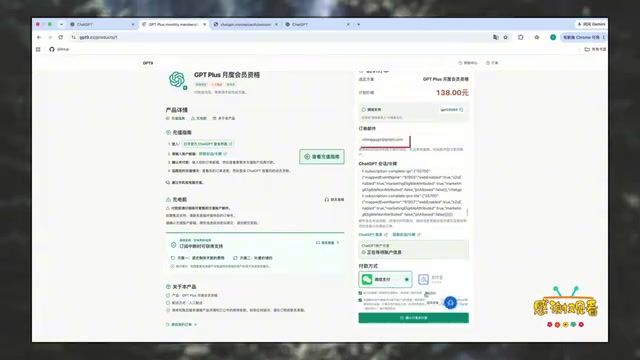
Step 3: Copy the account identifier and paste it. Return to the product page and click an entry such as obtaining the session token, choose to copy all (including parentheses), then go back to the top-up page and paste it into the input box. The essence of this step is handing your account identity information to the platform for backend proxy payment.
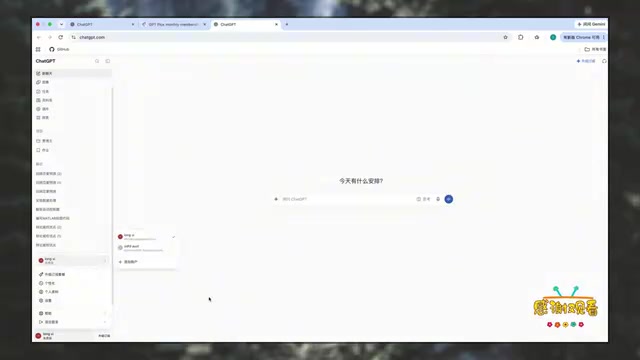
Step 4: Verify and pay. Confirm that the email is indeed the account you want to top up, and once correct, click to confirm payment. After payment is complete, wait one to two minutes, and the page will show that the top-up was successful.
Step 5: Verify arrival. Go back to the ChatGPT page and refresh; if the bottom-left corner shows Plus, the subscription is active. Platforms usually provide 24-hour online customer service, so you can contact them anytime if you run into issues.
The Hidden Costs of the Top-Up Model
The process looks simple, but handing your account information to a third party is something worth thinking about more carefully.
First is account security. Top-up requires you to log in to your account and copy session-related credentials, which means the platform has a considerable degree of access to your account during the operation. When choosing a platform, details such as account isolation and how credentials are handled deserve more attention than price.
Second is the sustainability of the subscription. Third-party top-up relies on the platform's payment channel; once the channel is flagged by risk control or the platform itself has problems, renewals may be interrupted, and whether paid fees can be refunded depends on the platform's after-sales policy.
Third is account risk-control risk. Logins from unusual locations and abnormal payment behavior can both trigger OpenAI's risk-control mechanisms, and in extreme cases the account may be restricted. This isn't a problem unique to top-up services, but the top-up model amplifies the probability of triggering it.
A session token is an identity credential issued by the server after an account logs in; carrying it is equivalent to accessing the account as you during its validity period, usually without needing to re-enter a password or complete secondary verification. This is precisely the core risk of the top-up model: what the platform gets is not just a one-time payment authorization, but a reusable login state that can be used across devices. Once the credential is leaked or retained, an attacker could read conversation history, consume the account's quota, or even modify bound information. A relatively safe approach is, after the top-up is complete, to proactively log out of all devices, reset the password, and check login records—artificially cutting short the credential's validity period rather than assuming the platform will destroy it immediately after the operation.
How to Choose the Plan That Suits You
If you have overseas payment capabilities, subscribing directly on the official site remains the safest path: transparent billing, controllable renewals, and the lowest account risk.
If you don't have an overseas bank card, third-party top-up is a realistically viable alternative, but it's recommended to use the following points as screening criteria: whether the platform supports 24-hour customer service, whether it has clear refund rules for failures, and whether it asks for account permissions beyond the necessary scope. Low price should not be the sole basis for a decision.
It's worth noting that claims mentioned in the original text such as "GPT6.2Sol/Astra officially released" were not elaborated on in the demonstration content; before subscribing, it's advisable to rely on model information from official channels to avoid being misled by marketing rhetoric.
In any case, subscribing is only the starting point. The value of ChatGPT Plus lies in continuous use—writing copy, doing analysis, running code—only when you truly put these capabilities to use is the $20 well spent.
What is called "official direct top-up" and "top-up" are technically not the same thing. A true official subscription means the payment occurs on OpenAI's own checkout page, with a third party only providing the payment channel; whereas most top-up services actually involve the platform logging in to your account in its own environment and completing payment on your behalf, with the payment entity, IP, and device fingerprint all differing from your daily usage environment. This environmental split is one of the main sources of risk-control triggers. If a platform claims "official direct top-up," you can check whether the payment page redirects to an OpenAI domain and whether it requires you to hand over your login state; combining the two basically lets you judge its true model.
Related articles

Xenon Flash Bug Returns: Radxa Dragon Q8B Affected
The Xenon flash bug resurfaces, this time on the Radxa Dragon Q8B board. This article reviews early Hacker News discussion and analyzes the potential impact and community concerns.

ChatGPT Plus Subscription Guide for Users in China: Official Top-Up Channel Walkthrough and Comparison
A complete guide to subscribing to ChatGPT Plus from China via official top-up platforms: plan selection, account login, copying account info, payment verification, plus a comparison of top-up, proxy, and self-supplied card channels.
GPT-6.2 Sol/Astra Released? A Step-by-Step Guide to Subscribing to Plus in China
A Bilibili tutorial shows how to subscribe to ChatGPT Plus using domestic payment methods without an overseas bank card, via an official website direct top-up platform, with detailed steps and precautions to help you decide if this subscription method suits you.