ADAP Protocol: Adding a Compliance Control Layer to LangChain Agents

ADAP enforces compliance and state constraints through a deterministic control layer before agent actions are executed.
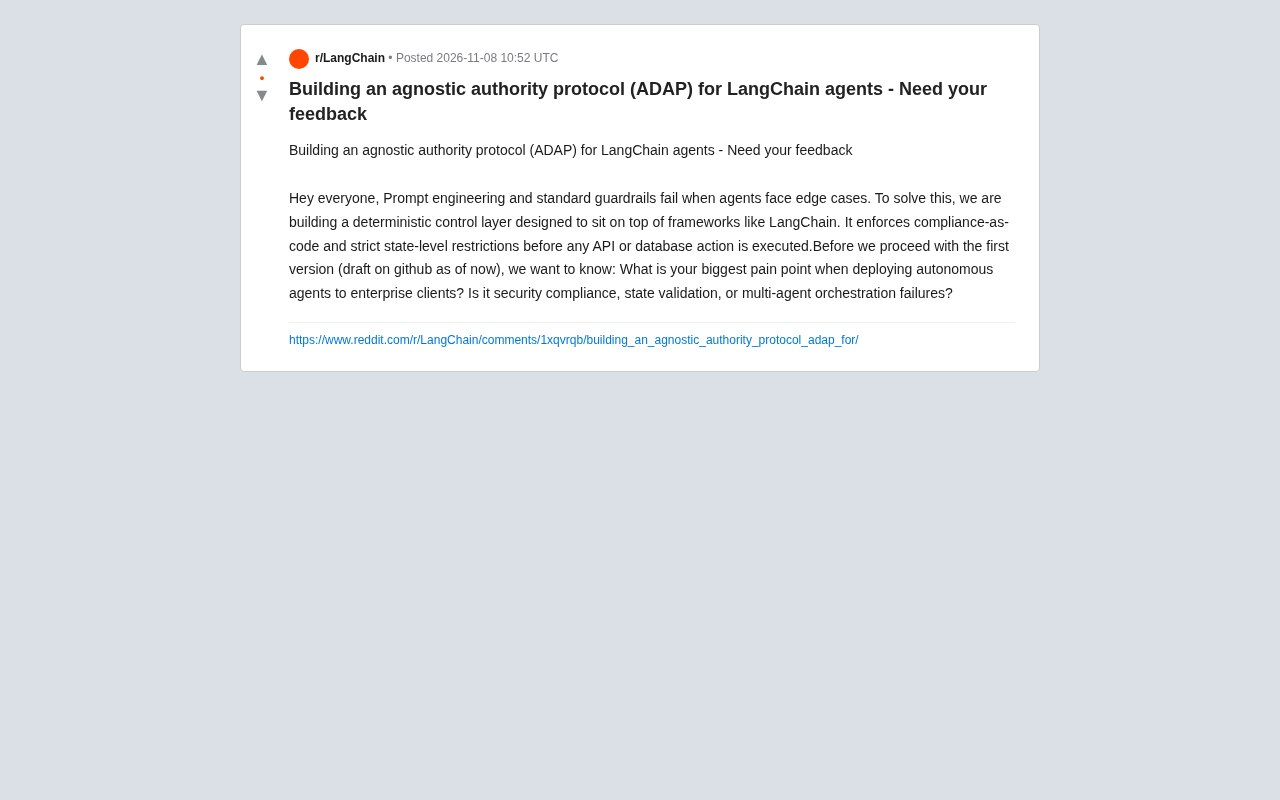
The article introduces ADAP (Agnostic Authority Protocol), a framework-agnostic authority protocol being built by a Reddit community team. To address the failure of prompt guardrails in edge cases when autonomous agents enter enterprise production, ADAP does not replace frameworks like LangChain but layers on top of them, intercepting and validating compliance policies and state constraints before any API or database operation, shifting the security boundary from model self-discipline to system enforcement. It also discusses three enterprise pain points—security compliance, state validation, and multi-agent orchestration failure—and the challenges of framework-agnostic design and compliance-as-code implementation. ADAP is at an early draft stage, with the team using community feedback to prioritize first-version features.
Why Do Agents Need a "Permission Control" Layer?
When autonomous agents move from demo environments to enterprise production, prompt engineering and conventional guardrails often fail in edge cases—models may bypass rules to call sensitive APIs, perform database writes when state is inconsistent, or overstep authority in multi-agent collaboration. According to a development team sharing on the Reddit community, they are building a framework-agnostic authority protocol (Agnostic Authority Protocol, or ADAP) that attempts to solve these problems with a deterministic control layer.
ADAP's positioning is clear: it does not replace agent frameworks like LangChain, but layers on top of them to enforce "compliance-as-code" and state-level restrictions before any API or database operation is executed. This approach separates permission verification from model inference and hands it to a deterministic rules engine, thereby reducing the risks brought by model unpredictability.
Autonomous Agents refer to AI systems that can autonomously plan, call tools, and execute multi-step operations under a given goal without step-by-step human intervention. Unlike traditional conversational models, autonomous agents typically have tool-calling capabilities (such as accessing APIs and reading/writing databases), memory management, and task decomposition. Typical implementations include agents built on frameworks such as LangChain and AutoGPT. Because their behavior chains are long and their decision spaces are large, once the model deviates at any step, the error will be amplified by subsequent steps. Therefore, a control mechanism independent of model inference needs to be introduced at the system level.
Guardrails are safety constraints set around large model inputs and outputs, commonly including content filtering, format validation, sensitive-word blocking, and prompt-level behavioral norms. The advantage of guardrails is that they are lightweight and easy to integrate, but their essence still operates on the probabilistic outputs of the model. When facing carefully constructed adversarial prompts or complex multi-step tasks, they may be bypassed or fail, which is also an important reason why a deterministic permission layer is needed.
How ADAP Works: Intercepting Before Actions Are Executed
According to the team's description on Reddit, ADAP's core mechanism is "pre-action interception." When an agent decides to call a tool or execute an operation, ADAP first checks whether the operation complies with preset compliance policies and state constraints. Only actions that pass validation are allowed through to the real API or database. This design shifts the security boundary from "relying on the model's self-discipline" to "enforced by the system."
Compared with traditional prompt guardrails, ADAP emphasizes determinism and state awareness. Prompt guardrails are still probabilistic in nature—the model may be induced to bypass instructions; whereas ADAP, as an independent control layer, has hard and auditable rules. For scenarios that need to meet enterprise security and compliance requirements, this determinism is crucial. The team has currently released an initial draft on GitHub and is publicly soliciting feedback.
Compliance-as-Code refers to transforming laws, regulations, industry standards, and internal enterprise policies that originally exist in document form into code rules that can be version-controlled and automatically executed. In agent scenarios, this means writing constraints such as "which APIs can be called," "which data fields are prohibited from being written," and "under what states transfers are allowed to be executed" as machine-readable policies, which are then verified one by one by the rules engine at runtime. Its value lies in moving compliance checks from manual auditing forward to pre-execution interception, so that violations are blocked before they occur, while also leaving traceable audit logs.
Three Major Pain Points of Enterprise Agent Deployment
When soliciting feedback, the team raised a key question: What is the biggest pain point when deploying autonomous agents to enterprise customers? They listed three candidate directions: security and compliance, state validation, and multi-agent orchestration failure.
From industry practice, these three issues are indeed intertwined. Security and compliance involve data access permissions, operation auditing, and regulatory requirements; state validation concerns whether agents can maintain contextual consistency in long workflows and avoid making decisions based on outdated or incorrect states; multi-agent orchestration failure is common in scenarios such as task decomposition, role conflicts, and inconsistent communication protocols. ADAP attempts to cover these aspects with unified state-level restrictions, but its actual effectiveness still needs community validation.
The Value and Challenges of an Open Protocol
ADAP calls itself "agnostic," meaning it is not bound to LangChain and can theoretically adapt to other agent frameworks. This neutrality helps it become a universal control layer across frameworks, but it also brings challenges: different frameworks differ greatly in tool-calling interfaces and state management methods, so the abstraction layer design needs to be flexible enough.
Another noteworthy point is how "compliance-as-code" is implemented. Enterprise compliance policies are often defined by legal and security teams. How to translate them into executable code rules and keep them maintainable is a question ADAP needs to answer. The team's choice to publicly release a draft and seek feedback at an early stage shows that they recognize that protocol design needs to be refined together with the community.
Framework-Agnostic is a design principle in software architecture that refers to a system not depending on a specific framework's proprietary interfaces or data structures, so that it can be reused across different technology stacks. For an agent control layer, being framework-agnostic means ADAP needs to define a set of general abstractions, such as a unified intermediate representation for describing "actions," "resources," and "states," and then connect to different frameworks such as LangChain and AutoGen through adapters. The difficulty of this design lies in the significant differences among frameworks in tool-calling signatures, state persistence, and callback mechanisms. If the abstraction layer is too thin, it cannot cover the differences; if it is too thick, it increases integration costs.
Community Feedback Will Determine the Protocol's Direction
ADAP is still at a very early stage, and the draft version on GitHub has not yet been tested through large-scale practice. The team's main purpose in posting on Reddit is to collect real pain points from enterprise developers in order to determine the feature priorities for the first version. For developers concerned about agent security and compliance, this is an opportunity to participate in defining an open protocol.
From a broader perspective, ADAP reflects a trend in the agent ecosystem: as autonomous agents take on more and more critical tasks, an "infrastructure layer" around permissions, auditing, and state control is becoming a necessity. Regardless of whether ADAP ultimately becomes a standard, attempts like this are pushing the industry to think about how to let agents release value under controllable preconditions.
One-line Summary
ADAP uses a deterministic control layer to enforce compliance and state constraints before agent actions are executed.
Paragraph Summary
The article introduces ADAP (Agnostic Authority Protocol), a framework-agnostic authority protocol being built by a team in the Reddit community. To address the failure of prompt guardrails in edge cases after autonomous agents enter enterprise production environments, ADAP does not replace frameworks such as LangChain but layers on top of them, intercepting and validating compliance policies and state constraints before any API or database operation is executed, shifting the security boundary from relying on model self-discipline to system enforcement. The article also discusses the three major pain points of enterprise agent deployment—security and compliance, state validation, and multi-agent orchestration failure—as well as the challenges of an open protocol in framework-agnostic design and compliance-as-code implementation. ADAP is currently at an early draft stage, and the team is determining first-version feature priorities through community feedback.
Related articles
 Tech Frontiers
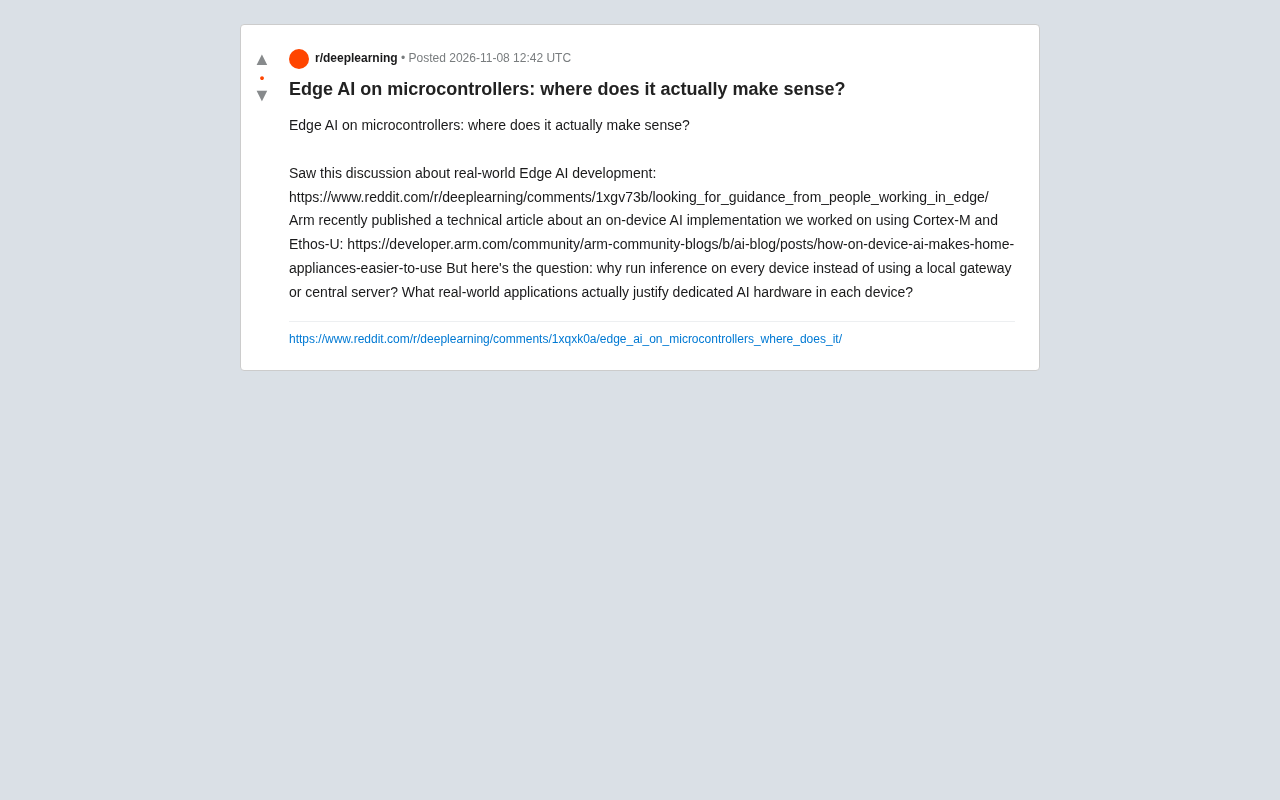
Edge AI on Microcontrollers: When Is It Actually Worth Deploying?
Drawing on Reddit discussions and Arm case studies, this article analyzes the real-world use cases for edge AI on microcontrollers: when each device needs independent inference, when a gateway or cloud is more reasonable, and the costs and boundaries of specialized hardware.
 Tech Frontiers
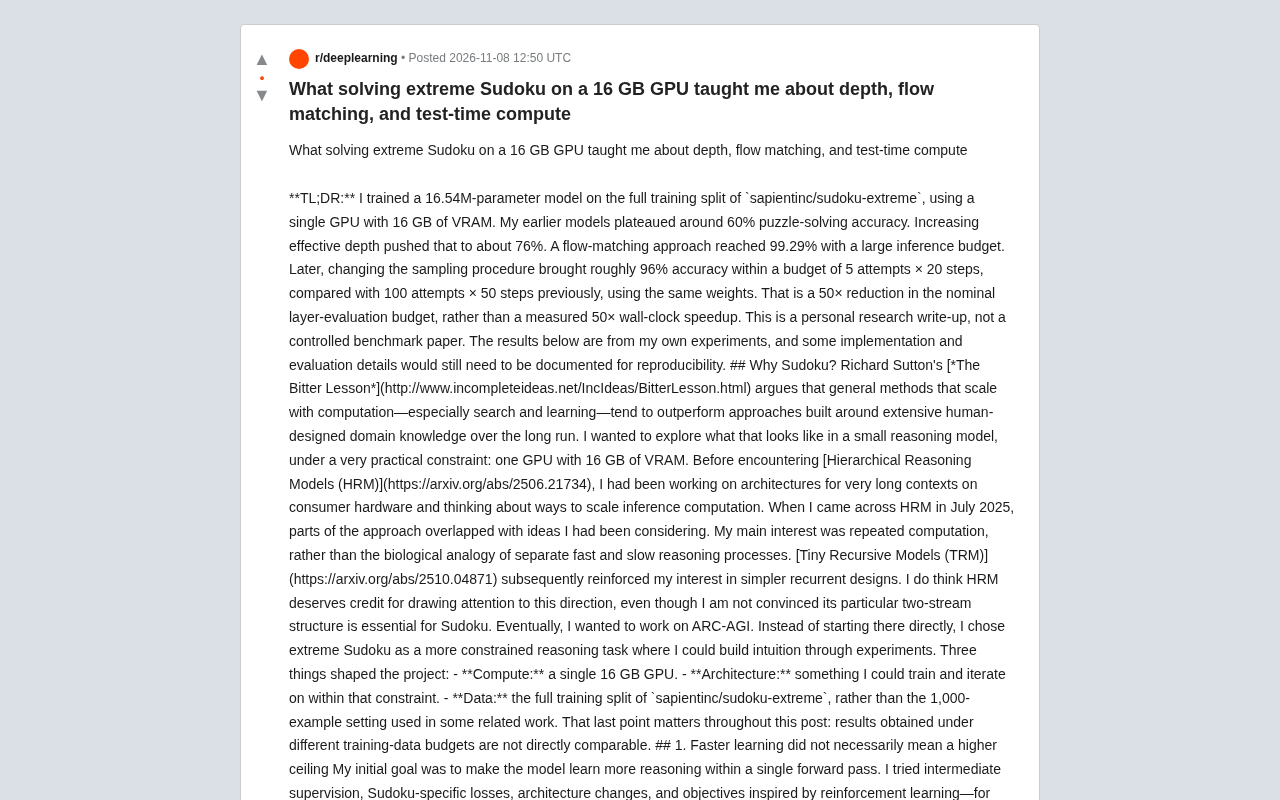
Pushing the Limits of Extreme Sudoku on a 16GB GPU: Insights from Depth and Flow Matching
A researcher trained a 16.54M-parameter model on a 16GB GPU to solve extreme Sudoku, finding effective depth breaks the 60% plateau and flow matching with improved sampling pushes accuracy past 99% with ~50× lower layer-evaluation budget.
 Tech Frontiers
AI Agent Approval Workflows: Why Human Confirmations Always Get Mindlessly Clicked
Why do AI agent approval workflows always get mindlessly clicked? A Reddit discussion shows that separating rules from keys, low-frequency high-risk approvals, and GitHub Environments-style gates are the keys to effective approvals.