AdCar Deep Dive: The Cross-Platform Marketing Innovation Combining Car Wraps, YouTube, and X
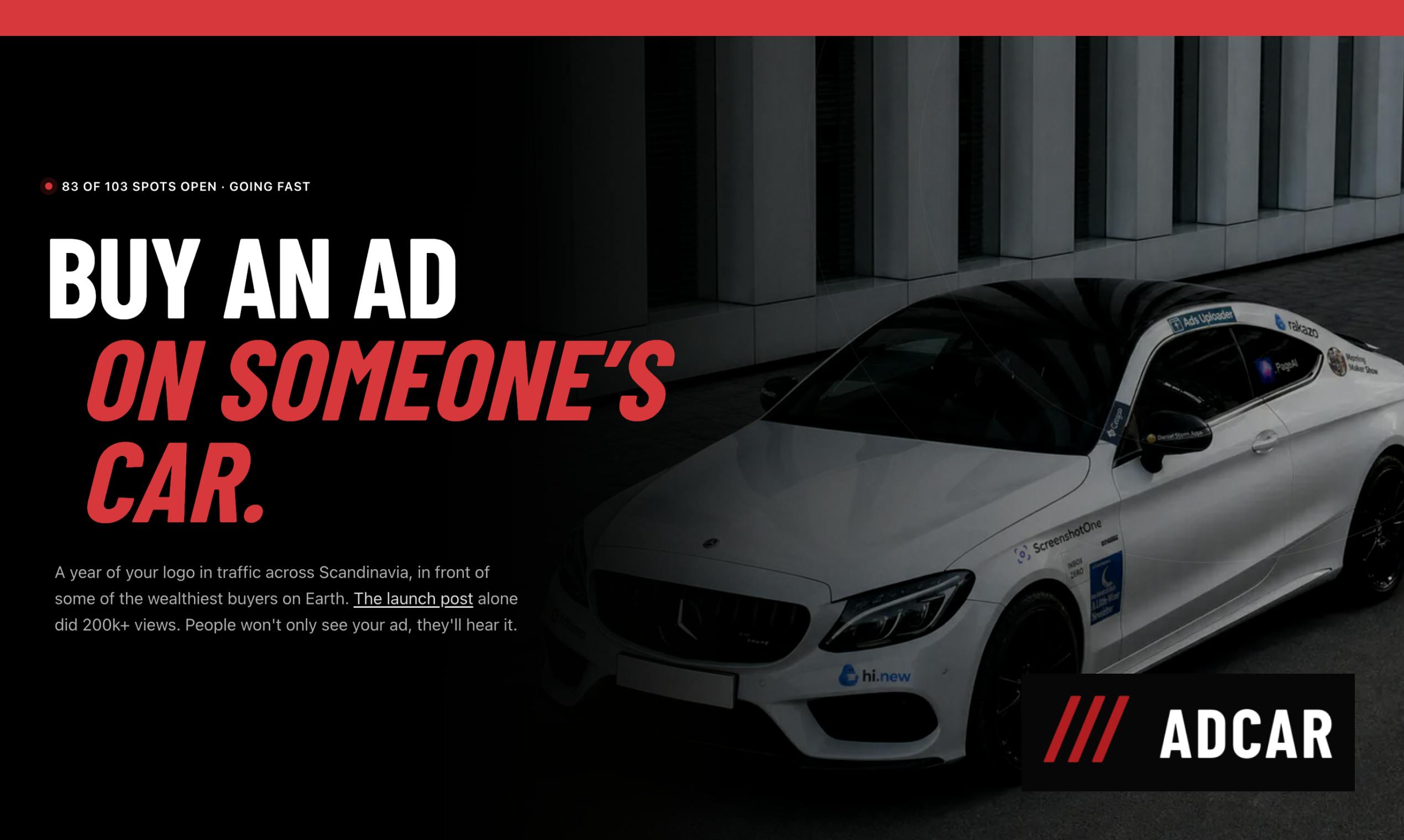
AdCar merges car wraps, YouTube, and X into a cross-platform marketing solution for the attention economy
AdCar combines physical mobile advertising (car wraps), digital marketing (YouTube/X), and the micro-influencer movement to create a new brand exposure model bridging offline and online. It targets indie developers and SMBs facing the paradox of easy product creation but expensive user acquisition in the AI era.
A New Marketing Solution for the Attention Scarcity Era
On Product Hunt, a product called AdCar has quietly emerged. Its positioning is cleverly conceived—"Put your brand on someone's loud car, YouTube and X (formerly Twitter)." Though it currently has only 10 votes and ranks 15th with modest scale, the industry trends it reflects are worth deep consideration for anyone following marketing and entrepreneurship.
Built by indie developer Dan Mindru, AdCar spans three major categories: social media, marketing, and advertising. Its core logic is straightforward: merge physical mobile advertising (ads on cars), digital marketing, and the currently hot micro-influencer movement to create a new form of brand exposure that bridges offline and online worlds.
Why Products Like AdCar Are Emerging
Product Oversupply Driven by Vibe Coding
AdCar's product description highlights a pain point in today's startup environment: "Vibe coding allows a small team to build a product in a weekend, so there are more apps than ever before."
"Vibe coding" refers to rapidly building applications using AI programming tools (like Cursor, Claude, GitHub Copilot, etc.). This concept was first introduced by OpenAI co-founder Andrej Karpathy in early 2025, describing it as a programming approach that is "fully immersed in the vibe, embracing exponential growth, forgetting the code itself exists." Developers no longer write code line by line; instead, they describe requirements to AI in natural language, with large language models generating runnable programs. The core toolchain includes Cursor (an AI-native editor based on VS Code), Anthropic's Claude (excelling at long-context code generation), GitHub Copilot (code auto-completion), and Replit Agent (end-to-end application generation). According to a16z's early 2025 report, developers using AI-assisted programming tools see prototype building speeds increase by an average of 5-10x—MVPs (Minimum Viable Products) that previously required an engineering team weeks to complete can now be delivered by one person in 48 hours.
The sharp drop in development barriers has brought explosive growth in product quantity. GitHub, Product Hunt, and the App Store see massive new applications emerge daily. The supply side has never been so abundant.
The Cost of Being Seen Hasn't Decreased
However, the product description immediately points out the harsh flip side: "Getting seen hasn't gotten cheaper. Attention is the bottleneck."
This assertion has deep theoretical roots. The concept of attention as a scarce resource was first proposed by Nobel laureate Herbert Simon in 1971: "A wealth of information creates a poverty of attention." This view has become even sharper half a century later. According to DataReportal's 2024 statistics, global internet users spend an average of about 6 hours and 42 minutes online daily, but the volume of information they encounter is more than 5 times that of 2010. Meanwhile, customer acquisition costs (CAC) in digital advertising continue to climb—Meta platform's cost per thousand impressions (CPM) has risen about 30% over the past three years, and Google Search Ads' average cost per click (CPC) in competitive SaaS categories has exceeded $10.
This is the common dilemma facing all indie developers and startups today—building products is getting easier, but getting them seen is getting harder. When the supply side expands infinitely while total user attention remains constant, marketing acquisition costs paradoxically rise. Traditional paid advertising channels (Google Ads, Meta Ads) are intensely competitive with high conversion costs that small teams simply can't afford.
It's precisely this structural contradiction that pushes companies toward more creative marketing approaches that can "penetrate the information feed." AdCar is one specific expression of this shift.
Deconstructing AdCar's Product Logic
Fusion of Three Marketing Formats
AdCar attempts to integrate three seemingly unrelated marketing methods:
- Physical Mobile Advertising: Placing brands on real car owners' "loud cars." Vehicles driving through city streets naturally possess high exposure and strong memory retention through physical reach. In fact, vehicle wrapping isn't a new concept. As early as the 2000s, companies like Autowrapped and Wrapify attempted business models turning ordinary owners' private cars into mobile billboards. Founded in 2015, Wrapify raised over $5 million in funding with a model that tracked vehicle routes via GPS and charged brands based on actual exposure mileage. However, first-generation players in this space mostly faced scaling difficulties and unclear attribution, with some companies shutting down. AdCar's difference lies in attempting to bundle physical mobile advertising with social media content creation, using digital methods to compensate for traditional car advertising's shortcomings in tracking effectiveness while leveraging car owners' online influence to generate additional viral value.
- Digital Marketing: Combining content distribution on platforms like YouTube and X to create secondary amplification of offline exposure online.
- Micro-Influencer Movement: Car owners themselves often have some social influence, playing dual roles as both advertising carriers and content creators.
The brilliance of this design is that it packages a car and a person's social accounts into a "composite ad placement." Brands aren't just buying simple display space but a three-dimensional channel covering both street-level and information feed exposure.
Riding the Wave of the Micro-Influencer Economy
In recent years, micro-influencers (creators with 10,000 to 100,000 followers) have gained increasing favor from brands. Compared to top-tier influencers, micro-influencers have higher follower engagement, lower per-unit interaction costs, and more authentic content. According to Influencer Marketing Hub's 2024 report, micro-influencers' average engagement rate is about 3.86%, far exceeding top influencers with millions of followers (typically below 1.5%). More importantly, micro-influencers' single collaboration costs typically range from $100-500, while top influencers' single promotional fees can reach tens or even hundreds of thousands of dollars. HubSpot surveys show that 82% of consumers are more willing to trust micro-influencer recommendations because their content is closer to daily life scenarios and lacks a "commercial feel." This trend explains why more and more DTC (Direct-to-Consumer) brands are shifting marketing budgets from top influencers to distributed investment strategies across numerous micro-influencers.
AdCar brings car owners into this system, essentially lowering the trust barrier between brands and real users—a car with brand advertising, driven by a real person and shared on YouTube and X, resonates more easily than cold information feed ads.
Opportunities and Challenges for Such Products
Opportunity: The Long-Tail Market of Creative Marketing
AdCar targets small and medium businesses and indie developers who can't afford expensive digital advertising yet crave differentiated exposure. Against the backdrop of attention scarcity, any channel that can "exchange lower cost for more authentic exposure" has value. The scarcity of physical advertising (people's immunity to outdoor advertising is far lower than to information feed ads) is precisely its moat.
Challenges: Scaling and Effectiveness Measurement
However, such products also face obvious practical constraints:
- Supply-Side Scaling: Requires recruiting enough car owners who match brands' geographic and target audience requirements, making cold start difficult.
- Measurability of Effectiveness: Physical advertising conversions are difficult to precisely attribute, making it hard for brands to quantify ROI, which may become the biggest obstacle to willingness to pay. Attribution is the core technical component for measuring marketing effectiveness. In digital advertising, attribution models are quite mature, including last-click attribution, multi-touch attribution, and machine learning-based marketing mix modeling (MMM). However, attribution in the physical world has always been an industry challenge. The out-of-home (OOH) advertising industry traditionally relies on traffic flow data and surveys to estimate exposure, with significant margins of error. In recent years, some companies have tried using mobile signal data, Bluetooth beacons, and computer vision technology to track actual reach of outdoor advertising, but for mobile carriers like car wraps, attribution complexity is even higher—vehicle routes are unfixed, audience demographics are difficult to precisely profile, and the path from seeing an ad to making a purchase is long and uncontrollable. This is also why AdCar's strategy of bundling physical advertising with social media content makes sense: the online portion's click, interaction, and conversion data can partially compensate for offline attribution gaps, providing brands with at least half-quantifiable ROI evidence.
- Platform Compliance Risk: Car wrap advertising involves local traffic and advertising regulations, with cross-regional operations presenting compliance complexity.
Judging from the current 10 votes and 3 comments, AdCar is still in early exploration stages with its business model yet to be validated.
Attention Is the New Scarce Resource
AdCar may not become a phenomenon-level product, but it precisely captures the core contradiction of AI-era entrepreneurship—when creation becomes cheap, being seen becomes expensive.
For every developer using vibe coding methods who can build a product over a weekend, AdCar poses a question more valuable than its solution: In an era when everyone can build products, how do you plan to get that critical first batch of users to see yours? The answer may not lie in more information feed advertising, but in those creative corners that can truly "penetrate" daily life.
Key Takeaways
Related articles

vLLM Speculative Decoding Lands on AMD GPUs: Inference Acceleration and an Ecosystem Breakthrough
vLLM brings Speculative Decoding to AMD GPUs, achieving 1.5–3× inference speedups via draft-model prediction and target-model verification. A deep dive into ROCm adaptation and its impact on AI ecosystem diversification.
Capslane: One API for YouTube Subtitle Extraction and Auto-Transcription
Capslane provides a unified API for YouTube subtitle extraction, supporting native subtitle retrieval and auto-transcription. Features JavaScript, Python SDKs and MCP integration for video analysis and AI applications. 50 free calls monthly.
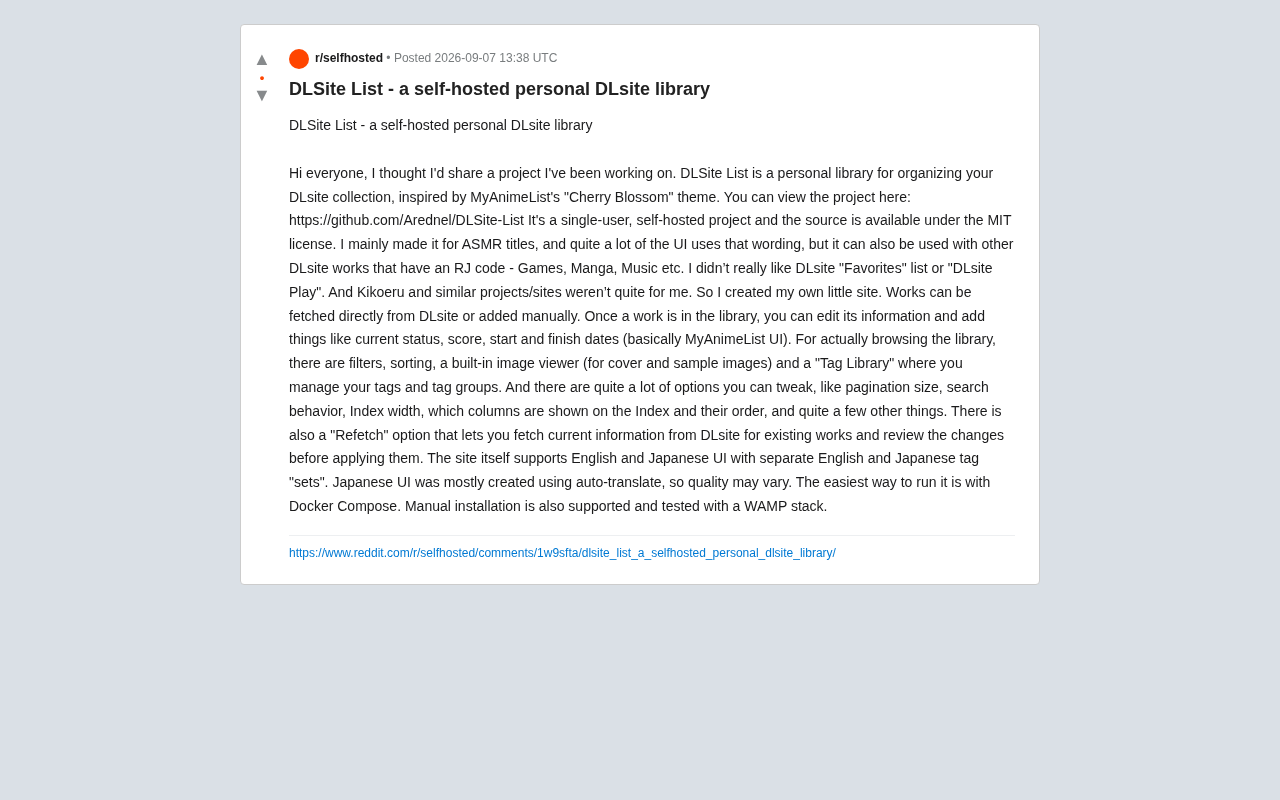
DLSite List: Complete Guide to the Open-Source Self-Hosted Digital Content Management System
DLSite List is an open-source self-hosted management system for DLsite digital content, supporting ASMR, games, manga, and RJ-numbered content scraping, categorization, and tracking. Complete guide to its features, architecture, and Docker deployment.