Adjoint-Based Calibration of Bioprocess Digital Twins: Stochastic Multiscale Modeling and Optimal Control

A bias-aware adjoint-based framework jointly calibrates stochastic multiscale bioprocess digital twins, designs experiments, and optimizes control policies.
Biopharmaceutical digital twins face a core challenge: parameters calibrated from sparse experimental data carry inevitable bias that propagates into control policies. This study proposes a bias-aware framework that models multiscale bioprocesses with SDEs, uses quasi-likelihood estimation and adjoint sensitivity analysis to efficiently quantify parameter bias, and tracks its propagation to policy performance via forward-backward adjoints. The resulting parameter error distribution drives both adaptive experimental design and robust policy optimization under a second-order Gaussian-averaged objective. The proposed Actor-Simulator algorithm unifies model updating, experiment selection, and policy optimization in a closed loop, outperforming state-of-the-art baselines in calibration accuracy, sample efficiency, and control performance.
When Digital Twins Meet Bioprocesses: An Overlooked Bias Problem
Biopharmaceutical manufacturing and synthetic biology are increasingly relying on digital twins to simulate and optimize complex production workflows. In practice, however, a long-underappreciated problem has come to the fore: when models are calibrated against sparse, discrete experimental observations, parameter estimation inevitably introduces bias — and that bias propagates all the way into the final control policy, degrading real-world production performance.
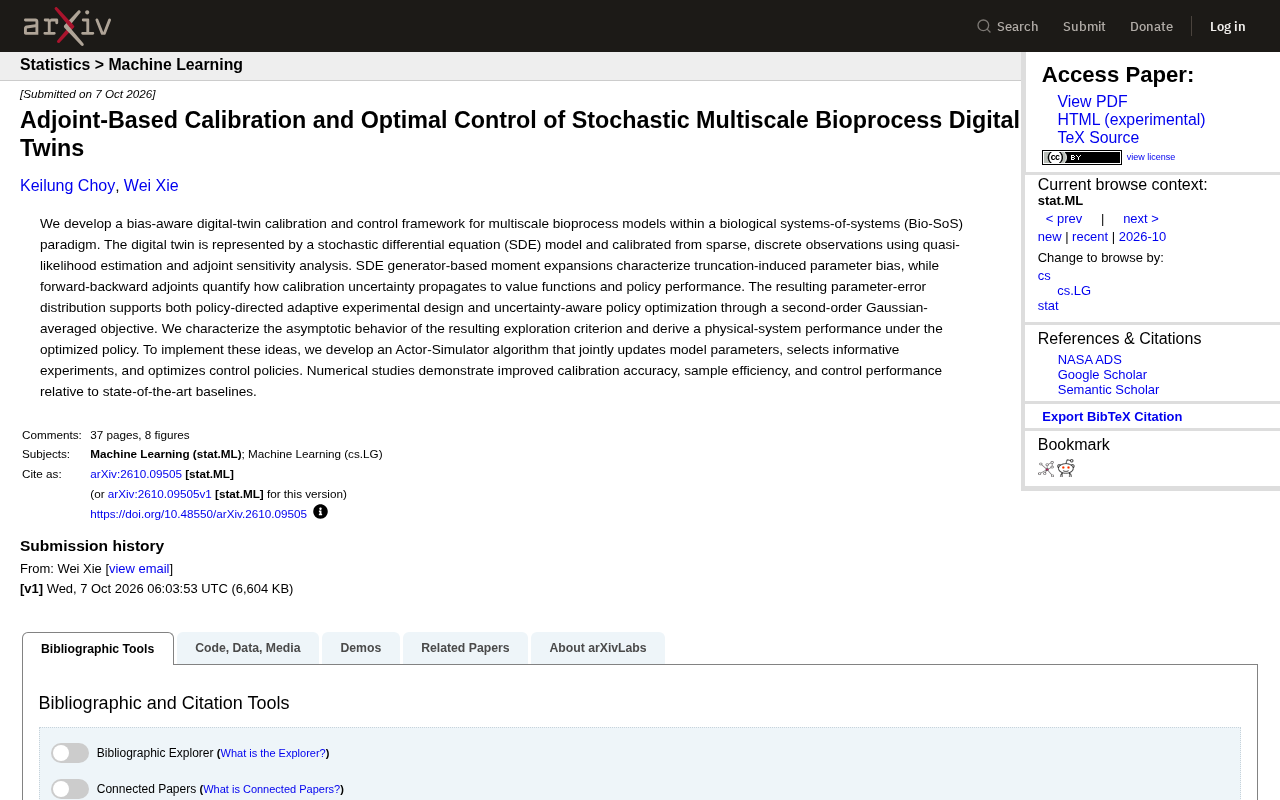
A study published on arXiv (titled Adjoint-Based Calibration and Optimal Control of Stochastic Multiscale Bioprocess Digital Twins) directly addresses this challenge. Under the Bio-SoS (Biological Systems-of-Systems) paradigm, the research team constructs a bias-aware digital twin calibration and control framework — one designed not just to run, but to maintain a clear-eyed awareness of its own uncertainty.
Core Methodology: Modeling Multiscale Bioprocesses with SDEs
Why SDE Modeling?
Bioprocesses are inherently stochastic — cellular metabolism, fluctuations in molecular concentrations, and coupling between microscale and macroscale dynamics all carry noise. The study adopts stochastic differential equation (SDE) models to represent the digital twin precisely because SDEs capture this intrinsic stochastic dynamics, rather than approximating it with deterministic equations.
The calibration step combines quasi-likelihood estimation with adjoint sensitivity analysis. Quasi-likelihood estimation offers robustness advantages when observational data is sparse and distributional information is incomplete; adjoint methods, borrowed from control theory and optimization, enable efficient computation of gradients of an objective function with respect to a large number of parameters — a critical capability for high-dimensional bioprocess models.
Adjoint Sensitivity Analysis is a gradient computation technique rooted in optimal control theory. In conventional forward sensitivity analysis, a separate set of equations must be solved for each parameter, making computational cost proportional to the number of parameters. The adjoint approach introduces a set of "adjoint variables" (Lagrange multipliers) and requires only one additional "backward" solve to simultaneously obtain gradient information for all parameters. This gives it a decisive computational advantage in bioprocess models with tens or hundreds of parameters. Adjoint methods are well established in computational fluid dynamics and neural network training (the continuous analog of backpropagation); applying them to the calibration of stochastic multiscale bioprocesses is a key innovation of this work.
Quantifying Parameter Bias
The most valuable contribution of this work lies in its refusal to dismiss model bias as mere noise — instead, it actively characterizes it. The study uses generator-based moment expansions of the SDE to describe the sources of parameter bias introduced by model truncation.
Furthermore, the team employs forward-backward adjoints to quantify how calibration uncertainty propagates into value functions and policy performance. In other words, it answers a question engineers genuinely care about: "My model parameters have errors — how much will those errors degrade my control decisions?"
The Generator of an SDE is the core operator describing how the statistical properties of a stochastic process evolve over time — also known as the Kolmogorov forward operator or infinitesimal generator. When the generator acts on some observable quantity, it yields the instantaneous rate of change of that quantity's expected value. By performing moment expansions of the generator, the dynamics of a stochastic system can be approximated as a set of deterministic equations governing statistical moments such as the mean and variance, converting a stochastic problem into a more tractable system of moment equations. However, such expansions typically require truncation at some order, and that truncation itself introduces systematic bias — the very source of "parameter bias from model truncation" discussed in the paper. One of the framework's core contributions is explicitly incorporating this truncation error into the calibration and optimization pipeline, rather than treating it as a negligible approximation artifact.
From Uncertainty to Decision-Making: Adaptive Experimental Design and Policy Optimization
The parameter error distribution obtained from calibration is not the endpoint of this framework — it serves as the core fuel driving subsequent decisions. It simultaneously supports two things:
- Policy-directed adaptive experimental design: Rather than sampling blindly, experiments are chosen based on what information the current policy most needs, improving sample efficiency.
- Uncertainty-aware policy optimization: A second-order Gaussian-averaged objective ensures the optimized control policy remains robust even when parameters carry errors.
The study also characterizes the asymptotic behavior of the resulting exploration criterion at the theoretical level, and derives bounds on the performance of the physical system under the optimized policy. This dual guarantee — theoretical rigor combined with practical realizability — is what distinguishes this work from purely empirical approaches.
Adaptive Experimental Design is an important branch of experimental design in which the next experimental plan is determined dynamically based on prior results, rather than being fixed in advance. Unlike traditional optimal designs (such as D-optimal designs that maximize the Fisher information matrix), "policy-directed" adaptive experimental design directly links the informational value of an experiment to improvements in downstream control decisions — prioritizing data that most reduces uncertainty in the control policy, rather than improving parameter estimation accuracy in a general sense. This philosophy is closely related to active learning in Bayesian optimization and the exploration–exploitation trade-off in reinforcement learning. In controlled industrial bioprocess settings where each experiment is extremely costly, the sample efficiency gains from such purposeful exploration have direct economic value.
The Actor-Simulator Algorithm: Three Tasks, One Loop
To make these ideas operational, the research team proposes an algorithm called Actor-Simulator. Its design philosophy unifies three tasks that are typically handled separately into a single closed loop:
- Jointly updating model parameters — continuously calibrating the digital twin with new data;
- Selecting the most informative experiments — guiding what data to collect next;
- Optimizing the control policy — improving decisions on the updated model.
This integrated "calibrate–explore–decide" loop echoes the interaction between an Actor and an environment simulator in reinforcement learning, but is purpose-built for the stochastic nature and multiscale characteristics of bioprocesses.
Experimental Results and Significance
According to the numerical studies reported in the paper, the proposed framework outperforms current state-of-the-art baselines along three dimensions:
- Higher calibration accuracy;
- Better sample efficiency (achieving the same result with fewer costly biological experiments);
- Superior control performance.
For the biopharmaceutical industry, sample efficiency gains are particularly significant — each biological experiment can take days or even weeks and carries substantial costs. A framework that actively plans "which experiment to run next" directly translates to reductions in R&D costs and timelines.
From a broader perspective, this research represents a direction toward maturity for digital twin technology: moving beyond "the model can predict" toward demanding that "the model knows where it is uncertain and actively improves accordingly." Integrating adjoint sensitivity analysis, stochastic modeling, and policy optimization into a unified framework also offers transferable insights for other high-value, high-uncertainty industrial control systems beyond bioprocesses.
Note: This article is based on a summary of an arXiv preprint. For specific algorithmic implementation details and complete experimental data, please refer to the original paper.
Related articles

JobRunner MCP Server: AI Agents Can Now Fix Failed Java Jobs
JobRunner launches an open-source MCP server enabling AI agents to view cluster status, diagnose failures, and recover Java jobs—incident response from any cloud coding environment or existing agent.

MLAI Digital Launches 9 Security Agents: MCP Server Safeguards the Full Lifecycle of Agentic AI
MLAI Digital launches Security MCP Server with nine built-in specialized security agents covering vulnerability discovery, attack simulation, prompt injection detection, API and infrastructure assessment, and accelerated remediation—embedding security validation across the full Agentic AI lifecycle from development to production.

Running Isaac Lab on H100 GPUs: Exploring Better Approaches
Exploring optimization methods for running Isaac Lab on NVIDIA H100 GPUs, including MIG configuration, mixed precision, TensorRT acceleration, and community experience to improve robotics simulation and reinforcement learning efficiency.