ADM: A Local LLM Deployment Tool That Launches Out of the Box

ADM is a zero-barrier open-source local LLM tool with a GUI, built-in Agent, and inference acceleration.
ADM is an open-source local LLM deployment tool designed for non-technical users, centered on one-click deployment and out-of-the-box usability through a fully graphical interface. It includes a built-in Admagent that can execute commands, read/write files, and run scripts, and claims support for a stable 60K context window with automatic hallucination recovery. On the performance side, ADM introduces MTP speculative decoding for faster inference and supports model compression for modest hardware. All data is stored locally, and the tool is free across Windows, Linux, and macOS. The article notes that promotional claims like "automatic hallucination repair" still require independent testing before being taken at face value.
Why Local LLM Deployment Needs a Simpler Solution
Running large language models locally has always been a dream for AI enthusiasts and developers alike — full privacy control, no data leakage, and no API bills to worry about. But the reality often looks quite different: intimidating command-line interfaces, complex environment setup, and GPU driver compatibility headaches have kept many non-technical users locked out.
ADM, an open-source local LLM deployment tool, was built specifically to address these pain points. According to its introduction on Bilibili, it emphasizes "one-click deployment, out-of-the-box usability, and zero configuration" — wrapping what used to require terminal commands and config file edits into a fully graphical interface. For anyone who's ever wanted to try local AI but got turned away by the technical barrier, this is a direction worth watching.

Core Features: A Fully Visual Journey from Download to Launch
ADM's most immediate selling point is streamlined setup. Users simply hit download, then launch — the tool automatically detects GPU and hardware configuration, eliminating the need to manually match environments. The entire process requires no technical background and is handled entirely through a visual interface.
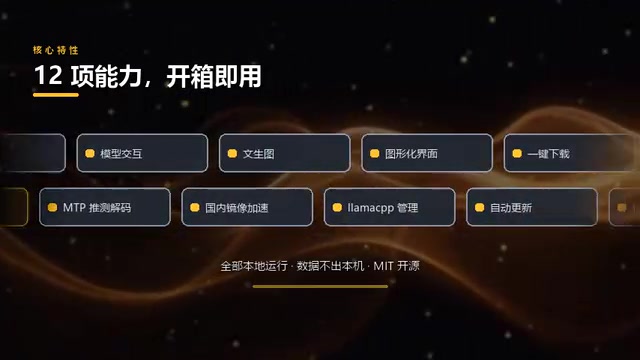
Looking at its feature list, ADM offers 12 core capabilities, including a graphical interface, hardware monitoring, model library management, and one-click download and launch. In real UI previews, you can see model management and Agent conversation modules integrated into a single control panel, letting users both manage local models and put them to work directly. This "plug-and-play" design philosophy significantly lowers the bar for local AI adoption.
Built-in Agent: More Than Just Chat — It Can Actually Do Things
What sets ADM apart from a basic model runner is its built-in Admagent capability. According to the documentation, it goes beyond conversation — it can execute commands, read and write files, and run scripts, giving it genuine hands-on operational capability.
Also worth noting is how it handles long tasks and context. ADM reportedly supports a stable 60K context window, can automatically recover from model hallucinations, and is less prone to crashing during extended task runs. If these features hold up in practice, they would provide meaningful help in scenarios involving complex, continuous tasks. That said, claims like "automatic hallucination repair" still warrant scrutiny — real-world testing is needed before drawing firm conclusions.

The fundamental difference between an AI Agent and a regular chatbot lies in its capacity for action. Ordinary conversational models only generate text responses, while an Agent can invoke external tools, execute system commands, and interact with the file system or network — forming a closed loop of "perceive → plan → act → feedback." A locally running Agent is particularly sensitive, because it has direct access to the user's files and processes. This is both its strength and a security boundary that deserves careful attention. A 60K context length refers to the volume of text the model can "remember" in a single session — roughly equivalent to around 100,000 Chinese characters, enough to hold a complete long-form report or an extensive multi-turn conversation history, which is critical for Agents that need to continuously track task state.
Performance Optimization: MTP Speculative Decoding and Lightweight Design
On the inference performance side, ADM introduces MTP speculative decoding (Multi-Token Prediction, a technique for accelerating inference). The core idea behind speculative decoding is to use a smaller model or auxiliary mechanism to predict multiple tokens in advance, which the main model then verifies — achieving faster generation without a meaningful loss in output quality. This kind of optimization matters especially for local deployment, where hardware resources are typically limited.
The tool also emphasizes a lightweight, native-first design philosophy, capable of compressing local models down to near-micro scale, making it accessible to users with more modest hardware. This attention to resource efficiency is one of the key factors determining whether a local deployment tool can achieve widespread adoption.

Speculative Decoding has become one of the mainstream techniques for accelerating LLM inference in recent years. Traditional autoregressive generation produces only one token at a time; speculative decoding introduces a lightweight "draft model" that batch-predicts several candidate tokens, which the main model then verifies in parallel — accepting or rejecting them — ultimately delivering a 2–3x speed improvement on the same hardware while maintaining mathematical equivalence to the original model's output quality. MTP (Multi-Token Prediction) is one variant of this approach, training the model to simultaneously predict multiple subsequent tokens to assist acceleration. It was systematically proposed by Meta in 2024 research and has since been applied in models such as DeepSeekAd. For local deployment scenarios, the significance of these techniques is clear: users can enjoy a smoother generation experience through algorithmic optimization alone, without upgrading hardware — an effect that's especially pronounced when running large-parameter models on consumer-grade GPUs.
Privacy and Cross-Platform Support
Data privacy is the core appeal of local deployment. ADM explicitly states that all data is stored locally with no external transmission — the most direct advantage over cloud-based services.
On platform compatibility, ADM supports all three major operating systems: Windows, Linux, and macOS, and is free to download. This combination of full-platform coverage and zero cost should help it reach a much broader user base.
Promising, But Real-World Testing Still Needed
Based on its introduction, ADM aims to make local LLM deployment feel "foolproof" while preserving advanced capabilities like Agent operations, long-context handling, and inference acceleration — a genuinely practical positioning. For everyday users who've been put off by command lines and configuration files, it offers a low-barrier entry point; for developers, the built-in Agent and script execution capabilities leave plenty of room to explore.
A word of caution: the information in this article comes primarily from a single-source product introduction. Claims like "stable 60K context," "automatic hallucination repair," and "near-micro compression" are promotional in nature, and their actual performance and applicable limits have yet to be independently verified. If you're interested in local AI, evaluate your own hardware first, then try it yourself — real-world scenarios are the best way to determine whether these capabilities live up to the hype.
Related articles

Felix Rieseberg Personal Homepage
Felix Rieseberg's personal homepage sparks attention on Hacker News. This article covers the Slack engineer's technical background, the rise and fall of nativefier, and the value of a developer homepage as a tech calling card.

@ai-sdk/vue 3.0.306 Patch Release Syncs with [email protected] Update
@ai-sdk/vue 3.0.306 released, synced with [email protected]. A routine patch release for the Vercel AI SDK ecosystem with no public API changes; the Vue adapter layer stays version-aligned with the core package.

Gemini 4 Argon API Launches: The Era of Million-Token Output Begins
Google launches Gemini 4 Argon with sparse MoE architecture, up to 1M output tokens, and a 68.90% Vals Index score, available across API, AI Studio, and the Gemini app.