AdSteer: A Lightweight Decoding Approach for Native Advertising in LLM Generation

AdSteer proposes a decoding-time native advertising framework that balances effectiveness and cost.
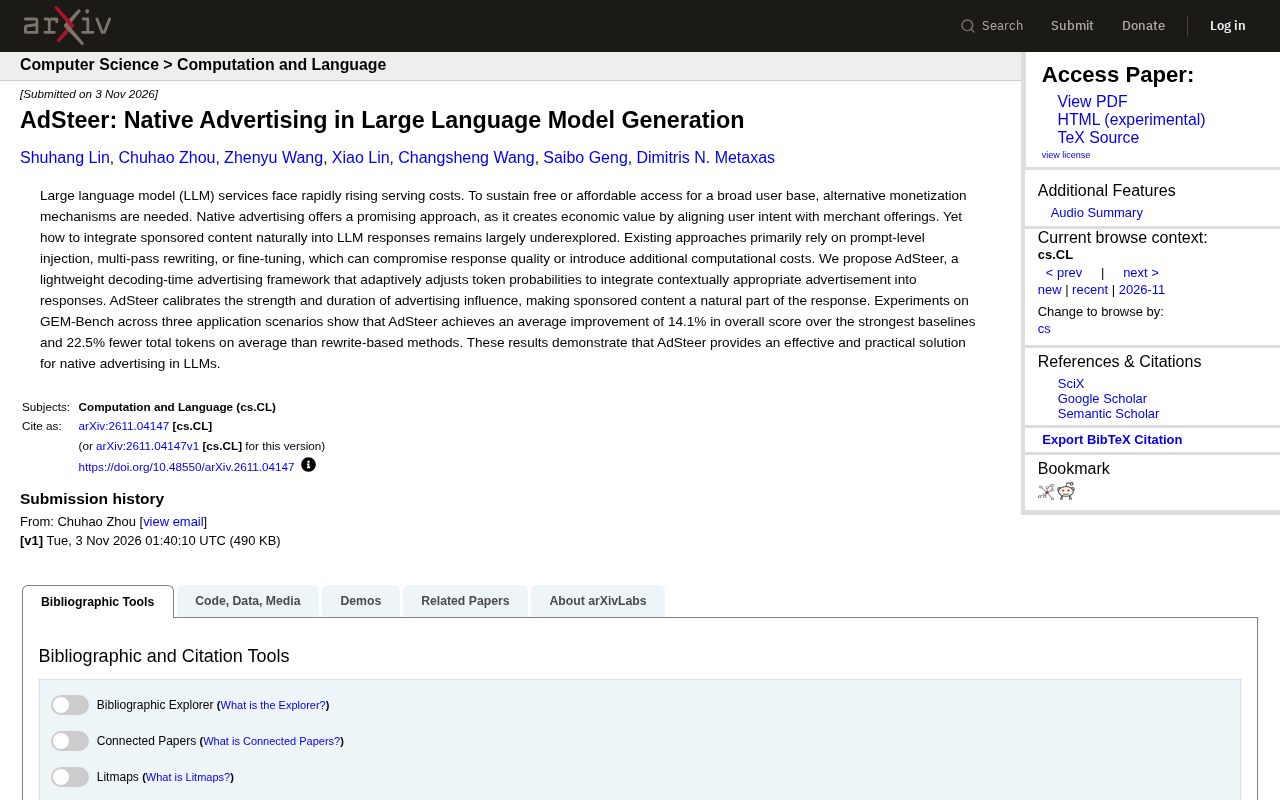
The article introduces a study called AdSteer, which explores how to embed ads natively during large language model generation. Existing methods—prompt injection, multi-round rewriting, and fine-tuning—either harm answer quality or increase computational overhead. AdSteer does not change model weights or perform multi-round rewriting; instead, it dynamically adjusts the token probability distribution at the decoding stage and calibrates the strength and duration of advertising influence, allowing sponsored content to blend more naturally into responses. Across three GEM-Bench scenarios, its overall score improves by an average of 14.1% over the strongest baseline, and total token count drops by an average of 22.5% compared with rewriting methods. The article suggests this offers a potential monetization path beyond subscriptions for sharing LLM serving costs, though real product environments still require further validation.
Free services built on large language models (LLMs) face a real tension: inference costs keep climbing, while user expectations for free or low-cost access show no sign of easing. Finding a sustainable monetization path without degrading the experience has become an unavoidable industry question. A paper titled AdSteer: Native Advertising in Large Language Model Generation proposes an imaginative direction—embedding ads natively into the model's generation process rather than interrupting answers with external insertions.
Ads in LLMs: Why It's Hard, and Where the Difficulty Lies
The logic behind native advertising is not complicated: when a user expresses a certain intent, matching merchant information that appears at just the right moment is valuable to both the user and the platform. But moving this into LLM responses is a challenge of an entirely different magnitude.
The paper notes that existing approaches fall into three main categories: prompt-level injection, multi-round rewriting, and fine-tuning. Prompt injection tends to make model output stiff or even off-topic; multi-round rewriting means extra inference passes, which noticeably raises computational cost; fine-tuning requires training resources and data preparation, with poor deployment flexibility. In other words, these methods either sacrifice answer quality or add overhead—it is hard to satisfy both "natural" and "lightweight" at once.
This is precisely the gap AdSteer attempts to fill: can we avoid changing the model and avoid rewriting the answer, and instead work only at the decoding stage?
AdSteer's Core Idea: A Gentle Nudge at Decoding Time
AdSteer positions itself as a lightweight decoding-time advertising framework. It does not alter model weights, nor does it cram advertising instructions into the input prompt. Instead, it dynamically adjusts the token probability distribution so that advertising-related content appears in responses in a more natural way.
The key here is "calibration." The paper emphasizes that AdSteer modulates the strength and duration of advertising influence—that is, the ad does not exert constant, overriding pressure throughout, but is integrated with rises and falls, with restraint. This design makes sponsored content feel more like part of the answer rather than a label slapped on top.
From an engineering perspective, the biggest advantage of decoding-time intervention is that it avoids the extra token consumption of multi-round rewriting, and it does not require training a separate model for advertising scenarios. For LLM platforms that need to control serving costs, this may be more appealing than the performance numbers themselves.
Decoding-time intervention refers to influencing the model's output probability distribution at each step when predicting the next token during autoregressive generation, rather than modifying model parameters or input prompts. Common intervention techniques include logit bias, probability reweighting, and constrained decoding. Because LLMs generate token by token, the decoding stage naturally provides fine-grained control points: the probability of certain types of tokens can be temporarily boosted when a particular context or intent appears, while the original distribution remains unchanged in irrelevant positions. The advantage of this approach is that it requires no additional training, adds no extra inference rounds, and the intervention can be switched on or off at any time; the cost is that the control logic must be tightly coupled with the decoder, which imposes certain requirements on engineering implementation and latency optimization.
What the Experimental Data Shows
The paper evaluates three application scenarios on GEM-Bench. Results show that AdSteer improves the overall score by an average of 14.1% over the strongest baseline, while reducing total token count by an average of 22.5% compared with rewriting-based methods.
These two numbers only make sense together: better performance at lower cost. For a format as user-experience-sensitive as advertising, the score improvement represents a higher degree of match between ads and context; the drop in token count directly corresponds to lower inference overhead. The authors therefore argue that AdSteer provides an effective and practical solution for native advertising in LLMs.
It should be noted that the current experiments are based on the GEM-Bench benchmark, and factors such as user tolerance and the diversity of advertiser demands in real product environments still require further validation.
GEM-Bench is the benchmark used in the paper to evaluate the effectiveness of native advertising in LLMs. It covers three typical application scenarios (such as question answering, recommendation, and dialogue) and scores along dimensions including ad relevance, answer naturalness, and overall score. The value of benchmark evaluation lies in providing a reproducible comparison environment so that different methods can be compared under the same scenarios and metrics. It is worth noting that benchmark scenarios are typically abstracted and simplified; in real products, user intents are more dispersed and advertiser demands more diverse. Therefore, score improvements on the benchmark can only serve as directional evidence, not a guarantee of real-world effectiveness.
What the Native Advertising Model Reveals About LLM Commercialization
The cost structure of LLM services makes it difficult to rely on a single subscription model over the long term. If done well, native advertising could in theory become a "non-annoying" supplementary revenue stream—users get free service, merchants get precise exposure, and the platform shares inference costs.
AdSteer's value lies in reframing ad integration from a "prompt engineering problem" to a "decoding control problem." This shift in perspective brings lower intrusiveness and less additional computation. Of course, how to calibrate ad strength and when to dial it up or down remain details that need repeated refinement at the product level. The paper offers technical feasibility, while commercialization will still require finding a balance among transparency, user trust, and ad relevance.
For teams focused on LLM serving costs and diversified monetization, AdSteer represents a direction worth tracking: not by piling on compute, but by finding room within fine-grained control of the generation process.
LLM serving costs mainly come from GPU compute consumption during inference, which is directly related to output token count, concurrency, and model size. The more users a free or low-cost service has, the harder it is for subscription revenue to cover the marginal cost per request—this is the real-world motivation for platforms to seek supplementary monetization paths such as advertising. Decoding-time advertising solutions are attractive on cost because they introduce no additional inference rounds and complete ad integration within a single generation, keeping token overhead controllable; by contrast, multi-round rewriting multiplies the number of generations per request, directly driving up serving costs.
Related articles

Glasshand: Giving AI Agents a Real iPhone and Mac
Glasshand lets AI agents rent real iPhones and Macs, supporting Claude Code, Codex, and more to post, book services, and test iOS apps on real devices. This article explains how it works, its use cases, and potential boundaries.

ChatGPT Images 2.6 Released: GIF Generation, Reference Image Reuse, and 50% Speed Boost
ChatGPT Images 2.6 released: prompt-to-GIF animation with frame-by-frame editing, reusable reference images for yourself, pets, or characters, 50% faster generation, plus Flare and Sunburst API model variants and SVG export for developers.

Rerun: Turn Your AI Subscription into an AI Coworker Team
Rerun, #3 on Product Hunt, turns your ChatGPT or Claude subscription into a team of AI coworkers that run on schedules or triggers, each with tools, a computer, and a shared workspace. It asks before risky actions, is open source (AGPL v3), and supports self-hosting.