Advanced AI/ML System Design Interview Prep Guide: From Architectural Thinking to Practical Strategies

A comprehensive guide to preparing for Senior+ AI/ML system design interviews with practical strategies.
This guide breaks down what Senior+ AI/ML system design interviews actually evaluate — architectural decision-making and trade-off awareness across data pipelines, training, inference, monitoring, RAG, and LLM infrastructure. It highlights the scarcity of quality AI-specific prep resources versus traditional system design materials, and offers practical strategies including building a case library, researching target companies, and practicing structured technical communication.
Why AI/ML System Design Has Become a Core Focus for Senior Roles
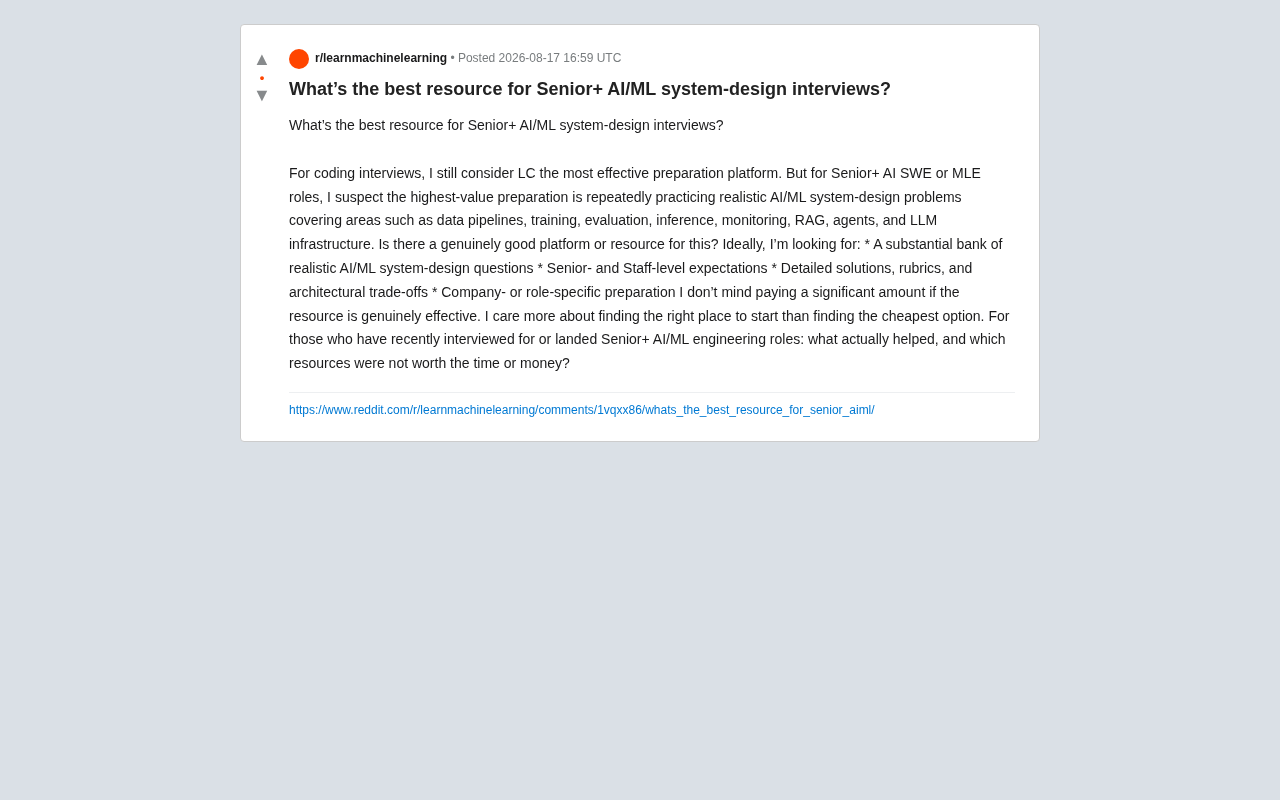
In a Reddit discussion, an engineer raised an increasingly common question: for Senior+ level AI SWE or MLE (Machine Learning Engineer) roles, what are the most effective interview preparation resources?
His observation is quite representative. For traditional coding interviews, LeetCode remains the universally recognized most efficient preparation platform. But as you advance to Senior or even Staff level, the evaluation focus shifts from "can you write a correct algorithm" to "can you design a scalable, maintainable, and observable end-to-end AI system."
The poster astutely pointed out that high-value preparation should involve repeatedly practicing AI/ML system design problems that closely mirror real-world scenarios, covering these key areas:
- Data Pipelines: Engineering data collection, cleaning, and feature engineering
- Training: Distributed training, hyperparameter management, experiment tracking
- Evaluation: Designing offline and online metrics
- Inference: Low-latency, high-concurrency model serving
- Monitoring: Detecting data drift and model degradation
- RAG and Agents: Retrieval-Augmented Generation and agent architectures
- LLM Infrastructure: Large model deployment and cost optimization
What Advanced AI/ML System Design Interviews Actually Evaluate
Unlike junior-level positions, Senior+ and Staff-level system design interviews don't care whether you can recite a specific algorithm. Instead, they assess your architectural decision-making ability and trade-off awareness.
The Mental Leap from "Components" to "Systems"
Junior candidates tend to focus on implementing a single model, while senior candidates need to demonstrate an end-to-end system perspective. For example, when asked to design a recommendation system, interviewers expect you to proactively discuss:
- How should the retrieval and ranking layers be structured?
- How does the Feature Store ensure consistency between training and inference?
- How do you design an A/B testing framework to validate model performance?
- How does the inference service scale elastically when QPS spikes?
Trade-offs Are the Core Evaluation Signal
The poster specifically emphasized that the resources they need should include "detailed solutions, rubrics, and architectural trade-off analysis." This is the essence of senior-level interviews — there are no standard answers, only optimal choices under specific constraints (latency, cost, accuracy, maintainability). Candidates who can clearly articulate "why choose A over B" are the ones who pass Staff-level evaluations.
The Real Challenge of Finding ML System Design Learning Resources
The poster explicitly stated willingness to pay a significant amount for truly effective resources, caring more about "starting from the right place" than finding the cheapest option. This reflects a real pain point in the current market: high-quality practice resources for AI/ML system design are relatively scarce.
General System Design vs. AI-Specific System Design
Mature system design resources on the market (such as the classic System Design Interview series, Grokking, etc.) mostly focus on traditional backend systems — designing URL shorteners, message queues, distributed caches, and so on. These are helpful for building foundational distributed systems intuition, but they inadequately cover AI/ML-specific challenges.
ML systems have unique characteristics:
- Data is a first-class citizen: Model quality is highly dependent on data quality and feature engineering
- Non-determinism: Model outputs carry uncertainty, making evaluation systems more complex
- Continuous evolution: Models degrade over time, requiring retraining and monitoring feedback loops
- GPU and cost constraints: Cost sensitivity for large model inference is far higher than for traditional services
Recommended Preparation Resources
While the original post didn't yield a definitive community answer, based on industry practice, the following types of resources are generally considered valuable:
-
Specialized books: Chip Huyen's Designing Machine Learning Systems is widely regarded as the authoritative introduction to ML system design, systematically covering the complete lifecycle from data to deployment.
-
Engineering blogs: Technical blogs from companies like Meta, Netflix, Uber, and Pinterest contain extensive real-world ML system architecture case studies and are the best material for understanding "production-grade" design.
-
Specialized interview platforms: Some emerging platforms have begun offering AI/ML-focused system design question banks and mock interviews, though quality varies significantly and careful vetting is needed.
-
Hands-on projects: Building an end-to-end pipeline that includes training, deployment, and monitoring yourself builds more genuine architectural intuition than any amount of problem grinding.
Practical Preparation Strategies for Senior ML Interviews
Build Your Own AI System Design "Case Library"
Rather than passively grinding problems, proactively construct a mental framework for AI system design. For each category of classic problems (recommendation systems, search ranking, RAG-based Q&A, real-time fraud detection, content moderation, etc.), systematically map out: data sources, model selection, offline/online evaluation, serving architecture, monitoring and alerting, and failure modes.
Deep-Dive into Your Target Company's Technical Landscape
The poster mentioned wanting "company or role-specific preparation." This is indeed critical — interviewing for an LLM infrastructure role at OpenAI versus a recommendation system role at an e-commerce company involves completely different evaluation focuses. Researching your target company's tech stack, open-source projects, and engineering blogs is often more targeted than generic problem grinding.
Practice "Thinking Out Loud"
A system design interview is fundamentally a structured technical conversation. Whether you can clearly clarify requirements, decompose modules, proactively surface trade-offs, and respond to interviewer follow-ups — these communication skills are equally as important as technical depth. Conducting mock interviews with peers is an extremely cost-effective preparation method.
Conclusion
This Reddit discussion reveals a real preparation gap in the AI engineering field: as MLE and AI SWE roles advance in seniority, system design capability has become the decisive factor, yet the supporting ecosystem of high-quality practice resources hasn't fully matured.
For engineers aiming at Senior+ positions, the most effective strategy may not be finding a single "silver bullet" platform, but rather combining book study, engineering blog reading, hands-on projects, and mock interviews to gradually build deep understanding and architectural intuition across the entire AI system lifecycle. After all, true system design capability comes from repeatedly weighing real engineering constraints — not from memorizing standard answers.
Related articles

Chain of Thought Isn't Just for AI: How Humans Can Use CoT to Improve Thinking Quality
Chain of Thought isn't just a prompt trick for large models. Starting from a Hacker News discussion, this article analyzes why CoT works for human thinking too, breaks down actionable ways to transfer it, and highlights the key differences between human CoT and machine CoT.
Cloudflare Teams Up with OpenAI: Closi…
Cloudflare Teams Up with OpenAI: Closing the Loop from Vulnerability Discovery to Defense with AI
Cloudflare uses OpenAI Daybreak to investigate security vulnerabilities and generate reviewable remediation plans, while developers use Codex to boost coding efficiency and quality.

Orca Multi-Agent Orchestration in Practice: A Guide to Parallel Collaboration with Claude and Codex
Orca is Stable AI's free open-source agent workbench supporting 34 agents like Claude Code and Codex in parallel. Learn its Git worktree isolation, multi-model orchestration, and mobile management.