Advanced LLM Application Engineering in Practice: Hybrid RAG, Tools, Memory & Evals

Packt workshop focuses on engineering LLM applications from demo to production, integrating hybrid RAG, tools, memory, and evaluation.
The article introduces an advanced LLM application engineering workshop hosted by Packt Publishing on November 28, led by Brij Kishore Pandey. The core message is that getting an LLM application to work in a demo and making it run reliably in production are two different things and require a systems engineering approach. The workshop no longer treats retrieval, tools, memory, and evaluation as isolated features but integrates them into a complete engineering system. The content covers hybrid RAG pipelines (beyond single vector search), tool calling and persistent memory across interactions, guardrails and failure handling, evaluation and observability, and platform practice with Google ADK and Gemini. The article notes that LLM application engineering is moving from feature stacking to systems engineering, and is suitable for developers who can already run demos with LangChain/LangGraph but face production reliability challenges.
From Demo to Production: The Critical Leap in LLM Application Engineering
Many developers share a similar experience: building an LLM application demo with LangChain or LangGraph takes only a few hours to get running, but making it run reliably in production can take weeks or even months. Packt Publishing will host a hands-on workshop on November 28, led by Brij Kishore Pandey, targeting this exact pain point — advanced LLM application engineering.
According to the original Reddit post, this workshop is aimed at developers who are building applications with LangChain and LangGraph, and its core message is clear: getting an LLM application to work in a demo and making it production-reliable are two completely different things.
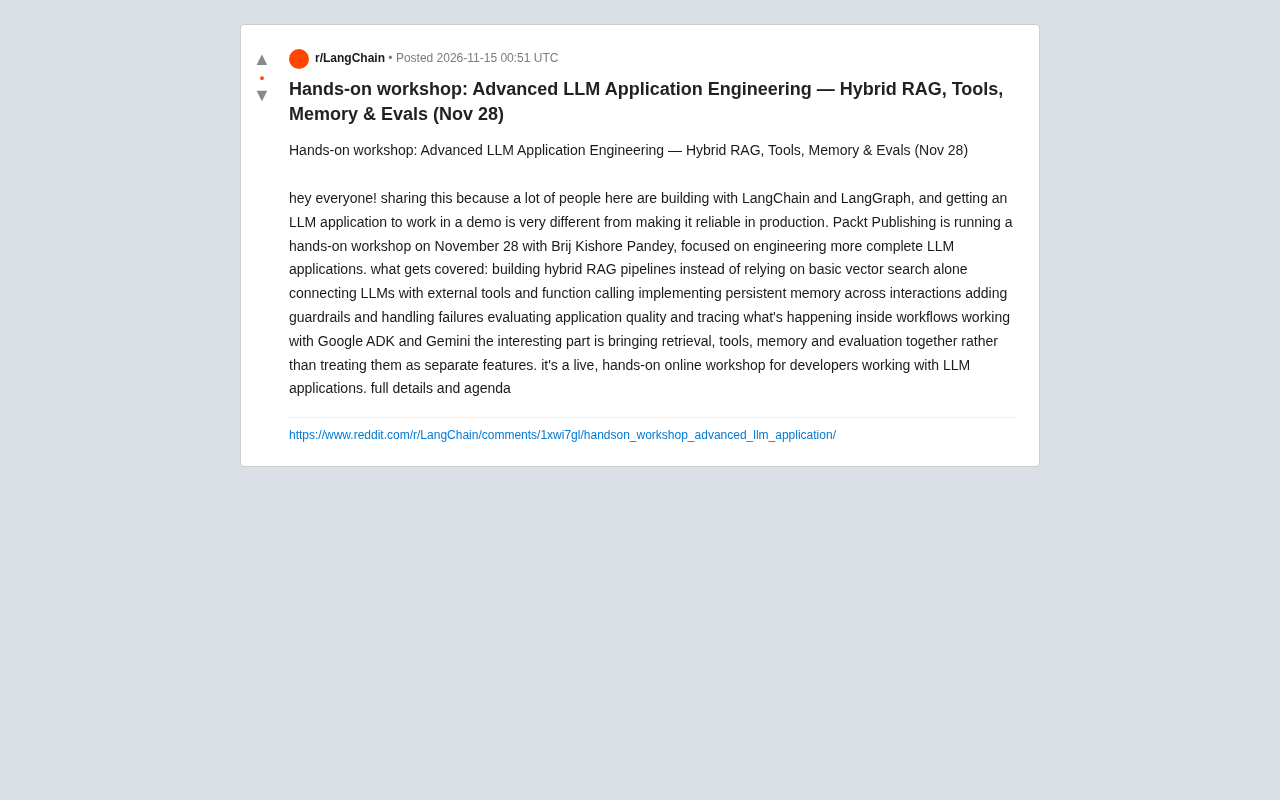
What makes the workshop unique is that it no longer treats retrieval, tools, memory, and evaluation as isolated feature points, but instead attempts to integrate them into a complete engineering system. The original author specifically emphasizes that this integrated perspective is the "interesting part" of the workshop.
Hybrid RAG: Beyond Basic Vector Search
The first focus of the workshop is building hybrid RAG pipelines, rather than relying solely on basic vector search.
Pure vector retrieval often struggles with exact matching, proper nouns, or structured queries. Hybrid RAG compensates for this shortcoming by fusing multiple retrieval strategies. Although the original post does not elaborate on the specific technical combinations, the direction itself sends a clear signal: production-grade RAG requires multi-route recall and fusion ranking, not just a single semantic similarity.
For developers already familiar with basic RAG, this section will help them understand how to design a more robust retrieval layer to handle complex queries in real business scenarios.
Hybrid Retrieval usually refers to combining sparse retrieval (such as BM25, TF-IDF, and other term-frequency-based algorithms) with dense retrieval (such as semantic similarity based on embedding vectors). Sparse retrieval excels at exact matching of keywords, proper nouns, and numbers, while dense retrieval excels at capturing semantic synonyms and context. Common fusion methods include weighted summation, Reciprocal Rank Fusion (RRF), or learned re-ranking (such as Cross-Encoder). In production RAG, hybrid retrieval can significantly improve recall, especially when facing short queries, domain terminology, or structured field filtering. In addition, after multi-route recall, a re-ranking stage is often needed to unify the ordering, ensuring that the context ultimately fed to the LLM is both relevant and concise.
Tool Calling and Persistent Memory: Giving LLM Applications "Hands and a Brain"
The second core module is connecting LLMs with external tools and function calling. LLMs themselves cannot directly operate databases, call APIs, or perform calculations. The function calling mechanism allows models to trigger external capabilities, thereby expanding application boundaries.
Closely related is the implementation of persistent memory across interactions. Most demo-level applications lose context after a single session ends, while production applications need to remember user preferences, historical actions, and intermediate states. The workshop will cover how to maintain memory across multiple interactions, which directly relates to the continuity and personalization of user experience.
Together, these two modules address the questions of "what an LLM application can do" and "what it remembers" — necessary conditions for moving from a toy to a tool.
Function Calling is a structured output capability of LLMs: developers describe available tools (function names, parameters, descriptions) using JSON Schema, and the model outputs a call request conforming to the Schema when needed. An external runtime executes it and passes the result back to the model to continue reasoning. Unlike letting the model generate code directly, it extends capabilities through controlled interfaces and reduces the risk of hallucination. Persistent memory usually relies on external storage (such as vector databases, key-value stores, or relational databases) to save conversation history, user profiles, and task states, and retrieves and injects them into prompts as needed in subsequent interactions. Memory can be divided into short-term (within a session) and long-term (across sessions), and design must consider write strategies, retrieval relevance, and privacy compliance.
Guardrails, Failure Handling, and Observability
The third section of the workshop focuses on adding guardrails and handling failures. The uncertainty of LLM applications is far higher than that of traditional software: models may output harmful content, call the wrong tools, or fall into loops. Guardrail mechanisms are used to constrain output boundaries, while failure handling ensures that the system degrades gracefully rather than crashing when exceptions occur.
Complementing this is evaluating application quality and tracing internal workflow states. The original post mentions the need to "evaluate application quality and trace what happens inside the workflow," which points to building observability for LLM applications — only by clearly seeing the inputs and outputs of every internal step can problems be located and continuous optimization be achieved. Evaluation is not only a pre-launch check but also a compass during iteration.
Guardrails are a set of input/output constraint mechanisms, including content filtering (toxicity, bias, sensitive information), format validation (JSON Schema, regex), tool call whitelists and permission control, and topic boundary restrictions. Observability in LLM applications is usually achieved through tracing: recording the prompt, model output, tool call parameters and results, latency, and token consumption of each request to form a traceable call chain. Commonly used tools include LangSmith, LangFuse, OpenTelemetry, and others. Evaluation (Evals) is divided into offline batch evaluation and online continuous evaluation, with metrics covering accuracy, relevance, faithfulness, harmfulness, and more, often assisted by LLM-as-a-Judge or human annotation.
Google ADK and Gemini: Platform Practice
The workshop will also cover the use of Google ADK and Gemini. ADK (Agent Development Kit) provides framework support for building agent applications. Combined with the capabilities of the Gemini model, participants can learn how to implement the above engineering patterns on a specific platform.
This section is especially valuable for teams currently selecting a technology stack — it provides a referable engineering implementation example rather than pure theoretical discussion.
Google ADK (Agent Development Kit) is an open-source framework launched by Google for building, deploying, and managing agent applications based on models such as Gemini. It provides multi-agent orchestration, tool integration, session management, and evaluation hooks, and connects with the Vertex AI ecosystem. Gemini is Google's multimodal large model series, supporting text, image, audio, and other inputs, and cooperating with ADK through interfaces such as function calling and structured output. Compared with LangChain/LangGraph, ADK is closer to Google Cloud's deployment and operations system, making it suitable for teams already on GCP. Understanding the abstraction levels and binding relationships of different frameworks helps weigh flexibility, portability, and operational costs during technology selection.
Who Should Attend
According to the original post, this is a live online hands-on workshop for developers who are building LLM applications. If you can already run a demo with LangChain or LangGraph but are struggling with production reliability, maintainability, and evaluability, the integrated perspective of this workshop is worth paying attention to.
The workshop agenda and full details can be viewed through the link provided in the original post. For developers unable to attend live, they can also watch for whether Packt Publishing later provides recordings or related materials.
Core signal: LLM application engineering is moving from the "feature stacking" stage to the "systems engineering" stage. Retrieval, tools, memory, evaluation, and observability need to be designed as a whole rather than in isolation.
One-line Summary
Packt workshop focuses on engineering LLM applications from demo to production, integrating hybrid RAG, tools, memory, and evaluation.
Paragraph Summary
The article introduces an advanced LLM application engineering workshop hosted by Packt Publishing on November 28, led by Brij Kishore Pandey. The core message is that getting an LLM application to work in a demo and making it run reliably in production are two different things and require a systems engineering approach. The workshop no longer treats retrieval, tools, memory, and evaluation as isolated features but integrates them into a complete engineering system. The content covers hybrid RAG pipelines (beyond single vector search), tool calling and persistent memory across interactions, guardrails and failure handling, evaluation and observability, and platform practice with Google ADK and Gemini. The article notes that LLM application engineering is moving from feature stacking to systems engineering, and is suitable for developers who can already run demos with LangChain/LangGraph but face production reliability challenges.
Related articles

Abnormal Error Rate Spike in Claude Mythos 5.2 and Fable 5.2
Claude Mythos 5.2 and Claude Fable 5.2 show an abnormal spike in request error rates, marked as investigating on the official status page. This article covers the incident overview, practical impact on developers, and recommended responses.

ReAct Runtime Context Trimming: Why Claude Code Acts at 70%
A deep dive into ReAct runtime context trimming: why Claude Code compresses at ~70% usage, why tool calls dominate, why messages must be dropped in pairs, and why codebases don't need RAG.

AI Agent vs LLM: How Cursor and Claude Code Actually Work
An in-depth analysis of the essential difference between AI Agents and LLMs: LLMs generate code suggestions, while Agents modify files and run tests via tool calls. Using a Spring Boot bug fix as an example, it breaks down the workflows, permission control, and verification mechanisms of Cursor and Claude Code.