Advancing Your Self-Taught Machine Learning Journey: Three Paths Forward After Completing Foundational Projects

Three advancement paths for self-taught ML learners after completing foundational projects like MNIST and paper reproduction.
This article addresses a common challenge for self-taught machine learning practitioners: what to do after completing foundational projects. It evaluates the value of implementing neural networks from scratch and reproducing papers, then outlines three advancement paths—computer vision (ResNet, diffusion models), NLP (Transformers, LLMs), and mathematical foundations—along with practical advice for balancing academics with self-study.
A Self-Learner's Dilemma
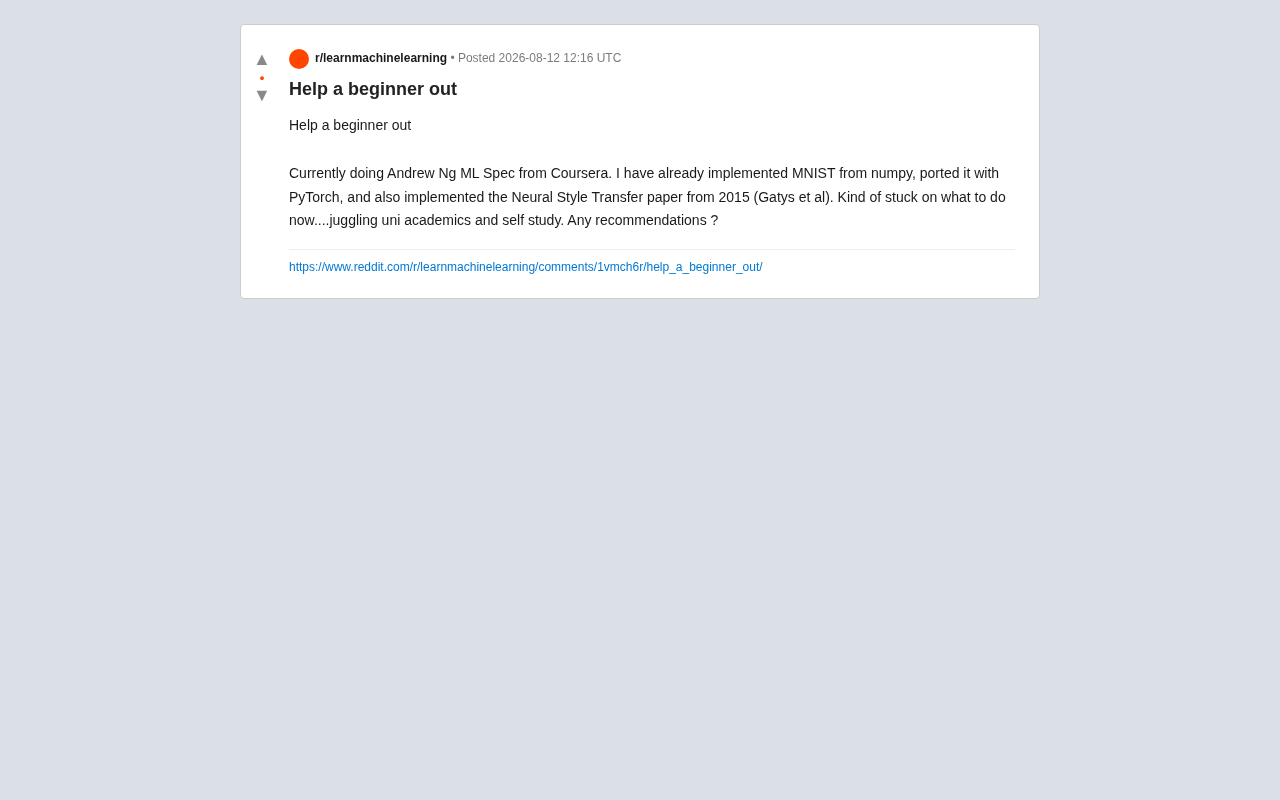
In Reddit's machine learning community, a self-taught developer posed a highly representative question. He's currently taking Andrew Ng's ML Specialization on Coursera and has already completed several impressive hands-on projects:
- Implemented MNIST handwritten digit recognition from scratch using pure NumPy
- Ported the implementation to the PyTorch framework
- Reproduced the 2015 Neural Style Transfer paper by Gatys et al.
However, after completing these projects, he found himself at a crossroads: while balancing university coursework with self-study, where should he go next?
Andrew Ng is a Stanford University professor, co-founder of Google Brain, and co-founder of Coursera—widely regarded as a pioneer in global machine learning education. His ML Specialization on Coursera was fully updated in 2022, upgrading from the earlier Octave/MATLAB version to a modern curriculum based on Python and TensorFlow, covering core topics including supervised learning, unsupervised learning, recommender systems, and reinforcement learning. The course explains algorithmic principles in a progressive manner, emphasizing intuitive understanding over pure mathematical derivation. It remains one of the most enrolled online ML courses globally, providing countless self-learners with their first stepping stone into machine learning.
This seemingly simple question touches on a common challenge faced by many self-taught ML practitioners—after completing foundational practice projects, how do you build a clear path for advancement?
Assessing the Value of Existing Foundations
First, it's worth acknowledging that this learner's study path is actually quite solid. Many beginners plateau at the level of "calling APIs to run models," but he did two things with significantly more depth.
The Significance of Implementing a Neural Network from Scratch
Implementing MNIST with pure NumPy means he had to write the complete logic for forward propagation, backpropagation, gradient computation, and parameter updates by hand. This "reinventing the wheel" process may be inefficient, but it's crucial for understanding the underlying principles of neural networks.
MNIST is a handwritten digit image dataset compiled by Yann LeCun et al. in 1998, containing 60,000 training images and 10,000 test images, each being a 28×28 pixel grayscale image. Implementing it with pure NumPy means not relying on any deep learning framework—the developer must manually implement matrix multiplication for forward propagation, use the chain rule to compute gradients layer by layer for backpropagation, implement activation functions (such as ReLU, Softmax) and their derivatives, and write gradient descent optimizers to update weights. This process requires precise understanding of tensor shapes and gradient flow at every step of the computation graph, making it the ultimate litmus test for "whether you truly understand neural networks."
By comparison, directly using PyTorch's automatic differentiation (autograd) mechanism, while convenient, can easily leave one with only a superficial understanding of gradient flow. PyTorch's autograd engine implements automatic differentiation based on dynamic computation graphs (define-by-run)—whenever tensors participate in operations, PyTorch constructs a directed acyclic graph (DAG) in the background, recording each operation and its inputs/outputs. When .backward() is called, the engine starts from the loss node, traverses the DAG in reverse, and automatically computes gradients for each leaf node parameter using the chain rule. Unlike TensorFlow 1.x's static graphs, dynamic graphs allow the network structure to change during each forward pass, making debugging more intuitive and code more Pythonic. This design dramatically lowers the barrier to experimentation but can also lead to a lack of deep understanding of underlying gradient computation—which is precisely why "implementing from scratch with NumPy" has irreplaceable pedagogical value.
The Advanced Value of Paper Reproduction
Reproducing the Neural Style Transfer paper represents an even more significant leap forward. Gatys et al.'s 2015 paper "A Neural Algorithm of Artistic Style" proposed a method that uses a pretrained VGG-19 convolutional network to separately extract content representations and style representations from images. Content loss is calculated by comparing the Euclidean distance between the target image and content image in high-level feature maps; style loss measures style similarity by comparing Gram matrices (inner product matrices of feature maps that capture statistical correlations of textures and colors) across layers. The final generated image is optimized directly at the pixel level through gradient descent, minimizing a weighted sum of content loss and style loss.
This classic paper involves concepts such as convolutional feature extraction, Gram matrix computation, and content/style losses. Being able to independently reproduce it demonstrates that he already possesses the ability to read academic papers and translate them into code—a core skill that many researchers and engineers need to train over extended periods. This paper pioneered the "deep learning + artistic creation" research direction and serves as an important theoretical cornerstone for later AI-generated art.
Three Paths for Advancing in Machine Learning
For self-learners at this stage, different directions can be chosen based on interests and career goals.
Path One: Diving Deep into Computer Vision
Since he's already worked with MNIST and style transfer, continuing deeper into computer vision is a natural progression. Recommended advanced projects include:
- Advanced image classification: Training classic architectures like ResNet and VGG on CIFAR-10 or ImageNet subsets
- Object detection: Learning the YOLO and Faster R-CNN algorithm families
- Generative models: From GANs to Diffusion Models, the latter being the core technology in today's AIGC space
ResNet (Residual Network) is particularly worth studying in depth. Proposed by Kaiming He et al. in 2015, it solves the vanishing/exploding gradient problem in deep network training through skip connections. The core idea is to have the network learn a residual mapping F(x) = H(x) - x rather than directly learning the target mapping H(x), allowing information to pass directly to deeper layers through identity mappings. This design enabled network depth to break through from a dozen layers to 152 or even thousands of layers, reducing the top-5 error rate to 3.57% on ImageNet—surpassing human-level performance for the first time. The residual concept has since been widely adopted in Transformers, diffusion models, and virtually all modern deep learning architectures.
Diffusion models deserve particular attention as they form the technological foundation of mainstream image generation tools like Stable Diffusion and DALL-E, making them extremely valuable to learn. The core idea of diffusion models comes from non-equilibrium thermodynamics: the forward process gradually adds Gaussian noise to data, transforming the original data distribution into a pure noise distribution; the reverse process trains a neural network to learn step-by-step denoising, recovering clear images from pure noise. Ho et al.'s 2020 DDPM (Denoising Diffusion Probabilistic Models) paper established the framework for modern diffusion models, followed by Rombach et al.'s 2022 Latent Diffusion Model, which dramatically reduced computational costs by performing the diffusion process in a compressed latent space rather than pixel space—directly giving rise to Stable Diffusion. Compared to GANs, diffusion models offer more stable training and more comprehensive mode coverage, and have become the dominant paradigm for image, video, and audio generation.
Path Two: Pivoting to Natural Language Processing (NLP)
In the era of Large Language Models (LLMs), NLP has become one of the hottest directions. Recommended learning path:
- Start with word embeddings (Word2Vec, GloVe) to understand text representation
- Master Recurrent Neural Networks (RNN, LSTM) for sequence data processing
- Focus on mastering the Transformer architecture—reproduce the "Attention Is All You Need" paper
- Try fine-tuning pretrained models like BERT and the GPT series
Vaswani et al.'s 2017 paper "Attention Is All You Need" completely abandoned RNNs and CNNs, relying solely on self-attention mechanisms to build sequence-to-sequence models. Self-attention computes relevance weights between every pair of positions in a sequence (via Query-Key dot products followed by Softmax normalization), enabling parallel aggregation of global information and solving RNN's inability to parallelize computation and difficulty capturing long-range dependencies. Multi-Head Attention further allows the model to capture different types of relationship patterns in different subspaces. Combined with positional encoding, layer normalization, and feed-forward networks, the Transformer has become the foundational architecture for BERT, GPT, ViT, and nearly all modern AI models. Its influence has extended far beyond NLP into computer vision, protein structure prediction, speech synthesis, and many other domains.
Reproducing the Transformer paper would be another highly valuable milestone project following style transfer. Unlike style transfer, reproducing the Transformer requires understanding multi-head attention matrix operations, the design philosophy of positional encoding, cross-attention mechanisms in the encoder-decoder architecture, and engineering details like learning rate warmup strategies and label smoothing during training.
Path Three: Strengthening Mathematical and Theoretical Foundations
If you find your understanding of certain concepts isn't deep enough, returning to mathematical foundations is equally important. Linear algebra, probability and statistics, and optimization theory are the three pillars of machine learning. Linear algebra provides the language for understanding data representation and model parameters (matrix decomposition, eigenvalues, singular value decomposition, etc.); probability and statistics form the foundation for understanding Bayesian inference, maximum likelihood estimation, and generative models; optimization theory covers convergence analysis of gradient descent, convex optimization, stochastic optimization, and adaptive learning rate methods (Adam, AdaGrad, etc.). These can be systematically strengthened through resources like the Deep Learning textbook (the "flower book") or Stanford's open courses CS231n (Computer Vision) and CS224n (Natural Language Processing).
Practical Advice for Balancing Academics and Self-Study
The original poster specifically mentioned the pressure of "balancing university coursework with self-study"—a very real concern. Here are several practical suggestions:
Project-Driven Learning
Don't blindly chase tutorials. Instead, set a clear project goal (such as reproducing a specific paper or entering a Kaggle competition) and learn the required knowledge around that goal. This approach provides both a sense of accomplishment and sustained motivation.
Kaggle is the world's largest data science competition platform, owned by Google. It hosts thousands of datasets and competition problems from real business scenarios, covering image classification, natural language processing, time series prediction, recommender systems, and more. Participants gain experience handling real-world data (with noise, missing values, and distribution shifts) and can learn top competitors' feature engineering, model ensembling, and hyperparameter tuning techniques through public Notebooks. Kaggle competition results (especially gold medals and Grandmaster titles) carry significant recognition in the industry, making it an effective way for self-learners to demonstrate practical skills and compensate for gaps in formal education or work experience.
Make Good Use of Fragmented Time
Reserve paper reading and concept review for fragmented time slots like commutes or breaks between classes, while saving blocks of uninterrupted time for focused coding. Consider using arXiv's mobile interface or the Papers With Code website to quickly browse the latest research developments and build intuition about where the field is heading.
Participate in Communities and Open Source Projects
Share your reproduction code on GitHub, participate in Kaggle competitions, or join study groups. Interacting with others not only provides feedback but also alleviates the loneliness of self-study. It's worth noting that high-quality GitHub projects (clear READMEs, complete documentation, reproducible experimental results) serve as a compelling portfolio in themselves, playing an important role in job applications and graduate school admissions.
Create Synergy with University Courses
If your university courses cover mathematics, algorithms, or programming, try to connect them with your machine learning studies to avoid fragmenting your energy. For example, SVD decomposition from linear algebra courses can be directly applied to understanding PCA dimensionality reduction and recommender systems; Bayes' theorem from probability theory is foundational for understanding Variational Autoencoders (VAE) and Bayesian neural networks; and dynamic programming concepts from data structures and algorithms courses are directly related to the Viterbi algorithm and CTC decoding in sequence models.
Conclusion
This poster's confusion is essentially a "growing pain"—it's precisely because he has completed enough foundational practice that he faces the challenge of choosing a direction. For self-taught ML practitioners, there is no single correct path. The key is to stay project-driven, maintain consistent output, and choose a direction to specialize in based on your interests.
Whether diving deep into computer vision, embracing large language models, or returning to mathematical theory, solid practical experience will serve as the foundation for long-term competitiveness. In today's era of rapidly iterating AI technology, the ability to translate papers into code is itself a scarce and valuable skill. With important new papers being published every week in AI, the ability to quickly read, understand, and implement the latest methods will keep self-learners competitive throughout this technological revolution.
Related articles

Chain of Thought Isn't Just for AI: How Humans Can Use CoT to Improve Thinking Quality
Chain of Thought isn't just a prompt trick for large models. Starting from a Hacker News discussion, this article analyzes why CoT works for human thinking too, breaks down actionable ways to transfer it, and highlights the key differences between human CoT and machine CoT.
Cloudflare Teams Up with OpenAI: Closi…
Cloudflare Teams Up with OpenAI: Closing the Loop from Vulnerability Discovery to Defense with AI
Cloudflare uses OpenAI Daybreak to investigate security vulnerabilities and generate reviewable remediation plans, while developers use Codex to boost coding efficiency and quality.

Orca Multi-Agent Orchestration in Practice: A Guide to Parallel Collaboration with Claude and Codex
Orca is Stable AI's free open-source agent workbench supporting 34 agents like Claude Code and Codex in parallel. Learn its Git worktree isolation, multi-model orchestration, and mobile management.