Adversarial Fashion: Using Clothing to Counter AI Surveillance
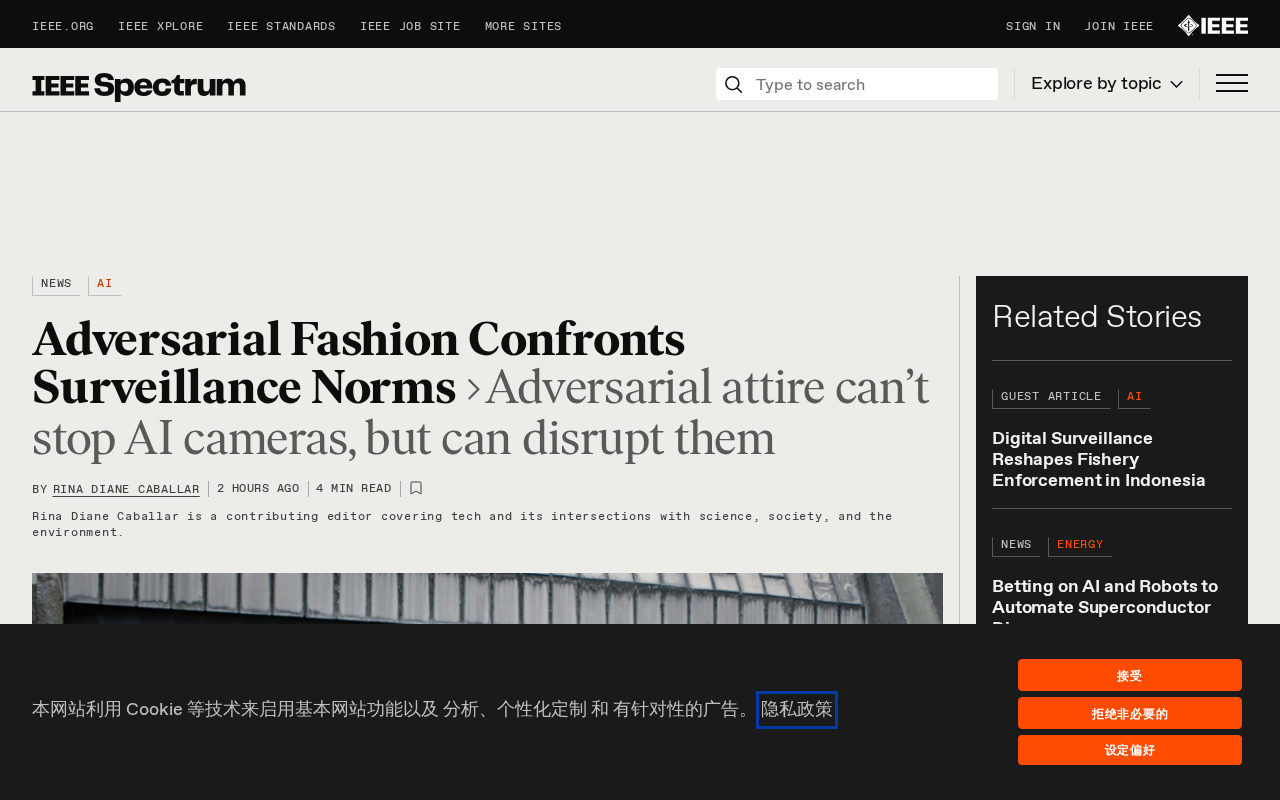
Adversarial fashion applies adversarial ML principles to wearable clothing to disrupt AI surveillance systems.
Adversarial Fashion translates machine learning research on adversarial examples into everyday wearables — clothing printed with fake license plates or disruptive textures that inject noise into facial and license plate recognition systems. Drawing on the Bentham-Foucault Panopticon metaphor, it serves both as a technical countermeasure to algorithmic surveillance and a visible act of advocacy for privacy. Its practical value is limited, however: recognition algorithms continuously evolve, adversarial patterns quickly lose effectiveness, and legal risks exist in some jurisdictions. Its true significance lies in making surveillance boundaries and privacy rights visible and discussable, rather than offering a genuine technical solution.
When Clothing Becomes an Anti-Surveillance Weapon
In an era of pervasive urban cameras, license plate recognition, and facial recognition technology, a concept known as "Adversarial Fashion" has begun entering public consciousness. The core idea is straightforward: by printing specific patterns on clothing and accessories, individuals can actively disrupt machine vision systems, carving out a small measure of privacy within an invisible "AI Panopticon."
A Hacker News discussion titled Adversarial Fashion Makes a Statement on AI Panopticon drew community attention. While modest in scale (22 upvotes, 10 comments), it touched on an increasingly urgent question — in a world of ubiquitous algorithmic surveillance, do ordinary people have any room to push back?
What Is "Adversarial Fashion"?
The word "adversarial" comes from adversarial examples research in machine learning. Researchers have long known that adding carefully crafted perturbations to an image — imperceptible to the human eye — can cause a neural network to make wildly incorrect predictions. Adversarial fashion is, essentially, wearing that research.
The most iconic example is clothing printed with fake license plate patterns. When an Automatic License Plate Recognition (ALPR) system scans a pedestrian wearing such a garment, it may misidentify the printed pattern as a real license plate, injecting large volumes of invalid, fabricated records into surveillance databases. This isn't about becoming "invisible" — it's about flooding the system with noise to make its data unreliable.
Beyond license plate patterns, there are also patterned glasses designed to confuse facial recognition, and scarves and jackets printed with adversarial textures. The shared goal: make machines "see wrong" or fail to see at all.
The concept of adversarial examples was systematically introduced by Szegedy et al. in 2013. They discovered that applying near-invisible pixel-level perturbations to an image could cause deep neural networks to output incorrect classifications with high confidence — for example, misidentifying a panda as a gibbon. This vulnerability stems from the nonlinear, high-dimensional decision boundaries of deep learning models, which differ fundamentally from human visual perception. Research later expanded into "physical-world adversarial examples": printing specific textures onto objects, or wearing adversarial eyeglass frames, can reproduce the deception effect in images captured by real cameras. ALPR systems are particularly susceptible to pattern-based interference due to their fixed character segmentation and OCR pipelines, making them one of the most accessible attack surfaces for adversarial fashion.
The Panopticon Metaphor
The "Panopticon" in the title comes from philosopher Jeremy Bentham's design for a prison, later reinterpreted by Foucault as a defining metaphor for modern surveillance society — because inmates can never know when they are being watched, they are forced into constant self-regulation. AI surveillance transforms this metaphor from an architectural structure into an omnipresent algorithmic network.
Beyond its technical dimension, adversarial fashion carries meaning as a statement. It expresses resistance to ubiquitous surveillance in a visible, wearable form, translating abstract privacy debates into street-level performance art. This is the deeper significance behind the original post's emphasis on "makes a statement."
The Panopticon was designed by British utilitarian philosopher Jeremy Bentham in the late 18th century: inmates are placed in a circular cell block, where a guard in a central tower can observe anyone at any time, while prisoners cannot tell whether they are being watched at any given moment — thereby internalizing external surveillance as self-discipline. French thinker Michel Foucault, in Discipline and Punish (1975), elevated this into the central mechanism of modern power: power no longer requires constant pressure; it only needs to create the perception that one might be seen at any moment. AI surveillance systems align with this logic at a technical level — large-scale camera networks paired with automated analysis drive the marginal cost of surveillance toward zero, while those being surveilled can neither sense when it is occurring nor easily opt out. Adversarial fashion is an embodied response to precisely this asymmetric power structure.
Effectiveness and Limitations
We should be clear-eyed: these approaches carry far more symbolic weight than practical effectiveness. Surveillance algorithms are continuously updated, and defenses against known adversarial patterns are evolving in parallel. A garment that fools a recognition system today may become completely ineffective after the next model update. This is fundamentally an ongoing arms race, and individuals are unlikely to maintain an advantage for long.
Additionally, in some jurisdictions, deliberately injecting false license plate data into law enforcement systems may cross legal boundaries. Users must weigh the value of making a statement against potential legal risks.
From a tech-ethics perspective, the real value of adversarial fashion may not lie in whether it successfully evades surveillance, but in the intuitive reminder it offers: we live in an environment under constant algorithmic observation, and public discourse around privacy rights and the boundaries of surveillance remains woefully insufficient.
Questions Worth Reflecting On
Adversarial fashion brings technological resistance into everyday life — but it also exposes the helplessness of individuals in the face of systemic surveillance. A piece of clothing cannot change the surveillance infrastructure itself. Real change still depends on legislation, industry standards, and the establishment of technical transparency.
For readers concerned with AI ethics and privacy protection, this phenomenon offers a valuable observation window: when technological power is highly concentrated, what forms does grassroots creative resistance take — and how far can it go?
Related articles

Xi Jinping Proposes Open Source AI Cooperation Zone Among BRICS Nations
Xi Jinping proposed an open source AI cooperation zone at the BRICS summit. Analyzing the strategic intent, open source rationale, and global AI governance implications.
Swift-Qwen3.8-27B: 58% Fewer Thinking Tokens, Nearly 2x Faster Inference
UkisAI open-sources Swift-Qwen3.8-27B, cutting thinking tokens by 58% and boosting inference speed 1.95x via overthinking token penalties and on-policy distillation — with under 1% accuracy loss.

Netflix Partners with Sega: Crazy Taxi Movie and New Sonic Animated Series on the Way
Netflix announces three Sega game adaptations: a Crazy Taxi movie, a new Sonic animated series with edge, and a live-action film based on RGG Studio's Stranger Than Heaven.