AegisFlow: Multi-Agent Framework Enables Self-Healing Data Pipelines, Reduces MTTR by 98%

AegisFlow uses multi-agent AI to auto-generate code patches for broken data pipelines, cutting MTTR by 98%.
Traditional data pipelines break easily from upstream schema changes, API drift, or DOM modifications, and existing observability tools only alert — leaving repair to humans and keeping MTTR high. AegisFlow is a multi-agent Agentic AI framework where a Watchdog agent monitors pipelines in real time and a Repair agent uses an LLM to automatically generate and deploy code patches, closing the detection-to-repair loop. Its core innovation, Parallel Shadow Patching, validates patches in a digital twin environment before production deployment, significantly reducing automation risk. Experiments show MTTR dropped from 170 minutes to 3.2 minutes (98.1% improvement), with an overall patch success rate of 92% — 98% for punctuation drift and 85% for Shadow DOM scenarios. The framework integrates as a plugin into existing orchestration systems with minimal disruption.
Why Fragile Data Pipelines Always Break at 2 AM
Data engineers have probably all lived through some version of this nightmare: a 3 AM alert fires because an upstream API quietly renamed a field, or a scraped webpage changed its DOM structure, and the entire data pipeline collapses. A new paper on arXiv (arXiv:2610.06971) puts the old problem plainly — traditional data pipelines are inherently brittle. Schema drift, API contract changes, and website DOM modifications can all bring them to a halt.
What makes it worse is that existing observability tools do exactly one thing: alert. They hand the problem off to human engineers to resolve, resulting in persistently high mean time to recovery (MTTR) and an endless cycle of "firefighting" fatigue. More alerts just make people more anxious — they don't fix anything on their own.
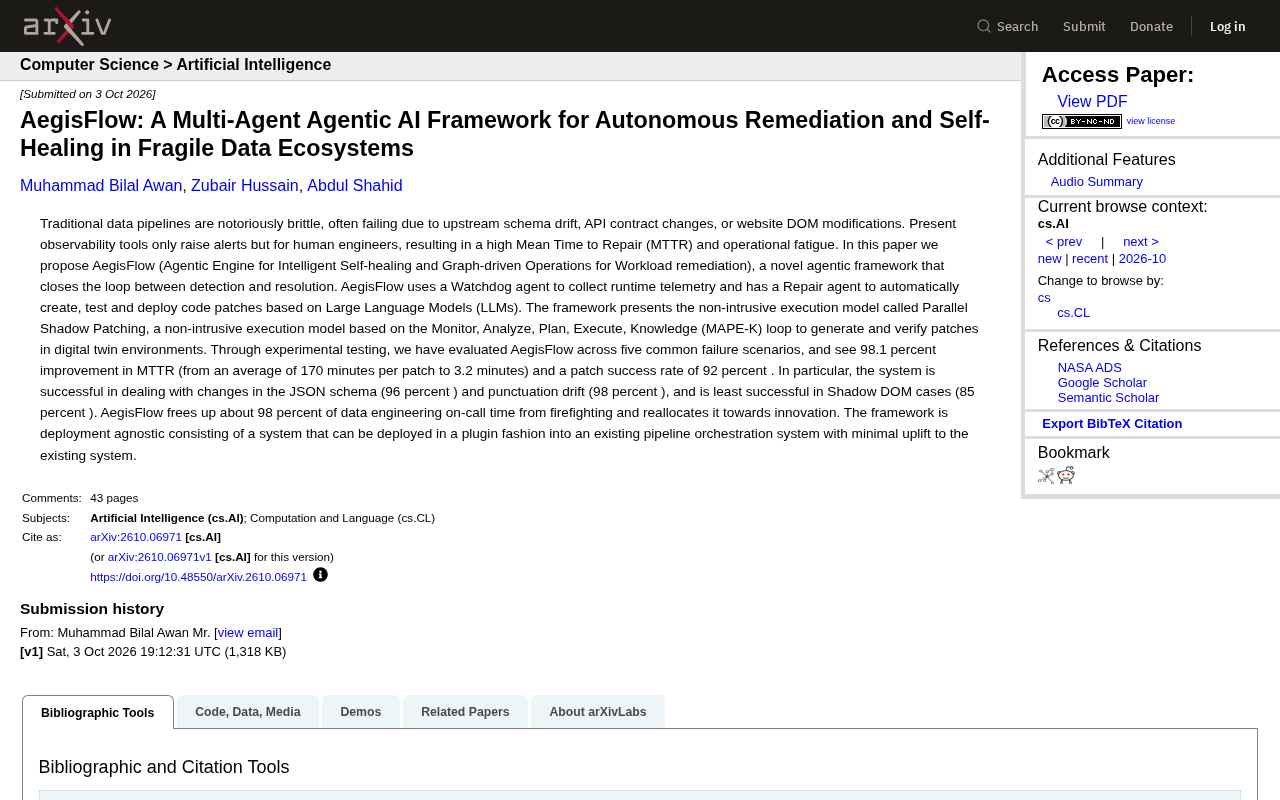
What AegisFlow sets out to change is precisely this broken link of "alert-only, no repair." Its full name is Agentic Engine for Intelligent Self-healing and Graph-driven Operations for Workload remediation, and its core goal is to truly close the loop between detection and remediation.
How AegisFlow Closes the Detection-to-Repair Loop
AegisFlow is fundamentally a multi-agent Agentic AI framework, where two key roles collaborate to achieve self-healing.
Two Core Agents: Watchdog and Repair
The first is the Watchdog agent, which collects runtime telemetry data and monitors pipeline health in real time. The second is the Repair agent, which uses a large language model (LLM) to automatically generate, test, and deploy code patches. In other words, when a pipeline errors out due to an upstream change, the system doesn't just fire a message to an on-call engineer — it directly attempts to write a fix and deploy it.
This mechanism is built on the classic MAPE-K loop — Monitor, Analyze, Plan, Execute, Knowledge. This is a mature self-management architecture in the field of autonomic computing. AegisFlow combines it with the code generation capabilities of LLMs, giving patch generation and validation a structured decision-making workflow.
The MAPE-K loop was formally introduced by IBM in 2003 as part of its Autonomic Computing research and remains the canonical reference architecture for self-managing systems. The four execution phases are tightly coupled: Monitor collects raw sensor data and runtime metrics from the system; Analyze models and correlates the data to determine whether an anomaly exists; Plan formulates an action strategy based on the analysis, deciding "what to do"; Execute carries out the strategy and feeds back results. The Knowledge layer, running throughout, is a shared knowledge base storing system topology, historical failure patterns, and remediation rules that each phase can query. The key to AegisFlow's integration of this framework with LLMs lies in the Plan phase: in traditional MAPE-K implementations, planning relies on manually predefined rule sets, whereas introducing an LLM allows the system to improvise repair strategies for novel failure types it has never encountered before, breaking through the coverage limits of static rule libraries.
Parallel Shadow Patching: Validate in a Digital Twin Before Going Live
The most noteworthy design in the paper is a non-intrusive execution model called Parallel Shadow Patching. The idea is straightforward: rather than making changes directly in the production environment, patches are generated and validated inside a digital twin environment.
This addresses the most worrying concern about automated repair — what if the AI-generated patch is itself wrong? By running the patch first in an isolated shadow environment to confirm it actually fixes the issue without introducing new failures, the system dramatically reduces the risk that automation introduces. This "shadow-validate first, production-deploy second" approach is the key to making self-healing systems viable in the real world.
The digital twin concept originated in industrial engineering for physical device simulation and has more recently been adopted in software engineering to mean a complete logical replica of a production system — including the same data structures, business logic, and dependencies — but with traffic and data fully isolated. In the data pipeline context, this means the shadow environment needs to replay real upstream data samples to genuinely evaluate patch effectiveness. The "parallel" in Parallel Shadow Patching means the original production pipeline continues running (even if it's broken), while the repair process proceeds in the shadow channel simultaneously — neither interfering with the other. This design avoids the dilemma of "taking downtime just to fix a bug" and prevents secondary failures from deploying inadequately validated patches. Similar approaches have precedents in financial systems' Blue-Green deployments and Netflix's chaos engineering practices; AegisFlow migrates this thinking into the context of validating AI-generated patches.
Experimental Results: MTTR Compressed from 170 Minutes to 3.2 Minutes
The paper evaluated AegisFlow across five common failure scenarios, with impressive results.
The headline metric is a 98.1% improvement in MTTR — average repair time per patch dropped from 170 minutes to 3.2 minutes. The overall patch success rate reached 92%, meaning the vast majority of automatically generated fixes were effective.
Breaking it down by scenario, performance was uneven:
- JSON schema changes: 96% success rate
- Punctuation drift: 98% success rate — the best performer
- Shadow DOM scenarios: 85% success rate — the weakest link
Shadow DOM being the trickiest case comes as no surprise — it involves encapsulated DOM structures within the browser, where parsing and locating changes is inherently more difficult, and the challenge of LLMs generating accurate patches in these scenarios is significantly higher. This honest disclosure of a weakness actually makes the overall evaluation more credible.
From an operational value standpoint, the paper claims AegisFlow can free roughly 98% of data engineering on-call time from firefighting, redirecting it toward innovative work. For teams long plagued by alert fatigue, this is a compelling promise.
Shadow DOM (Shadow Document Object Model) is a native browser encapsulation mechanism that allows components to hide their internal HTML structure, CSS styles, and JavaScript behavior within an isolated scope — external scripts and selectors cannot penetrate it by default. This mechanism is widely used in the Web Components standard, making pages built with modern frontend frameworks (such as Angular and Lit) highly hostile to traditional scrapers. When a website's core content is rendered inside a Shadow DOM, ordinary CSS selectors and XPath queries fail outright; you need specific APIs or a headless browser (like Playwright or Puppeteer) to access the content. This explains why AegisFlow performs weakest in Shadow DOM scenarios: the LLM must generate scraping code capable of crossing encapsulation boundaries, a significantly higher technical bar than handling simple JSON field renames or CSV delimiter changes.
Pluggable Deployment: Not Tied to Any Specific Orchestration System
Another practical advantage of AegisFlow is that it is deployment agnostic. The paper emphasizes that it can be integrated as a plugin into existing pipeline orchestration systems with minimal changes to what's already in place. This low-intrusion integration model is what determines whether it can move from the lab into real production environments — after all, no team wants to tear down and rebuild their entire data infrastructure just to adopt a self-healing tool.
Takeaway: Agentic AI Is Moving to the Operations Front Line
The AegisFlow paper illustrates a concrete direction for Agentic AI in data engineering operations: no longer satisfied with observability and alerting alone, but enabling multi-agent collaboration to complete the full cycle from detecting a problem to writing code that fixes it.
It's worth staying clear-eyed: these results come from the authors' own experimental environment. Whether the 92% patch success rate holds up in genuinely complex production pipelines — and how the security and compliance risks of automated deployment are managed — still requires much more real-world validation. But the Parallel Shadow Patching concept and the MAPE-K + LLM combination offer a valuable engineering paradigm for "self-healing data pipelines." As LLM coding capabilities continue to improve, efforts to push AI to the operational front line like this are likely to become increasingly common.
Related articles

Chain of Thought Isn't Just for AI: How Humans Can Use CoT to Improve Thinking Quality
Chain of Thought isn't just a prompt trick for large models. Starting from a Hacker News discussion, this article analyzes why CoT works for human thinking too, breaks down actionable ways to transfer it, and highlights the key differences between human CoT and machine CoT.
Cloudflare Teams Up with OpenAI: Closi…
Cloudflare Teams Up with OpenAI: Closing the Loop from Vulnerability Discovery to Defense with AI
Cloudflare uses OpenAI Daybreak to investigate security vulnerabilities and generate reviewable remediation plans, while developers use Codex to boost coding efficiency and quality.

Orca Multi-Agent Orchestration in Practice: A Guide to Parallel Collaboration with Claude and Codex
Orca is Stable AI's free open-source agent workbench supporting 34 agents like Claude Code and Codex in parallel. Learn its Git worktree isolation, multi-model orchestration, and mobile management.