After ElevenLabs' Latest Update, Should You Pick It or Retell for Your Voice AI Agent?
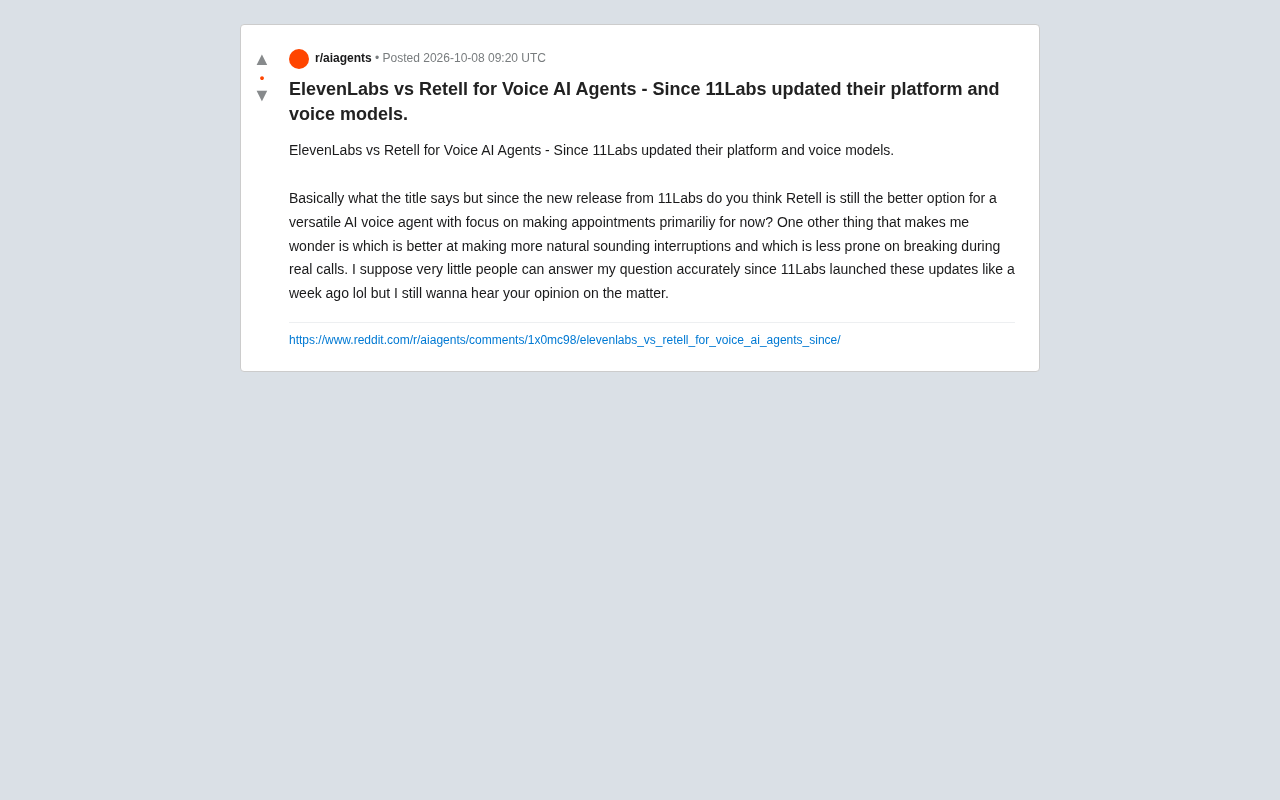
Developers revisit ElevenLabs vs. Retell for voice agents after a major update, focusing on interruption handling and call stability.
A developer building a voice agent for appointment scheduling sparked a representative debate on Reddit: after ElevenLabs' latest voice model and platform update, is Retell still the better choice for agent orchestration? The article distills two critical production metrics — natural interruption handling and real-call stability — and highlights the fundamental positioning difference: ElevenLabs excels at TTS quality while Retell focuses on agent orchestration and phone integration. With limited real-world data on the new update, the recommendation is to run your own comparative tests using the same scenario scripts, focusing on end-to-end latency, drop rates, and stress performance rather than relying on forum opinions.
A Real-World Platform Selection Dilemma
Platform selection is an unavoidable topic in developer communities building Voice AI Agents. A recent Reddit post raised a highly representative question: after ElevenLabs (11Labs) just updated its platform and voice models, is Retell still the better choice for building a general-purpose voice agent?
The developer's core requirement was clear — they wanted to build a voice agent primarily for making appointments. This type of application demands exceptional voice naturalness, conversational fluency, and call stability. In other words, this isn't a toy-level demo; it's a production-grade application that needs to work reliably in real phone calls.
Notably, the person asking openly admitted that very few people could accurately answer the question, since ElevenLabs' update had only gone live "about a week ago." This reflects a genuine pain point in the voice AI space — technology iterates faster than real-world evaluation data can keep up.
Two Core Concerns: Natural Interruptions and Call Stability
From this developer's question, two critical technical metrics emerge that matter most for deploying voice agents in production.
Natural Interruption Handling
Real human conversation is never a rigid back-and-forth exchange. People interrupt each other, interject, and start responding before the other person finishes. A great voice agent must handle interruptions naturally — stopping promptly when a user cuts in, and responding at the right moment rather than mechanically waiting for the speaker to fully finish.
The developer specifically asked which platform does better at "creating more natural interruptions" — a pursuit of genuine conversational feel. The quality of interruption handling is often what separates a voice agent that merely "works" from one that truly feels good to use.
Interruption handling relies technically on End-of-Speech Detection (VAD — Voice Activity Detection) and full-duplex communication capabilities. Traditional voice systems often use half-duplex mode — not accepting user input while the system is speaking — which was acceptable in the IVR era but makes AI agents feel mechanical and sluggish. True interruption handling requires the system to continuously listen to user input even while "speaking," immediately cutting off its own output and switching to listen mode the moment it detects the user starting to speak. This process is extremely sensitive to audio stream processing latency — if interruption response is slower than 300 milliseconds, users will perceive a noticeable "lag." The system also needs to distinguish genuine interruption intent from background noise, speech pauses, and other false triggers, which sets a higher bar for noise suppression and semantic understanding.
Stability During Real Calls
The other repeatedly emphasized concern is: which platform is less prone to "breaking" during real calls. A system that runs smoothly in a demo environment can face severe stability challenges once it enters a real telephone network — dealing with network latency variation, audio quality fluctuations, unexpected silences, or noise.
For appointment-based use cases, a dropped call or system error mid-conversation could mean a lost booking or a lost customer. This is why call stability often carries more weight in production environments than how "pleasant" the voice sounds.
The Variable Introduced by ElevenLabs' Update
ElevenLabs has long been recognized for its high-quality text-to-speech (TTS) capabilities. This latest update to its platform and voice models likely pushes naturalness and expressiveness even closer to real human speech. For developers who previously chose Retell due to ElevenLabs' weaker conversation orchestration capabilities, this update genuinely warrants a re-evaluation.
However, it's important to recognize that a voice agent is an end-to-end systems engineering challenge, not just a matter of TTS quality. It involves ASR (automatic speech recognition), dialogue management, latency control, interruption detection, and phone network integration. No matter how impressive ElevenLabs' voice models become, the orchestration capabilities, tool-calling support, and phone system integration stability of the overall agent platform are what ultimately determine whether it can handle an "appointment agent" at production scale.
Retell, as a platform focused on voice agent orchestration, typically demonstrates its advantages in dialogue flow management, low-latency response, and engineering optimization for call stability. The two products have meaningfully different positioning: one leans toward being a foundational voice capability provider, the other toward a higher-level agent orchestration and integration solution.
A voice agent's tech stack typically consists of three core modules in sequence: ASR (Automatic Speech Recognition) converts user speech to text, LLM (Large Language Model) understands intent and generates response text, and TTS (Text-to-Speech) synthesizes the response into audio output. The cumulative latency across these three stages forms the "response delay" perceived by users. ElevenLabs is fundamentally a TTS capability provider, with its core advantage in the naturalness and emotional expressiveness of synthesized speech. Platforms like Retell add a conversation orchestration layer on top of all three modules, managing state machines, calling external tools (such as calendar APIs), handling interruption logic, and managing integration with PSTN phone networks or VoIP. Therefore, platform selection should never be based solely on TTS audio quality — overall pipeline latency optimization and engineering integration capability matter equally.
How to Make the Right Selection Decision
Since this is a recently released update, the community currently lacks large-scale real-world comparison data. For this type of "freshly shipped" technology decision, a more pragmatic approach is:
- Build your own small-scale comparative test: Use the same appointment scenario script to build prototypes on both platforms, make a batch of real calls, and compare. Focus on recording the naturalness of interruption responses, latency performance, and call drop rates.
- Pay close attention to end-to-end latency: Appointment conversations have high real-time requirements. The time from when the user finishes speaking to when the agent begins responding (typically expected to stay within a few hundred milliseconds) is a critical experience metric.
- Stress-test for stability: Simulate edge cases like weak network conditions, extended call durations, and frequent interruptions to observe which system is more prone to failures under stress.
- Calculate total cost: ElevenLabs' high-quality voice typically comes with higher per-call costs — factor in total cost of ownership relative to your call volume.
For a general-purpose voice agent focused on appointment scenarios, if your primary requirements are conversation orchestration and call stability, a mature agent platform may still hold an engineering advantage. But if voice naturalness is your biggest differentiator and your team has the capability to handle conversation orchestration independently, ElevenLabs' updated capabilities deserve serious consideration.
Conclusion
What makes this Reddit post valuable is that it touches on the most genuine tension in deploying voice AI in the real world — the pace of technology updates far outstrips the pace of real-world validation. When facing a platform like ElevenLabs that has just shipped a new iteration, the most reliable answer rarely comes from forum discussions — it comes from the comparative test the developer runs themselves. In a domain as experience-dependent as voice agents, nothing is more convincing than real call data.
Related articles

Workbuddy for Absolute Beginners: How a Desktop AI Agent Fits Into Real Workflows
A beginner's guide to the Workbuddy desktop AI agent: installation, claiming credits, file management, and building automated workflows—compared with CodeX for fit and cost, helping professionals shift from AI question-askers to AI managers.

OpenAI's New Agent Stack: Computer Use, Decisions API, and Ultra-Fast Workflows
OpenAI Dev Day unveiled a new agent stack: Computer Use outperforms humans, Decisions API delivers ultra-low-latency classification via Luna, Agents API opens the same Computer Use capabilities, and GPT-6.1 Sol costs only one-seventh of Astra. Core updates, benchmark data, and developer insights.

Liang Wenfeng Open-Sources DeepInfo Inference Framework, Takes On U.S. Ban
DeepSeek open-sources its DeepInfo inference framework after its models, featuring GPU/CPU cross-pipelining, small-model prediction with large-model verification, and full Huawei Ascend and NVIDIA chip support—facing the U.S. federal ban head-on. This article analyzes its significance for AI deployment and open-source strategy.