After Jensen Huang's Exit, Hugging Face CEO Vows to Keep Fighting for Open-Source AI
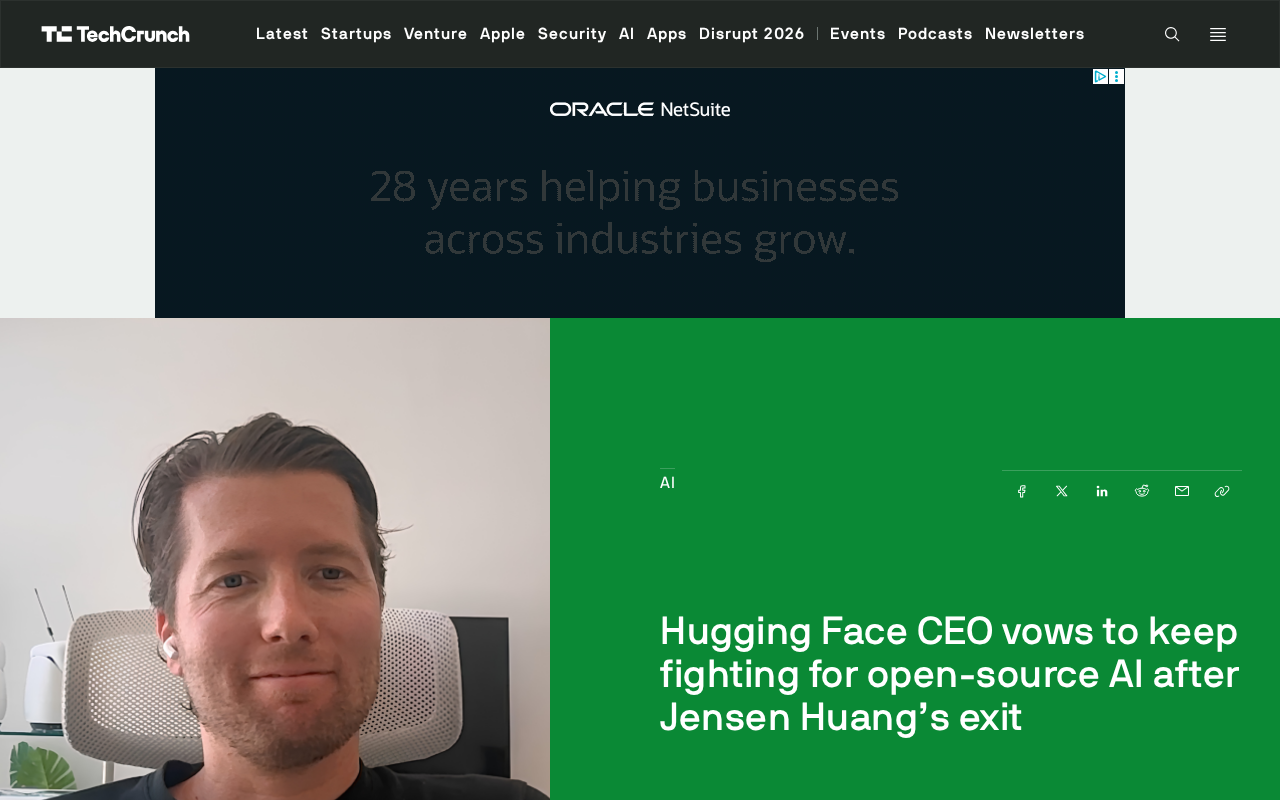
Hugging Face CEO vows to keep fighting for open-source AI after Jensen Huang's exit, sparking speculation about NVIDIA's $12.9 billion acquisition.
Hugging Face's CEO recently made a public commitment to continue fighting for open-source AI. The statement came after NVIDIA CEO Jensen Huang stepped down from a key position, immediately sparking widespread speculation about NVIDIA's $12.9 billion acquisition. The article notes that Huang's exit has unsettled the open-source community, and as the de facto hub for hosting and collaborating on open-source AI models, Hugging Face's leadership voice is seen as a firm endorsement of the open ecosystem. Although the original article did not disclose the specific target or terms of the deal, the overlapping timing has led observers to connect the two events. The long-standing tension between open-source and closed-source commercial routes has once again become a focus, and whether Huang's exit will affect NVIDIA's level of support for open-source projects is a variable worth watching.
Shockwaves Through the Open AI Camp
Hugging Face's CEO recently made a public commitment to continue fighting for open-source AI. The statement came after NVIDIA CEO Jensen Huang stepped down from a key position, immediately sparking widespread speculation about NVIDIA's $12.9 billion acquisition.
According to RSS sources, Jensen Huang's exit has unsettled the open-source community. As the de facto hub for hosting and collaborating on open-source AI models, Hugging Face's leadership voice is seen as a firm endorsement of the open ecosystem.

Cloud of Uncertainty Over the $12.9 Billion Acquisition
The source material notes that Jensen Huang's exit has prompted people to re-examine NVIDIA's $12.9 billion acquisition. Although the original article did not disclose the specific target or terms of the deal, the overlapping timing is enough for observers to connect the two events.
In recent years, NVIDIA has been continuously expanding its footprint beyond AI infrastructure, with frequent acquisition moves. As the soul of the company, Jensen Huang's personal comings and goings are often interpreted as a strategic bellwether. Whether this exit signals a shift in NVIDIA's attitude toward the open-source route remains officially undetermined.
Concerns in the Open-Source Community
Supporters of open-source AI worry that personnel changes at leading companies could affect the flow of resources. The Hugging Face CEO's vow is, to some extent, an effort to reassure the community—open models will not lose momentum because of the departure of an individual executive.
NVIDIA has frequently made acquisitions beyond AI infrastructure in recent years, one of the largest being its attempted acquisition of Arm, announced in 2020 and completed in 2022 (ultimately failed due to regulatory resistance, at approximately $40 billion). The $12.9 billion acquisition mentioned in the article, judging by its magnitude, is not a large-scale merger of a chip design company by NVIDIA, but more likely points to targets related to AI software, data platforms, or the model ecosystem. Understanding this helps assess: only if the deal involves open-source tools or model hosting platforms could Jensen Huang's personnel change be directly tied to the interests of the open-source community.
Hugging Face is the core hosting platform for open-source AI models and datasets today, hosting hundreds of thousands of open models and providing open-source libraries such as Transformers and Diffusers. It is widely regarded as the "GitHub" of open-source AI. Its CEO's statements carry bellwether significance in the community, because the platform's policies and resource allocation directly affect a large number of developers and small-to-medium teams.
The core disagreement between open-source AI and closed-source commercial routes lies in the accessibility of model weights and usage restrictions. The open-source camp advocates that model weights, training code, and datasets should be made public, allowing free use, modification, and redistribution; the closed-source camp primarily relies on API calls and commercial licenses, emphasizing safety, controllability, and commercial returns. The reason personnel changes at leading companies trigger concern is that resource flows tend to follow strategic priorities: if senior executives favor closed-source monetization, investment in open-source projects, open datasets, and community tools may shrink.
Hugging Face's role is not just a hosting platform; through open-source libraries, evaluation leaderboards, and community collaboration, it also influences model selection standards. Its CEO's public commitment is essentially sending a signal to developers and enterprise users: the public infrastructure of the open ecosystem will not be interrupted by the strategic wavering of a single vendor.
The Long Tug-of-War Between Open and Closed Source
This controversy once again brings the tension between open-source AI and closed-source commercial routes to the fore. Hugging Face has long played the role of a distribution center for open-source models, while NVIDIA occupies a core position in compute supply. Their ecological niches differ, and their interests are not entirely aligned.
Whether Jensen Huang's exit will affect NVIDIA's level of support for open-source projects is a variable worth watching going forward. The Hugging Face CEO's choice to speak out at this moment shows that the open-source camp does not intend to wait passively.
Editorial Observation
The core information in this news item is limited. The original article only provides the Hugging Face CEO's statement, the fact of Jensen Huang's exit, and the connection to the $12.9 billion acquisition. Deal details, the specific position exited, and subsequent impacts are not elaborated. For readers following the direction of open-source AI, it is advisable to continue tracking NVIDIA's official announcements and Hugging Face's follow-up actions.
Related articles

Frontier AI Risk Management: Full-Pipeline Practices from Training to Deployment
OpenAI outlines a frontier AI risk management framework: from training-stage model alignment to deployment-stage sandboxing and blocking safeguards, plus post-deployment monitoring—a layered risk control system across the model lifecycle.
DaisyRose-27B: 1,200-Task RL Boosts Qwen3.8 from 5.6% to 12% on Terminal-Bench 4.1
DaisyRose-27B uses RL training on 1,200 tasks to boost Qwen3.8's Terminal-Bench 4.1 score from 5.6% to 12%, showing lightweight RL can more than double terminal task performance.
Show HN: Having Fun with Bicycle Trainers and Web APIs
A Show HN project on Hacker News, Fun with bicycle trainers and web APIs, explores combining bicycle trainers with Web APIs. This article analyzes its possible technical directions and significance.