After Show HN, My Inbox Was Flooded with Automated Sales Emails

After a Show HN post, your inbox floods with automated sales emails—a hidden cost of public exposure.
The article discusses an overlooked side effect: after posting a Show HN on Hacker News, developers receive many automated sales emails, mostly templated pitches for SEO and lead-gen tools, spiking after launch. Senders target intent-clear developers with products and growth needs, while public posts and landing pages lower scraping costs. The community sees public exposure and contact info as inevitably bound, suggesting alias emails, forms instead of exposed emails, archiving templated mail, and treating it as the 'tax' of promotion.
An Unexpected Side Effect: Show HN Brings More Than Traffic
Posting a Show HN on Hacker News is a standard move for many indie developers and early-stage teams looking to get initial exposure. The post itself brings attention, comments, and potential users—but one developer shared a side effect in the community that's easy to overlook: after a Show HN post goes live, your inbox gets flooded with automated sales emails.
This discussion received 27 upvotes and 18 comments on Hacker News, showing it struck a chord with many people's shared experience. Compared to methodology questions like "how to hit the front page," this phenomenon is more of an "after-sales problem" that comes after publishing—yet it genuinely affects every product builder who makes their contact info public.
Show HN is an established posting format in the Hacker News community: the title starts with "Show HN:" and the content points to a product, tool, or experimental project you've just built, with the goal of showing it to the community and getting feedback. Unlike regular news link posts, it emphasizes "I made this thing, please take a look." Since Hacker News readers are primarily engineers, entrepreneurs, and early-stage tech professionals, Show HN has long been viewed as a low-cost channel for getting your first batch of seed users and real technical feedback. And precisely because visitors are highly concentrated and intent-driven, this section not only attracts potential users but also service providers hoping to reach developers.
What These Emails Look Like
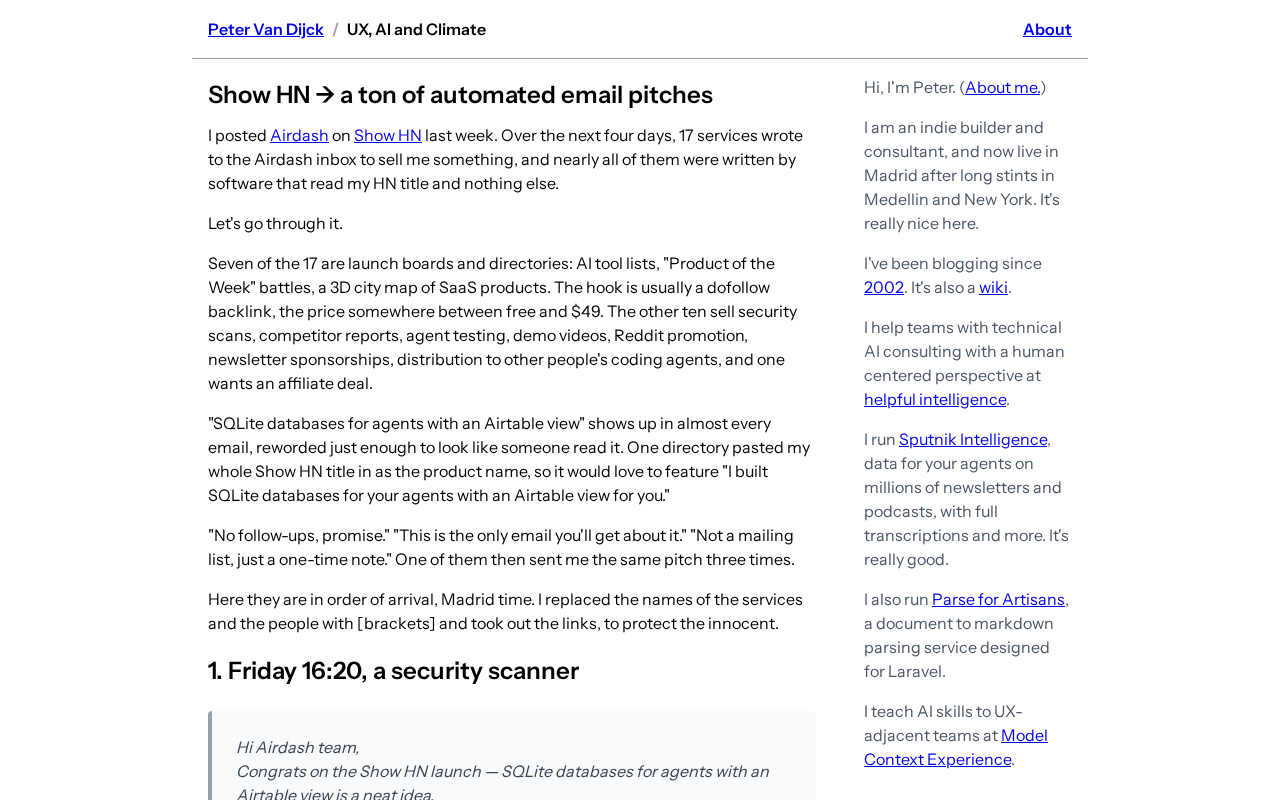
According to the original post, these emails don't come from genuinely interested users but are automated product pitches: some sell SEO services, some sell lead-generation tools, and others use templated language saying "I saw your project and think it has great potential." Their common traits are high similarity, lack of specific understanding about the project itself, and a clear uptick in sending frequency after a Show HN post.
Developers in the comments added similar observations: once your project gains visibility on public channels, your email address becomes a resource that can be bulk-scraped and contacted. The logic behind this isn't complicated—Show HN pages are public, posters often leave contact info in the post or on the project homepage, and automated tools collect this information.
Why Automated Pitches Target Show HN
The Poster Profile Is Too Clear
Show HN participants are typically developers who just launched a product and are looking for early users. To pitch senders, this is an extremely intent-clear group: they have a product, possible budget, and growth needs. Compared to aimless mass mailing, targeted scraping of Show HN posts offers much greater imagined conversion potential.
Public Information Lowers Outreach Costs
The posts themselves are public, project links often point to landing pages, and landing pages commonly feature contact emails or forms. Automated tools have enough material to generate seemingly "personalized" emails—for example, embedding the project name in the subject line or quoting a line from the project description.
Lead scraping is a common technique behind these sales emails: programs automatically crawl public web pages, extract email addresses, company names, project keywords, and other information, then feed it into sales lead databases. Compared to early simple regex matching, today's tools also scrape page titles and descriptions to insert "personalization" fields into emails, creating the illusion that they're not mass mailings. Since Show HN posts and project landing pages are fully public and accessible without login, scraping costs are extremely low with virtually no technical barrier. This also explains why posters experience not sporadic harassment but a dense influx of templated emails in a short period.
What This Means for Indie Developers
Judging from reactions in the comments, most people's attitude is "annoying but unavoidable." This reflects a reality: public exposure and public contact info are almost always bound together. You want potential users to find you, which means pitch senders can find you too.
What's worth considering is the energy cost. The first few days after launch should be the most valuable window for user feedback. If a lot of time is spent filtering and ignoring sales emails, the actual product iteration pace gets slowed down.
Some Actionable Coping Strategies
Ideas that emerged in the community discussion can roughly be grouped into a few categories: use a dedicated project email or alias email to isolate public contact info from your personal main inbox; use a form on the landing page instead of directly exposing your email; and directly archive obviously templated emails without investing energy in replying. None of these approaches can eradicate the problem, but they can keep the disturbance within manageable bounds.
Another angle mentioned is mindset adjustment: treat these emails as the "tax" of public exposure—no need to respond to each one, and no need to develop an aversion to public promotion because of them.
Email alias is a low-cost solution repeatedly mentioned in the community. The approach is not to put your main email directly on public pages, but to generate a separate address for each project or each public channel, with emails forwarded to your main inbox. Once an alias starts receiving a lot of spam, you can disable it or change its rules independently without affecting other communications. Common implementations include Gmail's "+suffix" addresses, catch-all forwarding on domain emails, and services like Fastmail and SimpleLogin that offer alias management features. For indie developers, separating "project public email" from "personal main email" from the start is much less hassle than cleaning up afterward.
Conclusion
Show HN is still a publishing action worth doing, but it brings more than just traffic and feedback. The phenomenon the original post pointed out in one sentence, combined with the resonance in the comments, shows this is a widespread but rarely formally discussed cost. For developers preparing to launch a product, having an email isolation strategy ready in advance is probably more worthwhile than scrambling after publishing.
One-line Summary
After a Show HN post, your inbox gets flooded with automated sales emails—a hidden cost of public exposure.
Paragraph Summary
The article discusses an easily overlooked side effect: after posting a Show HN on Hacker News, developers' inboxes receive a large number of automated sales emails, mostly templated promotions for SEO and lead-generation tools, with sending frequency rising noticeably after launch. The author analyzes that pitch senders target an intent-clear group of developers—those with a product, possible budget, and growth needs—while public posts and landing pages greatly lower scraping and outreach costs. The comments generally agree that public exposure and public contact info are almost inevitably bound together and hard to eradicate. Community coping strategies include using alias emails, replacing direct email exposure with forms, directly archiving templated emails, and treating this interference as the "tax" of public promotion—no need to respond to each one.
Related articles

Abnormal Error Rate Spike in Claude Mythos 5.2 and Fable 5.2
Claude Mythos 5.2 and Claude Fable 5.2 show an abnormal spike in request error rates, marked as investigating on the official status page. This article covers the incident overview, practical impact on developers, and recommended responses.

ReAct Runtime Context Trimming: Why Claude Code Acts at 70%
A deep dive into ReAct runtime context trimming: why Claude Code compresses at ~70% usage, why tool calls dominate, why messages must be dropped in pairs, and why codebases don't need RAG.

AI Agent vs LLM: How Cursor and Claude Code Actually Work
An in-depth analysis of the essential difference between AI Agents and LLMs: LLMs generate code suggestions, while Agents modify files and run tests via tool calls. Using a Spring Boot bug fix as an example, it breaks down the workflows, permission control, and verification mechanisms of Cursor and Claude Code.