After the Prototype: Two Indie Developers on Real-World Product Growth

Two indie developers prove that shipping is just the start — growth and business validation are the real challenge.
This article centers on two indie developers from Friday Showcase, exploring what comes after prototype validation. Austin Eckman integrates Meta ads, conversion funnels, and A/B testing entirely within Replit, using a "full-stack growth" approach to cut tooling overhead. Andy Liu, starting with zero technical experience, quit his consulting job and shipped HuHuu to the App Store within months — proof that AI-assisted coding tools have meaningfully lowered the bar for non-technical founders. Together, both cases point to a clear shift: as building costs fall, the scarce skills are no longer about shipping, but about acquiring users, driving conversion, and validating willingness to pay.
When the Prototype Actually Works
For many products, the story ends at "the prototype is functional." But the real challenge begins precisely after prototype validation — how to acquire users, how to validate willingness to pay, and how to turn a working demo into a sustainable business. In the latest Friday Showcase, two indie developers shared their honest experiences navigating this phase.
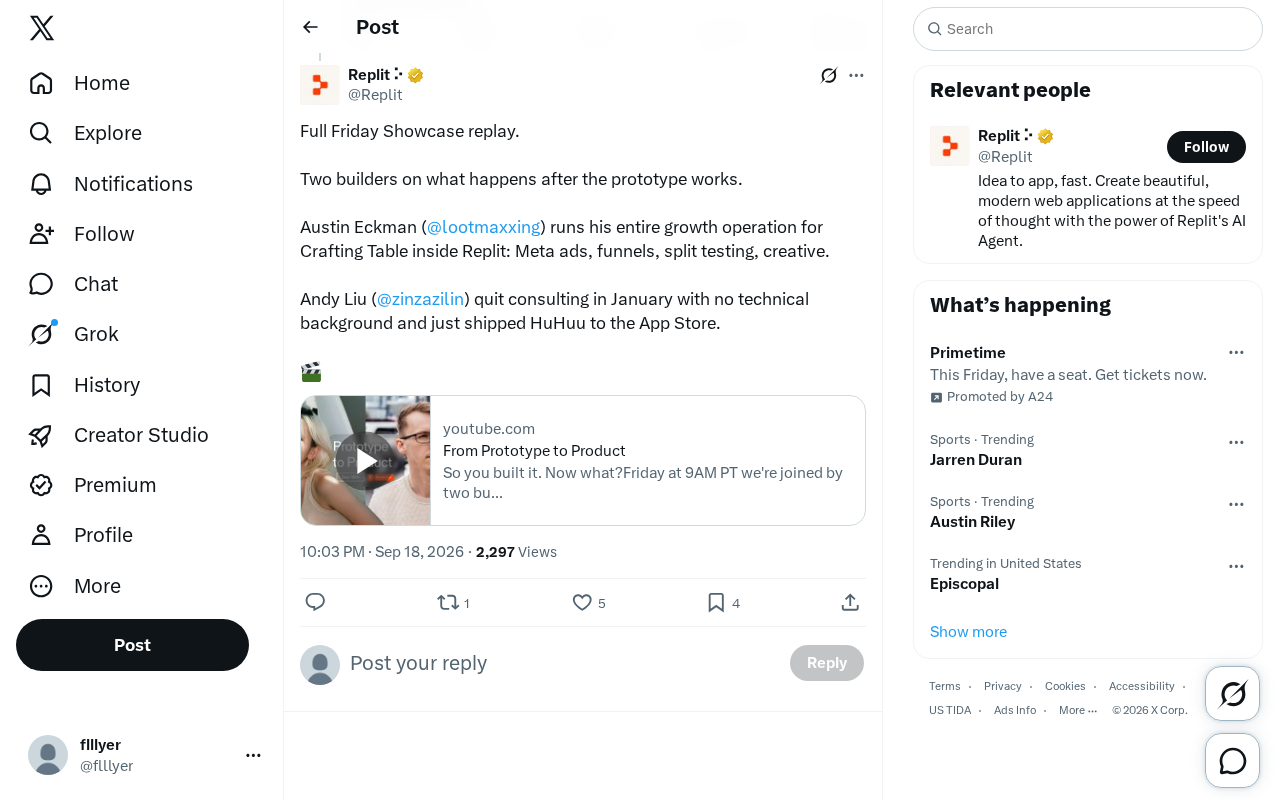
These two builders come from very different backgrounds, yet both point to the same truth: shipping the product is just the starting line — closing the business loop is what actually matters.
Austin Eckman: Building an Entire Growth Engine Inside Replit
Austin Eckman (@lootmaxxing) takes a notably systematic approach. For his product Crafting Table, he runs a complete growth operation — one built almost entirely within the Replit platform.
His growth stack covers several key components:
- Meta ad campaigns: driving traffic directly from social platforms
- Conversion funnels: guiding visitors step-by-step toward a target action
- Split testing: using data to validate which approach performs better
- Creative assets: continuously producing and iterating on ads and landing pages
The value of this approach is that indie developers no longer need to stitch together a fragmented toolchain. Traditionally, ad buying, landing page creation, and analytics are spread across multiple platforms, each with its own learning curve and maintenance overhead. Centralizing growth operations in a single programmable environment means faster experimentation and more flexible strategy adjustments. For solo or small-team projects, this "full-stack growth" mindset can dramatically lower the operational barrier.
Replit is a browser-based cloud coding environment that lets developers write, run, and deploy code directly in the browser — no local setup required. For indie developers, its core value is merging the "write code" and "run code" steps into a single interface with built-in deployment. By building his growth operations inside Replit, Austin can directly control ad logic, landing page content, and traffic-splitting rules through code, without relying on dedicated SaaS tools like Unbounce or Optimizely — which typically charge separately, silo data, and are difficult to integrate. This "manage growth with code" philosophy essentially transforms what would otherwise require multiple tool subscriptions and manual coordination into a version-controlled, automatable system.
Andy Liu: No Technical Background, Still Shipped to the App Store
If Austin's story is about "how to grow," Andy Liu's (@zinzazilin) experience answers a more fundamental question: Can someone with zero technical background actually build and ship a real product?
Andy quit his consulting job earlier this year with no prior technical experience. Starting from that point, he built HuHuu and successfully launched it on the App Store.
The significance of this story isn't the complexity of the product itself — it's what it demonstrates about how much today's tooling ecosystem has empowered non-technical founders. In the past, a consultant wanting to independently build and ship an app almost certainly faced a long programming learning curve or had to rely on an outsourced team. Now, with AI-assisted coding and low-barrier development platforms, the path from "I have an idea" to "live on the App Store" has been dramatically compressed.
Going from resignation to launch in just a few months speaks for itself — it's a testament to how mature the indie development ecosystem has become.
App Store submission requires developers to navigate Apple's review process: registering an Apple Developer account ($99/year), complying with App Store Review Guidelines, and handling code signing and certificate configuration. These steps were once a significant obstacle for non-technical founders. In recent years, AI-assisted coding tools like Cursor and GitHub Copilot, along with frameworks like Expo (React Native) that simplify cross-platform builds, have made it possible for people without Swift or Kotlin experience to describe requirements in natural language, have AI generate runnable code, and complete packaging and submission through templated workflows. Andy's journey validates this path — though it's worth noting that AI-generated code still requires human review for quality and security, and shipping is only the beginning; maintenance and iteration demand ongoing commitment.
The Common Signal Behind Both Stories
Looking at these two developers together, some broader trends emerge.
The barrier to entry keeps falling. Whether it's Andy shipping as a complete beginner or Austin integrating his entire growth operation into one environment, both confirm that today's development and operations tooling is placing work that once required specialized teams directly in the hands of individuals.
The focus has shifted from "can it be built" to "what happens after it's built." This is exactly the theme the Showcase highlights — "what happens after the prototype works." As the cost of building a product approaches zero, the truly scarce skills become distribution, growth, and business validation. Austin's conversion funnels and Andy's App Store launch are both, at their core, answers to this new set of questions.
The value of the indie developer community. Public, real-world case studies like these give other builders concrete, replicable reference points. Compared to abstract methodology, seeing how specific people made specific decisions under real constraints is almost always more useful.
"Business validation" in the indie development context typically refers to "willingness to pay" validation — confirming, at minimum cost, that target users will actually pay for your product before scaling acquisition. Common approaches include: pre-sale pages that collect credit card info without charging immediately, limited-time early-bird pricing to test price sensitivity, and conversion funnels like those Austin uses — tracking drop-off at every step from ad click to completed payment to quantify exactly where conversion breaks down. This phase often takes longer than development itself, because it depends on accumulating real user behavior data and can't be solved by optimizing code alone. For indie developers, entering this phase as early as possible — rather than obsessing over feature completeness — is often the key judgment call that keeps a project alive.
What This Means for Indie Developers
For developers currently in the trenches, these two cases offer a few practical takeaways:
First, don't treat "launch" as the finish line. A working prototype just means you've earned your entry ticket — the real competition plays out in acquisition and retention.
Second, embrace integrated tooling. Rather than context-switching between fragmented platforms, consolidate development, deployment, and growth into a unified workflow as much as possible, and save your energy for decisions that actually require judgment.
Third, a technical background is no longer a hard prerequisite. Andy's experience shows that determination plus the right tools is enough to carry a product all the way to launch.
The full replay from this Showcase is now available — interested developers can dig into it for more operational detail.
Related articles

Felix Rieseberg Personal Homepage
Felix Rieseberg's personal homepage sparks attention on Hacker News. This article covers the Slack engineer's technical background, the rise and fall of nativefier, and the value of a developer homepage as a tech calling card.

@ai-sdk/vue 3.0.306 Patch Release Syncs with [email protected] Update
@ai-sdk/vue 3.0.306 released, synced with [email protected]. A routine patch release for the Vercel AI SDK ecosystem with no public API changes; the Vue adapter layer stays version-aligned with the core package.

Gemini 4 Argon API Launches: The Era of Million-Token Output Begins
Google launches Gemini 4 Argon with sparse MoE architecture, up to 1M output tokens, and a 68.90% Vals Index score, available across API, AI Studio, and the Gemini app.