Aftermath Project Development: Learning and Collaboration in Full-Stack Practice

Developer shares the Aftermath full-stack project, emphasizing learning by doing through real challenges and collaboration.
A developer on Reddit shared their experience participating in the Aftermath project, describing how this development journey gave them genuine exposure to real-world software development rather than just completing tasks. The team's goal was to build a product that runs well and makes them proud, covering full-stack aspects including feature polishing, UX improvements, troubleshooting, and continuous optimization. The article notes that this learn-by-doing approach is particularly suited to teams with hackathon backgrounds, with unexpected challenges becoming learning opportunities that help members understand how software components fit together. The team's division of work involves frontend, backend, and full-stack collaboration, with emphasis on continuous improvement and user perspective rather than just getting features working. The original post indicates the project is still iterating, and the team remains optimistic about its future development.
A Development Journey of Learning Through Challenges
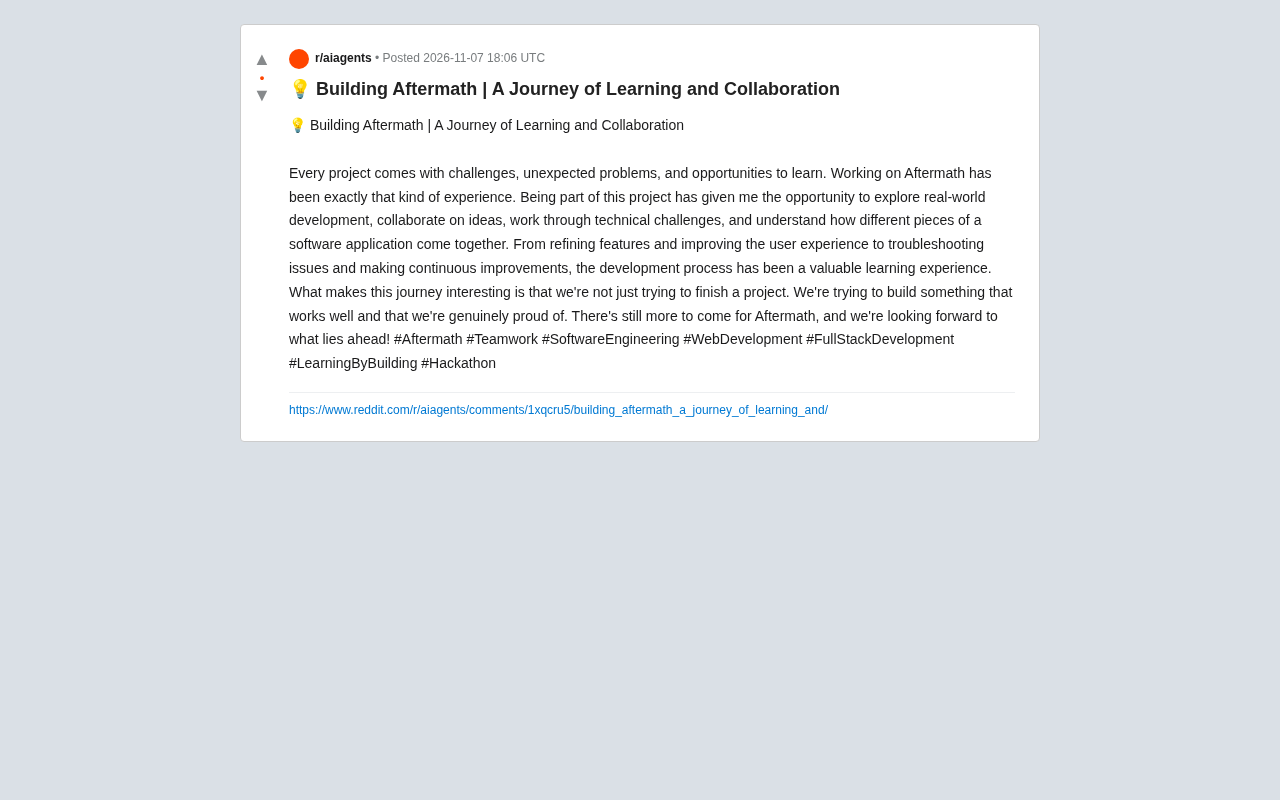
According to a developer sharing on Reddit, participating in the Aftermath project gave him genuine exposure to real-world software development. This project wasn't just about completing a task—it was an attempt to build a product that "runs well and makes you proud." From feature polishing and user experience improvements to troubleshooting and continuous optimization, the entire development process covered multiple aspects of full-stack development.
This "learn by doing" approach is particularly well-suited for teams with a hackathon background. The developer mentioned that the challenges and unexpected problems in the project actually became learning opportunities, giving team members a more concrete understanding of how the various parts of a software application fit together.
Hackathon is an intensive collaborative programming event where participants typically form small teams within 24 to 72 hours to rapidly develop from idea to prototype around a specific theme or tech stack. The core value of a hackathon isn't in producing a polished product, but in intensively practicing requirement trade-offs, rapid iteration, and teamwork. Many real projects start as hackathon prototypes—teams decide to continue investing after the event, evolving the prototype into a usable product. The article's mention of "teams with a hackathon background" means members already have experience with rapid onboarding, learning by doing, and cross-role collaboration. However, hackathon projects often have obvious shortcomings in architecture, maintainability, and user experience, so transitioning to a real product requires filling gaps in engineering practices and continuous iteration capabilities.
Collaboration and Engineering Practice: Goals Harder Than Completion
The Aftermath team's goal wasn't just to "finish" but to "do it well." This is uncommon in technical projects—many projects only aim for functional completion before deadlines, while Aftermath emphasizes continuous improvement and user-perspective optimization.
Based on public information, the team's division of work involves frontend, backend, and full-stack collaboration, with tags like #WebDevelopment and #FullStackDevelopment confirming the breadth of the tech stack. During collaboration, idea exchanges and problem-solving are the norm—exactly the parts of software engineering practice that are hard to learn in a classroom.
One detail worth noting: the developer specifically mentioned "understanding how the different parts of a software application fit together," which suggests the project has a certain level of architectural complexity rather than being a simple single-page application.
Full-Stack Development refers to developers or teams being able to cover the complete technical chain from frontend interfaces and backend services to data storage. In full-stack collaboration, the frontend focuses on interaction and rendering, while the backend focuses on business logic, API design, and data consistency, with the two connected through API contracts. The article's emphasis on "understanding how the different parts of a software application fit together" typically involves layered architecture, module boundaries, and dependency management: how frontend components call backend APIs, how the backend organizes routes and data models, and where state is stored and synchronized. Teams with this holistic perspective are better at locating cross-layer issues and controlling technical debt during iterations, rather than treating frontend and backend as two unrelated pieces of code.
The Project Is Still on Its Way
The original post explicitly states that "Aftermath has more to come," and the team remains optimistic about the future. Although no specific features, technology choices, or user data have been disclosed, it can be inferred from the description that the project is in a continuous iteration phase, and the team has clear aspirations for code quality and product experience.
For readers interested in full-stack development and team collaboration, the Aftermath sharing provides a microcosm of a real project: challenges, collaboration, polishing, and most importantly—learning from building.
Continuous Iteration is a common practice in agile development, where products continuously release small versions in short cycles, adjusting priorities based on feedback and troubleshooting results, rather than delivering a large version all at once. Continuous iteration typically comes with engineering habits such as version control, code review, automated testing, and continuous integration, with the goal of making "polishing" and "optimization" repeatable processes rather than occasional actions. The article mentions the project is "still on its way," meaning the team is in this small-step, fast-paced phase: features may not be complete yet, but the architecture and collaboration methods have already reserved space for future expansion, which also explains why the team remains optimistic about the future.
Related articles
 Tech Frontiers
MuJoCo: An Analysis of DeepMind's Open-Source General-Purpose Physics Simulator
An in-depth analysis of Google DeepMind's open-source physics simulator MuJoCo: high-performance C++ kernel, MJCF modeling format, contact solving principles, MJX GPU acceleration, and robot reinforcement learning use cases.
 Tech Frontiers
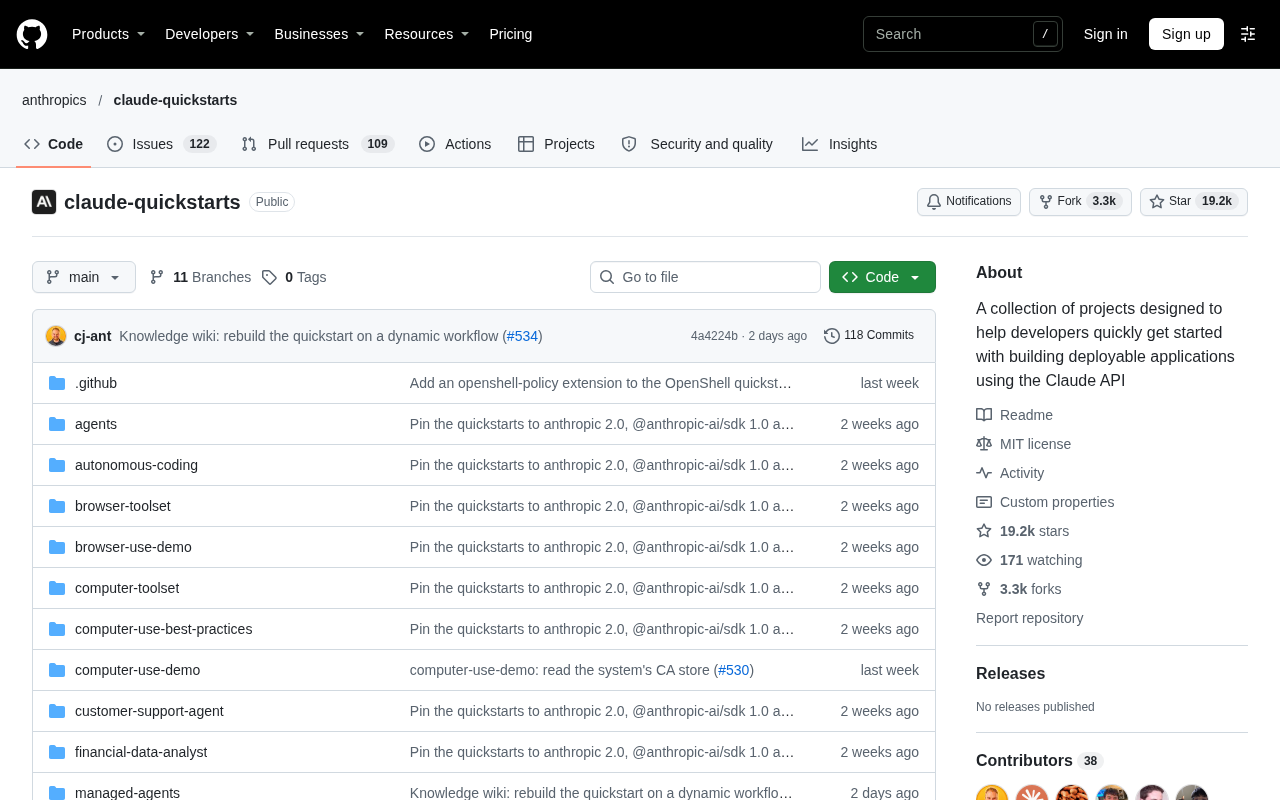
Claude API Quick Start: The Official Quickstarts Project Collection
Anthropic's official claude-quickstarts project collection helps developers quickly build deployable apps with the Claude API. Nearly 20k stars, Python-based, great for beginners and prototyping.
 Tech Frontiers
AI Agents Connecting Directly to APIs: Which Calls Can Be Safely Allowed?
AI agents can call any API, but the real challenge is deciding which calls can be safely allowed. This article analyzes allowance decisions from three dimensions—intent matching, least privilege, and controllable impact—and argues that the control layer should sit outside the agent, combined with audit traceability to build a trustworthy API call governance mechanism.