Agent Activity: Real-Time Monitoring of What Your AI Coding Agents Do Behind the Scenes

Agent Activity gives developers real-time visibility into what AI coding agents like Claude Code are doing locally.
Agent Activity is a macOS tool by an indie developer that tackles the opacity of AI coding agents like Claude Code and Xcode. By reading session logs, build outputs, and test reports already written to local disk, it surfaces scattered terminal data as a clean, real-time, per-agent view. All processing stays on-device — usage data is only uploaded with explicit user consent. Requiring macOS 26 and Xcode 27, it targets early-adopter developers and represents a growing category of AI agent observability tools.
AI coding assistants are transforming how developers work — but when tools like Claude Code and Xcode automatically run builds, execute tests, and generate code, developers often only see the final result, with no visibility into what happened in between. A macOS tool called Agent Activity aims to solve exactly this problem by making every step of an AI coding agent's operation visible.
The Vision: Opening the AI Agent Black Box
Agent Activity's core idea is simple: "see what your AI agents are doing behind the scenes." It tracks every session, every build, every test run, and even screenshots generated along the way — all in real time, organized by agent.
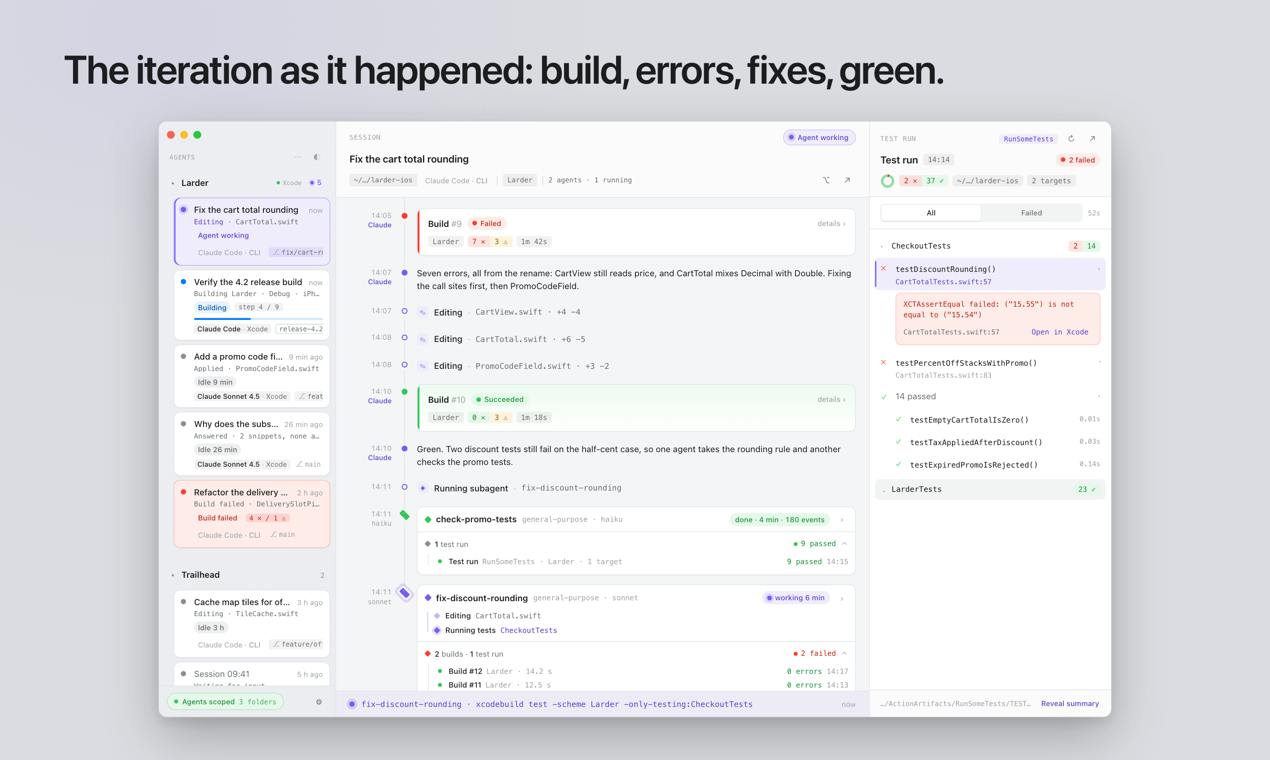
For developers who increasingly rely on AI-assisted coding, this kind of observability is critical. When an AI agent autonomously executes a chain of operations, developers need to understand its decision path and verify the correctness of its output — not just blindly accept the results. Agent Activity takes information that would otherwise be buried in terminal output and scattered logs, and surfaces it as a clean, real-time, per-agent view.
Observability is a concept borrowed from distributed systems engineering, where it originally referred to the ability to infer a system's internal state from its external outputs — logs, metrics, and traces. In the context of AI agents, the problem is even more acute: agents can execute dozens of steps in seconds — reading and writing files, running commands, triggering tests — and developers have no practical way to trace each one in real time or reverse-engineer the process from the final outcome. Traditional terminal logs exist, but their density and inconsistent formatting mean few developers read them systematically. "AI agent observability" tools aim to reorganize this scattered, low-readability raw data into human-friendly views, allowing developers to review each decision step — in real time or after the fact — without intervening in the agent's execution.
How It Works: Reading Local Disk Data
The tool's approach is elegantly straightforward — it reads data that Claude Code and Xcode already write to disk, with all processing happening locally on the user's Mac. This means no complex integrations to configure; the tool extracts information directly from your existing workflow.
Agent Activity currently supports data from two tools: Claude Code and Xcode. These represent two dominant categories — a leading AI command-line coding agent and Apple's official IDE — together covering much of the daily workflow for Apple platform developers.
Claude Code is Anthropic's command-line AI coding agent, capable of autonomously executing multi-step tasks within a local codebase — reading and writing files, running tests, invoking shell commands. Its operation logs and session context are typically stored in structured formats on local disk. Xcode, Apple's official IDE, similarly generates detailed build logs, test reports, and DerivedData locally. Agent Activity reads these existing files directly, rather than intercepting through plugins or APIs, making integration nearly zero-configuration — no injection or proxy setup is required before the agent runs; the tool simply parses existing artifacts in parallel or after the fact. This "sidecar read" architecture is also why it can remain fully local with no network permissions required.
Privacy-First Design
At a time when most AI tools default to cloud processing, Agent Activity takes a local-first approach. All data reading and display happens on the user's Mac, and usage and crash data are only collected if the user explicitly opts in by saying yes.
This "off by default, opt-in to share" design is a meaningful choice for privacy-conscious developers. When working with sensitive codebases and project details, local processing removes the worry of data leaking to third-party servers.
System Requirements and Target Audience
Notably, Agent Activity has high system requirements: it needs macOS 26 + Xcode 27. This signals that it's aimed at cutting-edge developers who track Apple's latest releases — not those prioritizing broad compatibility.
The product was built by indie developer Maksym Tartachnyk, earning 67 upvotes and a #16 ranking on Product Hunt, categorized under Mac, Developer Tools, and Artificial Intelligence. Community feedback suggests it's still in early stages, but it addresses a genuine and growing need — as AI agents become more capable, monitoring tools built on "trust but verify" principles will only become more important.
Requiring macOS 26 and Xcode 27 implies the tool relies on system-level APIs or data formats that Apple has not yet officially released (still in developer beta as of this writing). This raises the bar for early adopters, but also reflects a deliberate strategy of entering the market just as new platform capabilities mature. As macOS 26 rolls out broadly, the potential user base will grow naturally with the upgrade curve — and competitors who haven't yet adapted will face a disadvantage. For developers still on older systems, the tool is not yet available.
Why This Category of Tool Matters
As AI coding agents evolve from offering suggestions to autonomously executing multi-step tasks, the collaboration between developers and AI is fundamentally changing. Agents can run tests, modify code, and trigger builds on their own — but who's watching them? Agent Activity represents an emerging category of "AI agent observability" tools: they don't generate code; they help humans understand and supervise AI behavior.
The value of these tools lies in bridging the gap between automation and control. For professional developers who want efficiency without losing oversight, being able to see what the AI is doing often matters more than how fast the AI is doing it.
Related articles

@ai-sdk/vue 3.0.306 Patch Release Syncs with [email protected] Update
@ai-sdk/vue 3.0.306 released, synced with [email protected]. A routine patch release for the Vercel AI SDK ecosystem with no public API changes; the Vue adapter layer stays version-aligned with the core package.

Gemini 4 Argon API Launches: The Era of Million-Token Output Begins
Google launches Gemini 4 Argon with sparse MoE architecture, up to 1M output tokens, and a 68.90% Vals Index score, available across API, AI Studio, and the Gemini app.

DukaanAI: Turning Product Photos into Inventory Lists with Open-Source AI
DukaanAI is an AI inventory tool for small retailers that turns product photos into inventory entries using the open-source Gemma 3 model, with local inference, editable fields, and CSV export.