Agent as Its Own Optimizer: The Self-Evolving Harness Framework

A frozen model edits its own harness code, achieving cross-domain recursive self-improvement from just 49 lines.
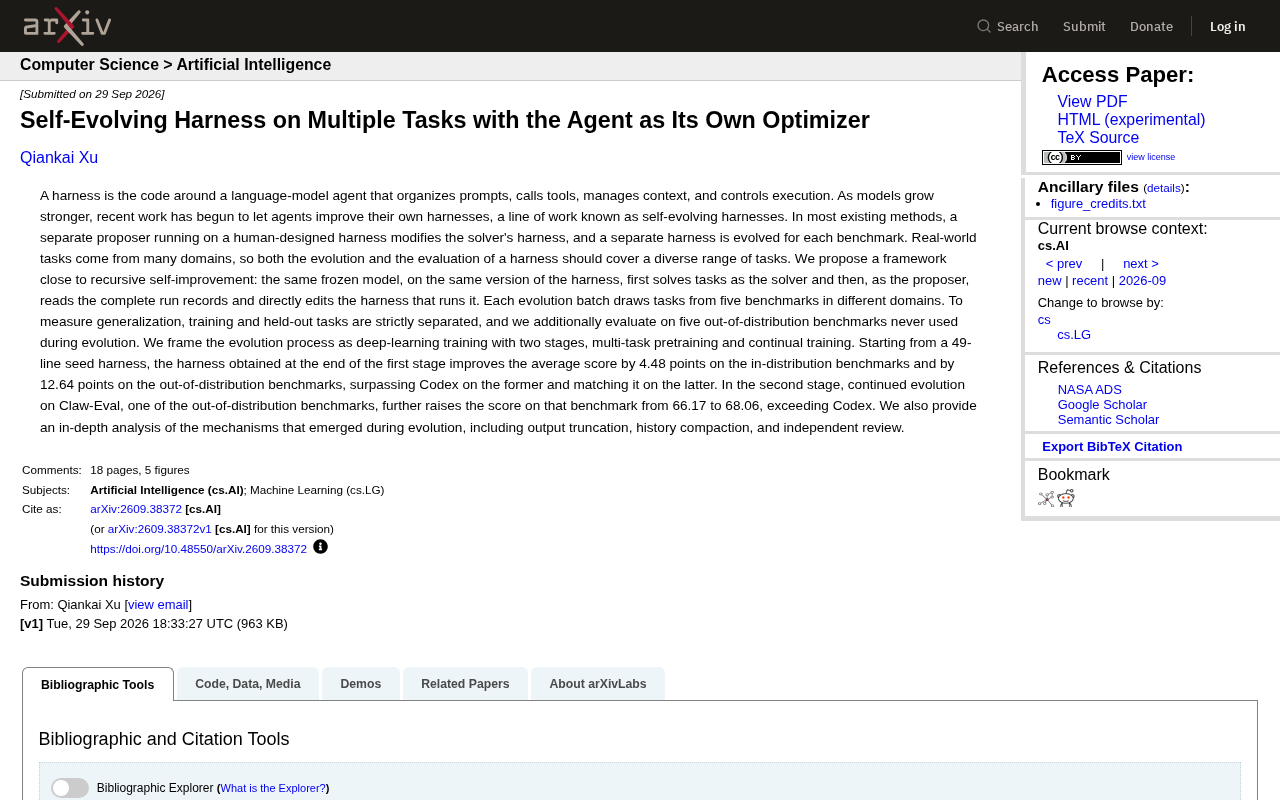
This paper proposes a Self-Evolving Harness framework where the same frozen language model acts as both task solver and harness optimizer, reading full execution logs to directly edit the code driving it — a closed loop approaching recursive self-improvement. Unlike existing methods that rely on separate proposers or optimize for single benchmarks, it drives evolution by sampling tasks from five domains and evaluates generalization on five OOD benchmarks. Starting from a 49-line seed harness, the two-phase process yields +4.48 in-distribution and +12.64 OOD score improvements, while spontaneously producing output truncation, history compaction, and independent review — rediscovering expert engineering practices through self-evolution.
What Is a Self-Evolving Harness
In language model agent systems, a harness refers to the layer of code surrounding the model — it organizes prompts, invokes tools, manages context, and controls execution flow. Think of it as the agent's "skeleton": the model is the brain, while the harness determines how that brain perceives tasks, exercises its capabilities, and produces results.
As underlying model capabilities continue to grow, a natural research direction emerges: can an agent improve its own harness? This is the concept of a "self-evolving harness." This arXiv paper proposes a framework that comes closer to recursive self-improvement (RSI) — using the same frozen model both as a solver and as an optimizer, editing the very code that runs it.
"Recursive Self-Improvement" (RSI) is one of the core concepts in AI safety and capability research, first implicitly touched upon by I.J. Good in 1965 with his "intelligence explosion" hypothesis. The basic idea is that an intelligent system can modify itself to become more capable, and that stronger version can in turn produce an even better successor, cycling indefinitely. For a long time, RSI remained largely theoretical, because truly realizing it requires two demanding conditions: the system must understand its own mechanics, and modified versions must be objectively evaluable. Most prior attempts either relied on external optimizers (undermining the "self" in self-improvement) or lacked rigorous generalization evaluation (making it hard to rule out overfitting). The Self-Evolving Harness framework in this paper attempts to approach the definitional boundary of RSI in a quantifiable, reproducible way.
Limitations of Existing Approaches
The paper identifies two notable constraints in most existing self-evolving methods. First, they typically rely on a separate "proposer" running on a human-designed harness to modify the "solver's" harness — meaning the system contains two distinct codebases internally, and the proposer itself never evolves.
Second, most methods evolve a separate harness for each individual benchmark. But real-world tasks span many different domains, and both the evolution process and the evaluation process should cover diverse task types. A harness optimized exclusively for a single benchmark can hardly be said to possess genuine generalization ability.
Core Innovation: One Model, One Harness
The key design in this work is a closed-loop self-improvement cycle: the same frozen model, running on the same version of the harness, first acts as a solver to tackle tasks, then switches to a proposer role, reads the complete execution log, and directly edits the harness that is running it.
This design brings the evolution process genuinely close to recursive self-improvement — there is no external, fixed optimizer; the optimizer is the agent itself. Each evolution batch samples tasks from benchmarks across five different domains, ensuring the evolution direction does not overfit to any narrow task distribution.
To rigorously measure generalization, the paper strictly separates training tasks from held-out tasks, and additionally evaluates on five out-of-distribution (OOD) benchmarks never used during evolution. This setup borrows from the deep learning evaluation paradigm to avoid the illusory gains of "train-on-test."
Two-Phase Evolution: Pre-Training and Continual Training
The paper frames the entire evolution process analogously to two stages of deep learning training: multi-task pretraining and continual training.
The starting point is a 49-line seed harness — extremely minimal. By the end of the first phase, the evolved harness achieves an average improvement of 4.48 points on in-distribution benchmarks and 12.64 points on out-of-distribution benchmarks — the OOD improvement is notably larger, providing strong evidence of generalization. At this point, performance surpasses Codex on in-distribution benchmarks and matches Codex on out-of-distribution ones.
In the second phase, the researchers continue evolution on one OOD benchmark, Claw-Eval, pushing its score from 66.17 to 68.06, surpassing Codex. This demonstrates that the continual training phase can further unlock potential in specific domains without undermining existing generalization capabilities.
"Codex" here refers to OpenAI's code generation model released in 2021, an important reference point in early programming capability benchmarks and a commonly used baseline for code-related tasks. Using Codex as a comparison point means this paper's evaluation focuses on programming and reasoning tasks — tasks whose outputs are automatically verifiable, since whether a program passes test cases is an objective standard that doesn't require human scoring, making them particularly suitable as reward signals in a self-evolving loop. The fact that OOD improvement (12.64 points) significantly exceeds in-distribution improvement (4.48 points) typically indicates, in machine learning terms, that the model has learned more fundamental inductive biases rather than simply memorizing surface patterns from the training distribution — providing strong empirical support for this framework's generalization capability.
Mechanisms That Emerged During Evolution
One of the most valuable parts of the paper is its in-depth analysis of mechanisms that spontaneously emerged during the evolution process. Researchers observed several key strategies arising naturally:
- Output truncation: The agent learns to trim overly long tool outputs, preventing the context from being overwhelmed by noise.
- History compaction: Running history is compressed to retain key information within a limited context window.
- Independent review: An independent review step is introduced to double-check the agent's own outputs.
None of these mechanisms were pre-designed by humans — they were "discovered" by the agent through repeated cycles of solving tasks and self-editing. They happen to correspond exactly to the best practices that experienced engineers manually incorporate when building agent systems, suggesting that self-evolution can genuinely rediscover effective engineering patterns.
These emergent mechanisms are closely related to the "context window management" problem in large language models. While mainstream LLMs have expanded their context lengths to tens or even hundreds of thousands of tokens, accumulating redundant information still causes "attention dilution," causing models to miss critical information in long contexts. Output truncation and history compaction are essentially the agent spontaneously learning "selective memory" — retaining only information truly useful for current reasoning, analogous to working memory in human cognition. Independent review corresponds to the "code review" culture in software engineering, catching blind spots in single-pass reasoning by introducing a second perspective. Notably, all three mechanisms can be implemented purely at the harness code level without modifying the underlying model weights — one of the key advantages of "evolving at the harness layer" over fine-tuning model weights.
Significance and Outlook
The core contribution of this research is demonstrating a key point: under multi-task, rigorous generalization evaluation conditions, an agent is fully capable of serving as its own optimizer, evolving from an extremely minimal starting point into a harness with cross-domain generalization ability.
For AI engineering practice, this suggests that future agent frameworks may not need to rely entirely on manual craftsmanship — they could continuously adapt to new domains through self-evolution. Of course, this direction is still in its early stages. The capability ceiling of frozen models, the stability of the evolution process, and safety controllability all remain topics requiring deeper investigation. But the paradigm of "agent as its own optimizer" provides a quantifiable, reproducible research specimen for recursive self-improvement.
Related articles

Chain of Thought Isn't Just for AI: How Humans Can Use CoT to Improve Thinking Quality
Chain of Thought isn't just a prompt trick for large models. Starting from a Hacker News discussion, this article analyzes why CoT works for human thinking too, breaks down actionable ways to transfer it, and highlights the key differences between human CoT and machine CoT.
Cloudflare Teams Up with OpenAI: Closi…
Cloudflare Teams Up with OpenAI: Closing the Loop from Vulnerability Discovery to Defense with AI
Cloudflare uses OpenAI Daybreak to investigate security vulnerabilities and generate reviewable remediation plans, while developers use Codex to boost coding efficiency and quality.

Orca Multi-Agent Orchestration in Practice: A Guide to Parallel Collaboration with Claude and Codex
Orca is Stable AI's free open-source agent workbench supporting 34 agents like Claude Code and Codex in parallel. Learn its Git worktree isolation, multi-model orchestration, and mobile management.