Agent Beginner's Roadmap: Don't Be Intimidated by New Buzzwords—Build an Enterprise-Grade Agent in Three Steps
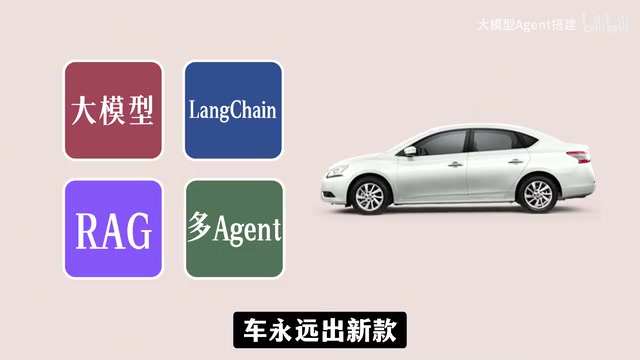
An application-focused Agent beginner roadmap: focus on model cognition and engineering, drive learning with real projects, and skip underlying derivations and buzzword noise.
This Agent beginner methodology argues most new concepts aren't worth learning—learning Agent is like learning to drive, where driving skill beats studying engine manufacturing. It targets the largest group: people who want to land jobs or build projects with Agent. Core formula: Agent = LLM + Memory + Tools. Must-learn: prompt engineering, API calls, RAG, LangChain, and tool calling. Three steps: build a knowledge map, drive with one real project, and choose the faster high-ROI path.
Agent Beginner's Roadmap: Don't Be Intimidated by New Buzzwords—Build an Enterprise-Grade Agent in Three Steps
LLMs, RAG, LangChain, multi-agent... The terminology in the agent space keeps piling up, and beginners are the easiest to be scared off by this situation. A video series on Bilibili that netizens have called the "most detailed Agent beginner tutorial" puts forward a counterintuitive judgment: most new concepts simply aren't worth learning. The author compares learning Agent to learning to drive—cars get new models every year, but what you need to master is driving skill, not engine manufacturing.
Behind this metaphor is an actionable learning path. Here's a breakdown of its core logic.
Which Type of Learner Are You?
The author divides people who encounter Agent into three categories:
- The first type scrolls past a video out of curiosity. They forget it right after watching; nothing systematic.
- The second type wants to study the underlying principles, derive formulas, and do algorithms. These people need solid math and paper-reading skills.
- The third type wants to use Agent to find a job, build projects, take on gigs, but doesn't know where to start. This is the largest group.
This roadmap is designed specifically for the third type. In other words, if your goal is to use Agent to solve real problems and produce deliverable work, the methodology below applies directly to you—and much of what the first two learning paths cover is exactly what you can skip.
Breaking Down Agent with One Formula
The core formula the author gives is: Agent = LLM + Memory + Tools.

Using the driving analogy: the LLM is the engine, memory is the fuel tank (it determines how far it can go and how much context it can remember), and tools are what actually make the car run and do work.
This formula directly determines what you should learn:
- Model cognition layer—prompt engineering, API calls, RAG (Retrieval-Augmented Generation). These are the basic driving skills.
- Engineering capability layer—using frameworks like LangChain, tool calling. These are the parts that make the Agent actually do work.
- Underlying principles—just know how it works; no need to get lost in mathematical derivations.
The key judgment: the first two layers must be practiced hands-on; the third layer only needs to be understood. Many beginners get stuck in the third layer, spending tons of time grinding through formulas, yet they've never built a single working Agent.
RAG (Retrieval-Augmented Generation) is currently the most commonly used technical pattern in enterprise-grade Agent deployment. Its basic workflow is: split internal enterprise documents (PDFs, Word files, database records, etc.) into small chunks, convert them into vectors via an embedding model and store them in a vector database; when a user asks a question, the system first uses similarity search to recall the most relevant chunks, then stuffs them together with the question into the LLM's prompt, letting the model answer based on this "evidence." RAG solves two hard problems with LLMs—outdated knowledge and hallucinated fabrication—while avoiding the cost of expensive fine-tuning. For developers building enterprise projects, the difficulty of RAG usually isn't in calling the API, but in chunking strategy (how big to split, how to split, whether to overlap) and retrieval quality (whether the recalled chunks are actually relevant). These two directly determine the final result and are the most frequently probed areas in interviews and real delivery.
LangChain is an open-source framework that emerged in late 2022, used to string together LLMs, prompts, memory, tool calling, retrieval, and other components into reusable pipelines. Its value lies in providing a unified abstraction layer: switching models (OpenAI, Claude, domestic models) doesn't require rewriting business code, and tool calling, conversation history management, and chain orchestration all have ready-made components. But it's also often criticized for being too thick in abstraction, fast version iteration, and difficult debugging. For beginners, LangChain is suitable as an entry-level tool for "knowing this thing exists and being able to piece together a working chain by following the docs"; once you actually get into projects, many people choose lighter solutions (like calling APIs directly + a small amount of glue code) or newer frameworks (like LlamaIndex, LangGraph). The key isn't memorizing APIs, but understanding what concepts like "chain," "tool," and "memory" actually do when mapped to code.
Three Steps to Build Your Agent Learning Path
Step One: Build a Knowledge Map, Cut Half the Learning Volume
Divide knowledge points into three tiers—must-learn, understand, skip:
| Knowledge Point | Category | Reason |
|---|---|---|
| Prompt Engineering | Must-learn | The foundation of Agent interaction |
| RAG | Must-learn | Most commonly used in enterprise projects |
| Agent Development | Must-learn | Core skill |
| Multi-Agent Collaboration | Understand | Rarely used in production |
| Underlying Algorithm Derivations | Skip | Low ROI |
This round of filtering alone can cut half the learning volume. The author's exact words were "what to learn and what to skip"—that judgment itself matters more than what you learn.
Prompt Engineering isn't about "knowing a few magic spells," but a set of engineering methods to make models stably output expected results. Core techniques include: using role settings and task descriptions to frame the scope, using few-shot examples to teach the model output format, using Chain-of-Thought to guide step-by-step reasoning, and using structured outputs (like JSON schema) to ensure downstream programs can parse them. In Agent scenarios, prompt engineering also has to handle more complex problems: how to describe the purpose and parameters of available tools, how to make the model correctly switch between "keep calling tools" and "give the final answer," and how to keep the task objective from drifting in multi-turn conversations. These abilities can't be acquired by memorizing templates—they must be repeatedly debugged in a real project to build intuition, which is also why it's listed as "must-learn."
Step Two: Project-Driven—Use One Real Project to Connect All Knowledge Points
Don't be a knowledge collector; be a project deliverer. For example, if you're building an enterprise knowledge base, grind hard on RAG's chunking and retrieval.

The author's judgment is direct: getting one project running is far better than learning ten knowledge points in isolation. The reason is that isolated knowledge points have no context and are forgotten once learned; a project forces you to make trade-offs under real constraints, and that learning density is far higher than watching tutorials.
Step Three: Calculate ROI, Choose the Faster Path
The author compares two approaches:
- Plan A: Start from Python syntax, and it takes three months just to touch the door of Agent.
- Plan B: Speed-run Python in three or four days, jump straight into following a project, and produce work in a month.

The author explicitly recommends Plan B. The reason is that opportunities wait for no one, and the underlying logic of application development is relatively stable—you don't need to wait until you've "finished learning" to start.
When Facing New Concepts, Ask Three Questions First
The most practical part of this methodology is that it provides a decision filter. Whenever a new concept gets hot, first ask yourself:
- Is it useful for your target project? If not, don't learn it.
- Can you produce something visible after learning it? If not, hold off.
- Is the ROI of time invested versus return high? If not, skip it.
Technology changes every day, but the underlying logic of application development is stable. Plan your path around your goals, and you won't be led around by endless new buzzwords.
Complete Roadmap Summary
The final roadmap the author gives is: Speed-run Python → LLM cognition → RAG → Agent hands-on practice → Project integration.
This path has no multi-agent collaboration, no underlying algorithm derivations, and looks "incomplete"—but that's exactly where its value lies. For people who want to use Agent to find jobs and build projects, complete doesn't equal useful; usable is what counts.
This tutorial series is labeled as "748 episodes in total" on Bilibili, and the author says they will later guide learners through real projects, learning by doing. If you're currently drowning in various Agent concepts, try filtering your current learning plan through those three questions first.
One-line Summary
An Agent beginner's roadmap for applied learners: focus on model cognition and engineering capability, be driven by real projects, and decisively skip underlying derivations and new-concept noise.
Paragraph Summary
The core judgment of this Agent beginner methodology is: most new concepts aren't worth learning, and learning Agent is like learning to drive—mastering driving skill matters more than studying engine manufacturing. The author divides learners into three types, and the roadmap is designed specifically for the third type—those who want to use Agent to find jobs, build projects, and take on gigs. The core formula is Agent = LLM + Memory + Tools, from which it follows what to learn: prompt engineering, API calls, RAG, LangChain, and tool calling must be practiced hands-on, while underlying algorithm derivations only need to be understood. The three-step path is: build a knowledge map to cut half the learning volume, use one real project to connect all knowledge points, and calculate ROI to choose the speed-run path. When facing new concepts, filter with three questions: is it useful for the project, can it produce visible results, and is the ROI high. The final roadmap is speed-run Python → LLM cognition → RAG → Agent hands-on practice → project integration.
Related articles

Gmod TTT: Boba's Winning Streak and Game Design Insights
An in-depth analysis of Gmod TTT's role system, creative items, and social gameplay mechanics, exploring the relationship between randomness design and game balance through Boba's winning streak phenomenon.

FlexBudget: Fair Comparison of KV Cache Eviction Strategies Under a Unified Compute Budget
AMD engineer proposes FlexBudget at PyTorch Conference: a training-free fair comparison method for KV cache eviction rules using fixed kernels and memory budgets, all in core PyTorch.
