Agent Behavior Maps: Predicting Agent Performance Without Running the Model

Behavior maps locate LLM agents using only reference-trajectory log-likelihoods, predicting behavior without running them.
The paper proposes a "behavior map" method that treats the LLM-harness combination as a whole, building low-dimensional coordinates solely from centered action log-likelihoods on shared reference trajectories to characterize agent behavior without running the target agent. It derives error bounds between squared coordinate distances and trajectory KL divergence, validated on 100 LLMs across four environments including ALFWorld.
Why Do We Need to Predict Agent Behavior Without Running the Model?
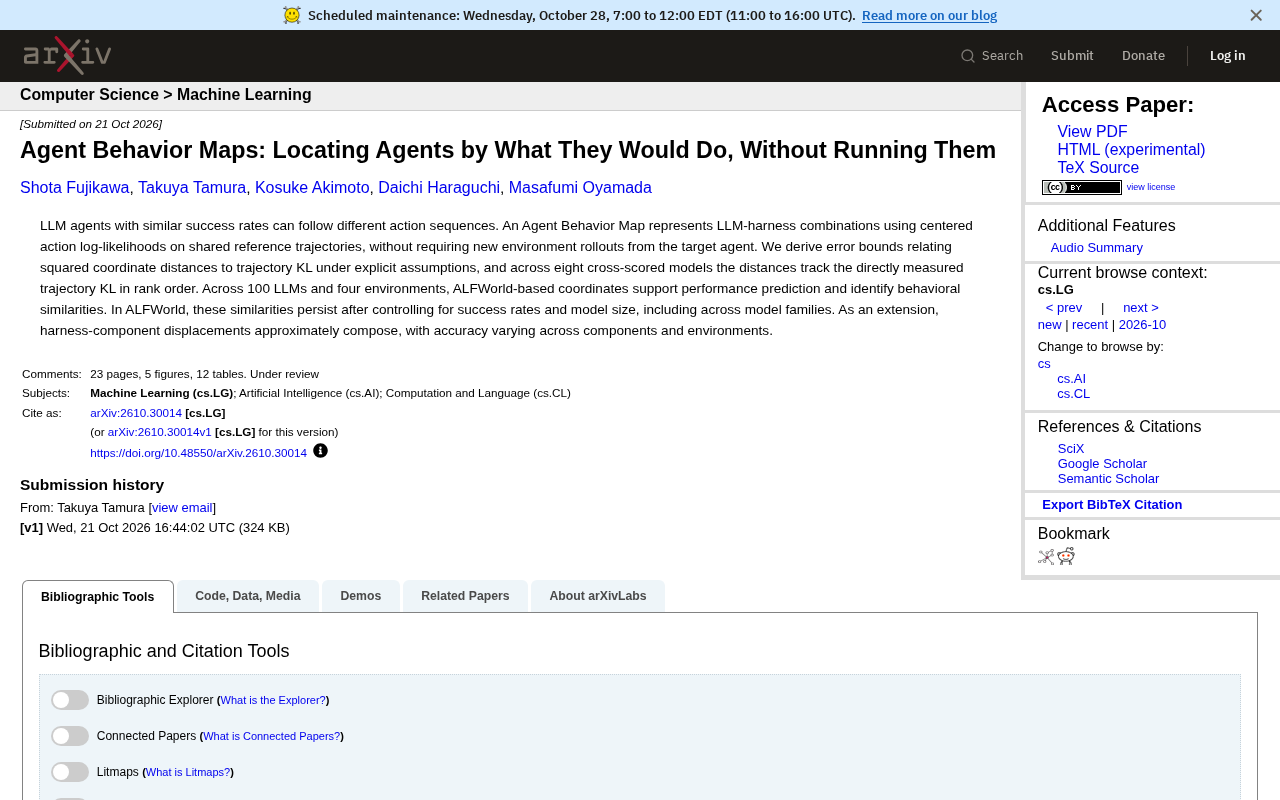
Evaluating LLM agents typically relies on running complete tasks in real environments. This is costly and time-consuming, and even when different models have similar success rates, the action sequences they actually take can differ dramatically. According to the paper "Agent Behavior Maps: Locating Agents by What They Would Do, Without Running Them," a "behavior map" approach can characterize an agent's behavioral traits without launching the target agent—locating the model solely through its action log-likelihoods on shared reference trajectories.
The core idea is to treat the combination of LLM and harness as a whole, using its conditional probability distribution over several standard trajectories as coordinates to construct a low-dimensional behavior space.
How Behavior Maps Are Built and the Theoretical Basis
Centered Log-Likelihoods on Shared Reference Trajectories
For each LLM-harness combination, the researchers compute the centered log-likelihood of each action step on shared reference trajectories. Centering removes differences in the inherent difficulty of different trajectories, so that the coordinates better reflect the model's behavioral tendencies rather than task difficulty. Each agent thus corresponds to a point in behavior space, without any rollout in the target environment.
Log-likelihood and centering: In a language model, given the preceding context, the model outputs a conditional probability for the next action (e.g., "open the fridge"); taking the logarithm gives the log-likelihood, where a larger value means the model is more inclined to take that action. Centering means subtracting the average log-likelihood of all steps within each reference trajectory from each step's log-likelihood, thereby removing differences in inherent trajectory difficulty (e.g., some task steps are naturally harder to predict) and making the coordinates purely reflect the model's behavioral preferences.
Error Bounds Relative to Trajectory KL
Under explicit assumptions, the paper derives error bounds between squared coordinate distances and trajectory KL divergence. This means that Euclidean distances on the behavior map are theoretically tied to true differences in trajectory distributions. On eight cross-scored models, these distances are rank-consistent with directly measured trajectory KL, providing empirical support for the method.
KL divergence: Kullback-Leibler divergence measures the difference between two probability distributions and is commonly used in reinforcement learning and imitation learning to compare policy distributions. Trajectory KL divergence is the KL difference between two agents' behavioral distributions over the full trajectory space; a smaller value indicates more similar behavior. The error bounds derived in this paper show that an upper and lower bound relationship exists between the squared Euclidean distance between two points on the behavior map and trajectory KL divergence, providing a theoretical guarantee for approximating behavioral differences with coordinate distances.
Large-Scale Validation: 100 LLMs, Four Environments
The researchers validated the method on 100 LLMs across four environments. Coordinates based on ALFWorld support performance prediction and identify behaviorally similar models. Notably, in ALFWorld these similarities persist after controlling for success rate and model scale, and even span different model families.
This shows that the behavior map captures not merely "strong models cluster together" or "same-family models cluster together," but some finer-grained behavioral pattern. According to the paper's data, distance rankings across eight cross-scored models are consistent with trajectory KL, providing direct evidence for the semantic validity of the coordinates.
ALFWorld: A text-based interactive environment for embodied agents, containing six scene types such as kitchens and living rooms, where tasks require the agent to complete household goals (e.g., "put the apple in the fridge") through navigation, picking up, and placing actions. It is often used to evaluate LLMs' planning and execution capabilities in long-sequence decision-making. This paper uses ALFWorld as one of its main validation environments because its task structure is clear and its action space is discrete, making action log-likelihoods easy to compute.
Extension: Harness Component Displacements Can Be Approximately Composed
As an extension, the paper examines whether displacements from harness components can be approximately composed. Results show that behavioral displacements from component substitutions can be superimposed to some extent, but accuracy varies by component and environment. This offers a new perspective on understanding how harness design affects agent behavior—how changing a component will shift the model's position on the behavior map might be estimable in advance.
Harness: The engineering framework wrapped around an LLM that parses model outputs, manages tool calls, maintains memory, or executes actions—for example, ReAct or AutoGPT. The same LLM paired with different harnesses exhibits vastly different action sequences. This paper treats the LLM and harness as a single agent, so substituting harness components produces a "displacement" on the behavior map; that displacements can be approximately composed means the displacement vectors caused by individually substituting multiple components can be added, thereby estimating the overall behavioral change after a combined substitution.
Practical Significance and Limitations
For AI application developers, behavior maps offer a low-cost behavioral pre-screening tool: before deployment, one can judge a model's behavioral tendencies on a specific task without running full evaluations. For researchers, they turn "behavioral similarity" from a qualitative description into a measurable coordinate distance.
The limitations are also clear: the error bounds rely on explicit assumptions, the accuracy of displacement composition fluctuates considerably across components and environments, and the method is currently validated mainly in environments such as ALFWorld; transfer to more open-ended environments still requires further research.
Frequently Asked Questions
Does a behavior map require running the target agent? No. It only uses the target model's action log-likelihoods on shared reference trajectories and does not require the target agent to roll out in the environment.
What is the relationship between coordinate distance and trajectory KL? The error bounds derived in the paper show that squared coordinate distance correlates with trajectory KL, and the rankings are consistent across eight cross-scored models.
Is behavioral similarity merely a reflection of success rate or model scale? In ALFWorld, similarities persist after controlling for success rate and model scale, indicating that it captures additional behavioral information.
One-line Summary
Behavior maps locate LLM agents using only reference-trajectory log-likelihoods, predicting behavior without running them.
Paragraph Summary
The paper proposes a "behavior map" method that treats the LLM-harness combination as a whole, constructing low-dimensional coordinates solely from the centered log-likelihoods of each action step on shared reference trajectories, thereby characterizing an agent's behavioral traits without running the target agent. The study derives error bounds between squared coordinate distances and trajectory KL divergence and verifies rank consistency on eight cross-scored models. Experiments across 100 LLMs and four environments (including ALFWorld) show that the coordinates support performance prediction and identify behaviorally similar models, and that these similarities persist after controlling for success rate and model scale, even across model families. In addition, behavioral displacements from harness component substitutions can be approximately composed, though accuracy varies by component and environment. The method offers a new tool for low-cost behavioral pre-screening, but its error bounds rely on explicit assumptions, and transfer to open-ended environments still requires further research.
Related articles

Chain of Thought Isn't Just for AI: How Humans Can Use CoT to Improve Thinking Quality
Chain of Thought isn't just a prompt trick for large models. Starting from a Hacker News discussion, this article analyzes why CoT works for human thinking too, breaks down actionable ways to transfer it, and highlights the key differences between human CoT and machine CoT.
Cloudflare Teams Up with OpenAI: Closi…
Cloudflare Teams Up with OpenAI: Closing the Loop from Vulnerability Discovery to Defense with AI
Cloudflare uses OpenAI Daybreak to investigate security vulnerabilities and generate reviewable remediation plans, while developers use Codex to boost coding efficiency and quality.

Orca Multi-Agent Orchestration in Practice: A Guide to Parallel Collaboration with Claude and Codex
Orca is Stable AI's free open-source agent workbench supporting 34 agents like Claude Code and Codex in parallel. Learn its Git worktree isolation, multi-model orchestration, and mobile management.