Agent-Devtools: A Deep Dive into the Local-First AI Agent Debugging Tool

Agent-Devtools is a local-first, zero-dependency debugging toolkit for AI Agents with causal tracing and behavior diff.
Agent-Devtools is an open-source Python tool for debugging AI Agents entirely locally without API keys. It offers causal debugging to trace memory, retrieval, and context influences on decisions; behavior diff to compare correct vs. incorrect runs; deterministic replay for reproducible testing; and context provenance to inspect full prompts. With native LangChain and Groq integration plus SQLite storage and a FastAPI dashboard, it provides a privacy-first alternative to cloud-based observability platforms.
The Debugging Pain Points of AI Agents
As AI Agents transition from concept to production environments, more and more developers are discovering that building an Agent that runs isn't the hard part — making it stable, reproducible, and traceable is. An AI Agent is an autonomous intelligent system that typically combines the reasoning capabilities of large language models (LLMs) with external tool calls, memory management, information retrieval, and other modules to form a system capable of autonomously planning and executing multi-step tasks. Unlike traditional single-turn Q&A-style LLM applications, Agents have longer execution chains, more complex states, and involve multi-turn decision loops where each step can be influenced by context injection, Retrieval-Augmented Generation (RAG) results, historical memory, and many other factors.
When an Agent suddenly produces an incorrect answer, it's often extremely difficult to pinpoint where the problem lies — was the memory retrieval wrong? Was the context incorrectly injected? Or did a tool call return an unexpected result?
Traditional LLM application debugging typically relies on printing logs or third-party cloud monitoring platforms. The former produces fragmented information that makes it hard to reconstruct the complete execution chain, while the latter introduces API Key dependencies and privacy concerns from data leaving your environment. Recently, a developer open-sourced Agent-Devtools on Reddit — a lightweight Python project that attempts to fundamentally solve these pain points.
Core Features of Agent-Devtools
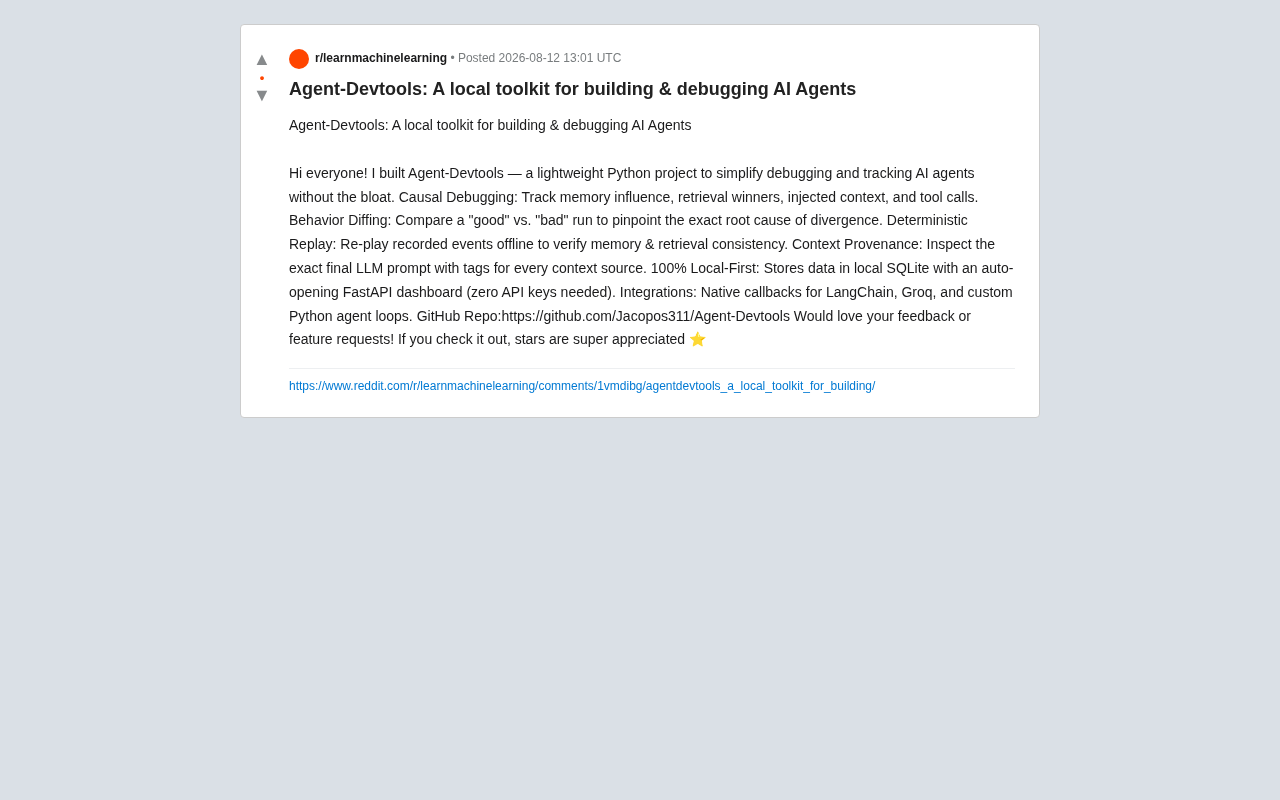
Agent-Devtools positions itself as a "local-first" Agent debugging toolkit, with the author emphasizing its design philosophy of being "without the bloat." The project is built around several core capabilities that directly address the most difficult-to-troubleshoot problems in Agent development.
Causal Debugging: Tracing Every Step of Agent Decisions
This is Agent-Devtools' most distinctive feature. It can trace four key categories of factors during Agent execution: memory influence, retrieval winners, injected context, and tool calls.
In traditional software engineering, Causal Debugging refers to the method of locating error sources by tracing causal relationships between variables in a program. Applying this concept to Agent systems means establishing a complete causal chain from input to output. Specifically, memory influence refers to the effect that information recalled from long-term memory has on current decisions; retrieval winners involve the document fragments selected after vector similarity ranking in RAG systems; and context injection is the process of dynamically inserting additional information into the Prompt.
For developers, this means that when an Agent produces a certain output, you can clearly see exactly which memory entry or which retrieval result influenced the final decision, enabling precise root cause identification instead of facing an impenetrable black box.
Behavior Diff: Quickly Pinpointing Bug Locations
The second highlight is "Behavior Diff." Developers can compare a "correct" run with an "incorrect" run, and the tool will precisely identify the exact point where the two runs diverged.
This approach borrows from the code Diff concept in software engineering — code Diff is a core concept in version control systems (like Git) that precisely marks change locations by comparing two versions of a file line by line. Migrating this concept to Agent execution chains requires structuring each Agent decision step (including tool call sequences, retrieval results, context assembly, etc.) into comparable event sequences. This method has similar applications in distributed systems debugging, such as comparing anomalous requests with normal requests in Distributed Tracing.
For those intermittent, hard-to-reproduce bugs, this comparison approach can dramatically reduce troubleshooting time — you no longer need to read through logs line by line, but instead focus directly on the divergence points.
Deterministic Replay: Making Agent Debugging Verifiable
Agent-Devtools supports replaying recorded events offline to verify the consistency of memory and retrieval. Deterministic Replay originates from a classic technique in system debugging, with its core idea being to record all non-deterministic inputs during program execution (such as network responses, random number seeds, etc.), and then substitute recorded values for actual inputs during replay, thereby achieving an entirely consistent execution path.
In Agent scenarios, LLM output is inherently random (controlled by sampling parameters like temperature), and tool call return values may also change over time. By recording these non-deterministic events and injecting fixed values during replay, developers can repeatedly verify Agent behavior logic under identical conditions. Since LLM output is inherently stochastic, being able to replay historical events deterministically is extremely important for regression testing and consistency verification. This transforms Agent debugging from "hoping for the best" to "verifiable."
Context Provenance: Seeing the Complete Prompt Sent to the LLM
The final core feature is context provenance. It allows developers to inspect the complete Prompt ultimately sent to the LLM and labels each context source.
In practice, an Agent's final Prompt is often assembled by concatenating multiple parts: system prompts, conversation history, retrieval results, tool outputs, and more. This process typically involves collaboration between multiple modules: the RAG system contributes retrieved document fragments, the memory module provides historical interaction summaries, tool calls return structured data, and all of this content is processed through template engines or orchestration frameworks before being assembled into a complete Prompt that can be thousands of tokens long. When output is anomalous, being able to see "what the final Prompt looked like and where each part came from" is invaluable debugging information.
Local-First Design and Framework Integration
100% Local Execution, No API Key Required
Agent-Devtools emphasizes a "100% Local-First" design. Local-First is a design philosophy that has emerged in recent years in developer tools and collaboration software, emphasizing that data sovereignty belongs to the user, offline availability, and privacy first. All data is stored in a local SQLite database — SQLite, as a representative embedded database, requires no independent database service process; the entire database is a single file, making it perfectly suited for local-first tools. The project also includes a FastAPI-based dashboard (FastAPI is a high-performance asynchronous web framework in the Python ecosystem, based on the ASGI standard) that opens automatically at runtime — the entire process requires no API Key whatsoever.
This design has two layers of significance: first, it protects data privacy, ensuring sensitive Prompts and retrieval content don't flow to third-party platforms; second, it lowers the barrier to entry, allowing developers to use it out of the box without registering accounts or configuring cloud services. For internal enterprise projects or teams with data compliance requirements, this is a remarkably pragmatic choice.
Native Support for LangChain and Other Major Frameworks
Regarding integration, Agent-Devtools provides native callback support for LangChain, Groq, and custom Python Agent loops.
LangChain is currently one of the most widely used LLM application development frameworks, offering abstraction layers for Chains, Agents, memory management, tool integration, and more, greatly simplifying the construction of complex LLM applications and covering a vast range of development scenarios. Groq is a hardware company focused on LLM inference acceleration, known for its ultra-low latency API, often used in Agent scenarios with strict response speed requirements. Support for custom loops gives developers who don't rely on heavy frameworks sufficient flexibility.
It's worth noting that mainstream Agent observability tools like LangSmith (officially launched by LangChain) and Langfuse (an open-source community solution) both provide cloud-based tracing, evaluation, and monitoring capabilities, but they all require uploading data to cloud servers. Agent-Devtools' choice of a fully local route may temporarily lag behind these platforms in feature richness, but it holds unique advantages in privacy protection and zero-configuration setup.
Positioning and Value Assessment of Agent-Devtools
From a positioning perspective, Agent-Devtools doesn't try to be a comprehensive, all-encompassing Agent platform. Instead, it focuses specifically on the "debugging and tracing" segment. It's more like a puzzle piece in the Agent developer toolchain, differentiating itself from cloud-based observability platforms like LangSmith and Langfuse — the distinction being its fully local, zero-dependency approach.
It's important to be objective: as a new project maintained by an individual developer, its feature maturity, community activity, and long-term maintenance capability still need to be proven over time. The author themselves stated frankly in the Reddit post that they welcome community feedback and feature suggestions, and are "very grateful" for Star support — this is typical of early-stage open-source projects.
Final Thoughts
As Agent applications gradually enter production environments, observability and debuggability are becoming unavoidable topics. The concept of observability originated in control theory and was later introduced to the distributed systems domain, typically comprising three pillars: Logs, Metrics, and Traces. In the AI Agent context, the meaning of observability extends further, needing to cover the Prompt assembly process, intermediate states of model inference, inputs and outputs of tool calls, and read/write operations of memory systems. Good observability not only aids debugging but also serves as infrastructure for evaluating Agent reliability and enabling continuous improvement.
Agent-Devtools enters this space with a lightweight, local, key-free approach — clear in its thinking and accurate in identifying pain points. For developers being tormented by Agent debugging, it's worth trying. Interested readers can visit its GitHub repository for more details. Of course, whether it's suitable for your project still requires evaluation based on your specific scenario.
Related articles

Chain of Thought Isn't Just for AI: How Humans Can Use CoT to Improve Thinking Quality
Chain of Thought isn't just a prompt trick for large models. Starting from a Hacker News discussion, this article analyzes why CoT works for human thinking too, breaks down actionable ways to transfer it, and highlights the key differences between human CoT and machine CoT.
Cloudflare Teams Up with OpenAI: Closi…
Cloudflare Teams Up with OpenAI: Closing the Loop from Vulnerability Discovery to Defense with AI
Cloudflare uses OpenAI Daybreak to investigate security vulnerabilities and generate reviewable remediation plans, while developers use Codex to boost coding efficiency and quality.

Orca Multi-Agent Orchestration in Practice: A Guide to Parallel Collaboration with Claude and Codex
Orca is Stable AI's free open-source agent workbench supporting 34 agents like Claude Code and Codex in parallel. Learn its Git worktree isolation, multi-model orchestration, and mobile management.