Agent Hands-On Tutorial: From Principles to Multi-Agent Deployment

Agents use large models as the brain, completing the perception, thinking, and action loop to move AI from passive Q&A toward proactive problem-solving.
The article points out that traditional large models, despite being able to write copy and answer questions, expose shortcomings in real workflows: passive response, no long-term memory, and lack of task planning. The tutorial uses three analogies—an encyclopedia, an ATM, and a personal assistant—to distinguish large models, ordinary chatbots, and Agents. Only Agents possess a complete perception-thinking-action loop and can proactively advance multi-step tasks and invoke external tools. The article argues that Agents fill the key link for AI to move from cognitive intelligence to action intelligence, making them the necessary path to AGI, and illustrates application scenarios with personalized learning planning and intelligent homework grading in education.
Traditional large models can write copy, answer questions, and translate, but once you put them into a real workflow, their shortcomings are immediately exposed. In the first lesson of a tutorial series, Bilibili creator Zhibo AI Jingxing explains this problem thoroughly using a few everyday scenarios: ask a large model to book "the cheapest flight from Beijing to Changsha next Friday," and it will tell you to compare prices on Ctrip and Fliggy, but it won't place the order for you; ask it to organize meeting minutes and distribute to-dos, and it can only process the text you paste to it—it won't proactively check your email, send messages via WeCom, or follow up on completion status.
This gap points to a core conclusion: a traditional large model is essentially a passive question-answering machine—it has no autonomous action capability, no long-term memory, and lacks task planning ability. What we need is not an AI that can answer questions, but an AI that can solve real problems. This is precisely why Agents have emerged.
What Makes Agents Special: The Essential Differences Between Three Concepts
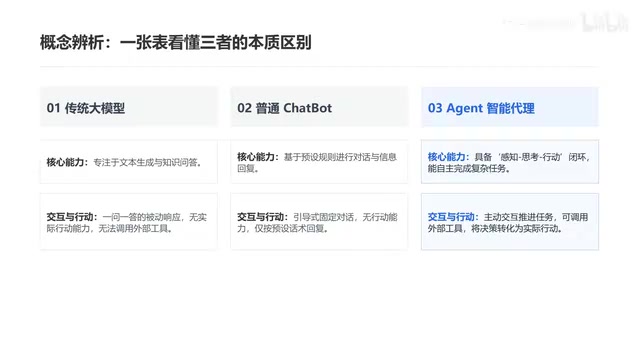
Many people conflate large models, ordinary chatbots, and Agents. The tutorial draws clear boundaries with a comparison table and pairs it with a vivid analogy.
- Traditional large model is like a universal encyclopedia: it can answer anything, but it won't take action for you. Ask it how to make tomato and egg stir-fry, and it gives you a recipe—it won't cook the dish for you.
- Ordinary chatbot is like a bank ATM: it can only operate according to preset options on the screen. Withdrawing money and checking balances are fine, but if you say "transfer half to my mom and put the rest in a fixed deposit," it's outside the preset flow.
- Agent is a dedicated personal assistant: you just say you want tomato and egg stir-fry, and it looks up recipes, checks the fridge, orders missing ingredients online, and finally walks you through cooking it step by step.
From a capability perspective, the gap between the three shows up on three levels: in core capabilities, large models only have text generation and knowledge Q&A, ordinary chatbots rely on preset rule-based replies, while Agents possess a complete "perception—thinking—action" loop; in interaction style, the former two passively wait or use fixed scripts, while Agents can proactively advance tasks and invoke external tools; in task handling, large models can only handle single-step simple tasks, chatbots get stuck when deviating from preset flows, while Agents can handle multi-step complex tasks with full-process automation.
Deconstructing an Agent: The Three-Layer Architecture of Perception, Thinking, and Action
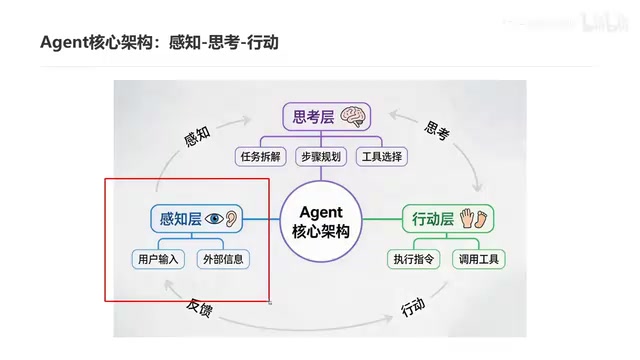
The internal structure of an Agent isn't mysterious. The tutorial breaks it down into three layers.
The perception layer is the eyes and ears, responsible for receiving user input and external information—what you say and data retrieved from the internet all enter from here. The thinking layer is the brain and the most core part: decomposing requirements into specific steps, planning the sequence, and deciding which tools to invoke at each step. The action layer is the hands and feet, strictly executing the instructions issued by the thinking layer and invoking corresponding tools to complete operations.
The key is that this is not a one-time pipeline but a loop. After the action layer executes, it feeds results back to the thinking layer, which judges whether the task is complete; if not, it continues planning the next step until the entire task loop closes. This feedback-driven loop structure is what distinguishes an Agent from a simple assembly of "large model + tool calling."
Tool Use / Function Calling is the key mechanism for understanding the action layer. A large model itself can only output text and cannot directly operate external systems. Tool calling allows the model, when generating a response, to output a structured invocation instruction (e.g., "query flights" with parameters such as origin, destination, and date), which an external program executes and returns the result to the model, which then continues reasoning based on it. It is precisely this mechanism that makes "the thinking layer decides which tool to invoke, and the action layer executes" possible, and it is also the technical foundation for an Agent to book flights, send messages, and query databases.
Task Planning and Task Decomposition are the core capabilities of the thinking layer. Facing a goal like "the cheapest flight from Beijing to Changsha next Friday," an Agent needs to first break it into subtasks such as querying dates, comparing prices, filtering, and placing orders, then sequence them and handle dependencies. Common approaches include ReAct-style reasoning, where the model decomposes steps on its own, and the Plan-and-Execute pattern, which plans first and executes afterward. Planning quality directly determines whether an Agent can handle multi-step complex tasks, and it is also the watershed that distinguishes it from single-turn Q&A.
Long-term Memory is an important component that makes up for the shortcomings of traditional large models. A large model's context window is limited, and information is lost after the conversation ends, making it difficult to remember user preferences or historical progress. Agents typically introduce external memory storage to persist key facts, historical interactions, and task states, then retrieve them back into context when needed. This allows it to maintain coherence across sessions and long-cycle tasks, and it is also the prerequisite for a "personalized learning planning Agent" to continuously track incorrect answers and study time.
Why Agents Are the Necessary Path to AGI
The tutorial provides a three-stage framework to answer this question. The first stage is perceptual intelligence, where AI can see and hear, with image recognition and speech recognition as representative achievements; the second stage is cognitive intelligence, where large models enable AI to understand, generate, and reason; the third stage is action intelligence, where AI cannot just stay at "thinking" but must also be able to "do."
The value of Agents lies precisely in filling the last link. Therefore, it should not be understood as adding a plugin to a large model, but as the path for AI to move from cognitive intelligence toward artificial general intelligence. This judgment aligns with the industry's positioning of Agents, but the tutorial itself is a single-source opinion output, and readers can cross-verify with other materials.
Application Scenarios: The Education Industry Is Already Running Ahead
The tutorial focuses on education scenarios because they are most directly relevant to learners.
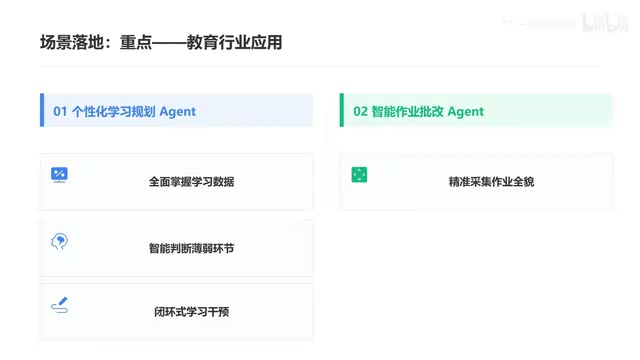
A personalized learning planning Agent collects data such as exam scores, incorrect answer records, and daily study time, analyzes weak knowledge points, and formulates a dedicated study plan accordingly—pushing corresponding practice questions daily, generating explainer videos, and reminding study times. An intelligent homework grading Agent can recognize handwritten assignments and automatically grade them. More importantly, it doesn't just give right or wrong answers; it also analyzes the reasons for mistakes, generates an incorrect-answer notebook, and pushes targeted explanations—freeing teachers from heavy grading work and returning time to teaching.
The application logic in other industries is similar: smart office automatically organizes minutes, assigns to-dos, and generates weekly reports; smart e-commerce acts as a dedicated shopping guide and after-sales service; finance provides intelligent investment advisory analyzing market conditions and risk preferences; healthcare assists with consultations and case organization. The common thread of Agents in these scenarios is that they transform from passively responding instruction tools into collaborators that proactively perceive needs, proactively plan paths, and proactively solve problems.
Learning Path and Hands-On Preview
The tutorial leaves three assignments: summarize in your own words the essential differences between large models, chatbots, and Agents (within 300 words); list an Agent application scenario from daily life and explain its core value; preview the activation process of the Alibaba Bailian cloud platform. The next lesson will deeply deconstruct the operating principles of the perception, thinking, and action layers, demonstrate the complete workflow with a Bailian cloud learning assistant case, and introduce the platform's three development modes and their applicable scenarios.
Following the tutorial's pace, it's recommended to first register an account and familiarize yourself with the console interface before moving into hands-on practice—the follow-along experience will be much smoother.
One-line Summary
Agents use large models as the brain, completing the perception, thinking, and action loop to move AI from passive Q&A toward proactive problem-solving.
Paragraph Summary
The article points out that although traditional large models can write copy and answer questions, putting them into real workflows exposes shortcomings: passive response, no long-term memory, and lack of task planning. The tutorial uses three analogies—an encyclopedia, an ATM, and a personal assistant—to distinguish large models, ordinary chatbots, and Agents: only Agents possess a complete "perception—thinking—action" loop, can proactively advance multi-step tasks, and can invoke external tools. Internally, they consist of a perception layer, thinking layer, and action layer, and through a feedback loop they continuously plan until the task loop closes. The article argues that Agents fill the key link for AI to move from cognitive intelligence to action intelligence and are the necessary path to AGI. It also uses personalized learning planning and intelligent homework grading in education as examples to illustrate application scenarios, and finally provides a learning path and hands-on preview.
Related articles

Private Key Set to 4? CA's Elementary Mistake Leaves TLS Exposed
CA eMudra set private keys to tiny values like 4, making TLS certificates brute-forceable. A Computerphile video demonstrates the full process from extracting public keys to forging certificates, and explores the fragility of the PKI trust chain.

How Gen Turns Data into Decisions with ChatGPT Work
In an OpenAI user case, business leader Gen shares how ChatGPT Work turns data into decisions: within hours of launch, teams can judge whether integrations and onboarding flows work, shifting decision iteration from hundreds of trial-and-error attempts to a fast feedback loop.

ChatGPT vs. Claude In-Depth Comparison: Strong at Coding but Weak at Research — How to Bridge the Gap?
A user considers switching from ChatGPT to Claude, finding Claude stronger at coding but shallower at research. We analyze the differences and share tips to make Claude's research deeper.