ChatGPT vs. Claude In-Depth Comparison: Strong at Coding but Weak at Research — How to Bridge the Gap?

Users debate switching from ChatGPT to Claude, and the community explores how prompt engineering can fix Claude's weak research.
Starting from a Reddit user's confusion, the article examines how Claude and ChatGPT differ in coding and research. The user found Claude more precise at coding but shallow in web research, browsing only a few sites, while ChatGPT explores 20–30 sources. The article attributes this to design philosophy and tool integration, and shows Claude's research can be greatly improved through explicit prompts, step-by-step guidance, project knowledge bases, and external tools. The community is divided: some say ChatGPT research is more comprehensive, others say Claude's potential is underestimated and hinges on prompt engineering. Whether to switch depends on the main use case — Claude for coding, ChatGPT or a combination for research — and optimizing workflows can narrow the gap.
User Dilemma: Weighing Coding Against Research
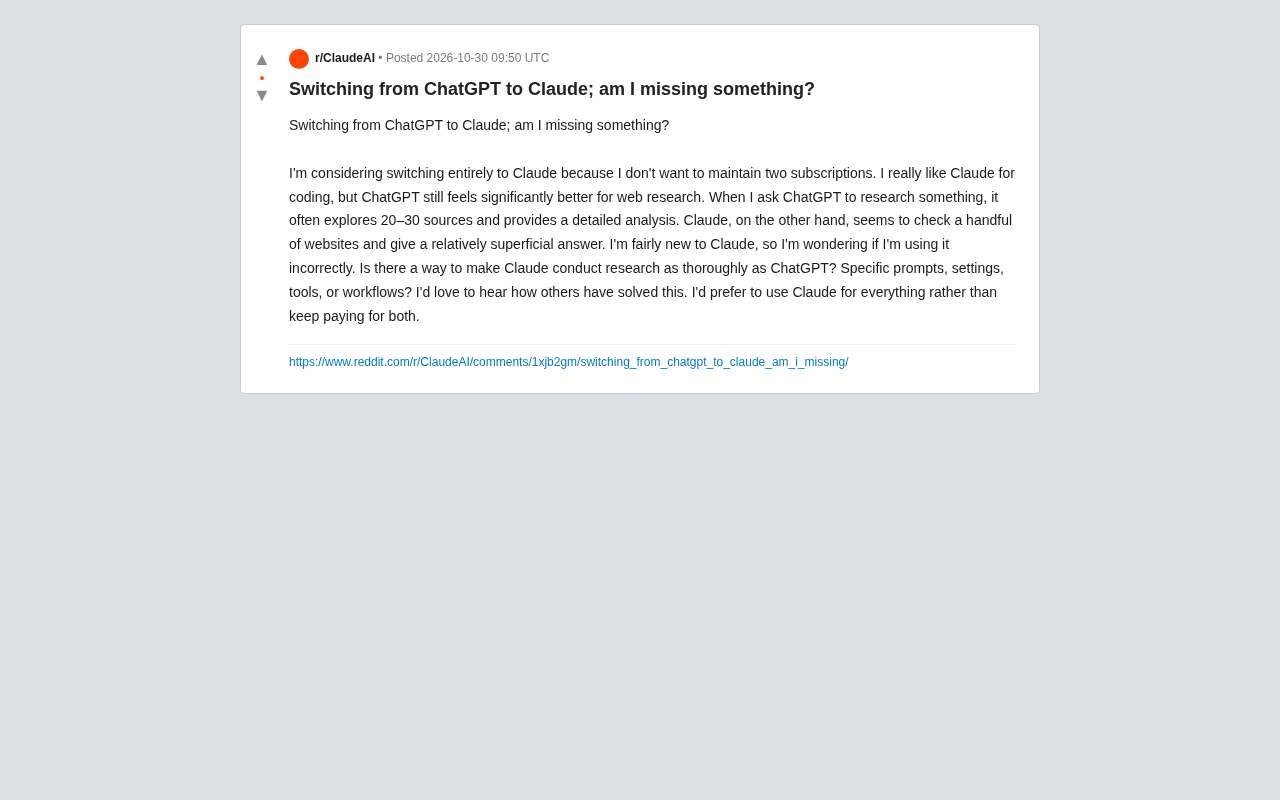
When choosing an AI assistant, many users face a tough decision: subscribe to multiple services, or focus on just one? Recently, a Reddit user posted that he is considering switching entirely to Claude because he doesn't want to maintain two subscriptions, but he found that Claude excels at coding while falling far short of ChatGPT in web research. He noted that when researching a question, ChatGPT typically explores 20–30 sources and provides detailed analysis, whereas Claude seems to check only a few websites and gives relatively shallow answers. As a Claude beginner, he wonders whether he's using it wrong and is seeking specific prompts, settings, tools, or workflows to help Claude conduct more thorough research.
This user's experience is not unique. Many developers and tech enthusiasts have noticed that Claude often has the edge in code generation, explanation, and debugging, with more precise and contextually appropriate answers. However, when tasks shift to research-oriented questions that require extensive information gathering and synthesis, ChatGPT seems better at extracting information from multiple sources and generating comprehensive reports. This difference may stem from their different emphases in design goals, training data, and tool integration.
According to the user, ChatGPT actively browses a large number of web pages (20–30) during research, while Claude's browsing scope is limited, resulting in insufficient depth. This raises a key question: Is Claude really bad at research, or is the user simply not using the right approach?
Claude's Research Capabilities: Limitations and Potential
Claude's research capabilities are not inherently weak. In fact, Anthropic has equipped Claude with web search functionality, but its default behavior may be conservative, or it may require more explicit instructions to trigger deep exploration. Some experienced users point out that carefully designed prompts can guide Claude to conduct more comprehensive research. For example, explicitly asking Claude to "gather information from at least 10 different sources," "compare similarities and differences between viewpoints," or "provide citations" can significantly improve the quality of its research output.
In addition, Claude supports a "Projects" feature that allows users to upload documents or set up a knowledge base, which can partially compensate for the limitations of web search. For research in specific domains, users can preload relevant materials and have Claude analyze them, yielding deeper results.
How Web Search and Deep Research Features Work
Claude's web search is not autonomous browsing enabled by default; rather, it is on-demand retrieval implemented through tool use. When a user asks a question, the model determines whether internet access is needed, generates search queries, and an external search API returns result snippets, based on which the model generates its answer. This mechanism differs from ChatGPT's "browsing" mode: the latter often has more proactive multi-round crawling and link-following strategies built in, automatically traversing a large number of pages. Claude's conservatism partly stems from its safety alignment design — the model tends to avoid unconfirmed broad crawling to reduce hallucinations and incorrect citations. Therefore, if users want broader coverage, they need to explicitly request in the prompt to "search multiple sources" or "list all relevant links," rather than relying on the model's default behavior.
Practical Tips: Making Claude's Research More In-Depth
If you want Claude to perform more like ChatGPT on research tasks, try the following strategies:
- Specify research scope and depth: In the prompt, specify the aspects to cover, the number of sources, or the time range, e.g., "Please search for reports on XX from the past month and summarize the main viewpoints from at least 15 sources."
- Guide step by step: Break complex research into multiple steps — first have Claude list key sub-questions, then dig into each one, and finally synthesize.
- Use tools and plugins: Claude supports web search; make sure this feature is enabled, and try "research mode" or similar options (if available).
- Combine with external tools: For extremely complex research, first use other tools (such as Perplexity) for preliminary information gathering, then feed the results into Claude for deeper analysis.
- Provide examples: Give Claude a sample ideal research report and have it mimic the structure and depth.
Some community users also share that role-playing prompts (e.g., "You are a senior researcher; please complete the following investigation to academic standards") can elicit more rigorous research behavior from Claude.
Why "Source Count" Instructions in Prompt Engineering Work
When generating responses, large language models implicitly allocate an "exploration budget" based on the constraints in the prompt. When the prompt explicitly specifies "at least 10 sources" or "cover 20 reports," the model treats these numbers in its internal reasoning as constraints to satisfy, thereby triggering more search queries and longer information synthesis chains. Conversely, a vague "help me research this" is interpreted by the model as a low-constraint task, leading it to do only a few retrievals before giving a general answer. This phenomenon is related to the model's instruction-following training: explicit quantitative requirements activate more systematic reasoning paths. However, more sources are not always better — excessive mandatory requirements may cause the model to cobble together low-quality sources, so it is advisable to also require "prioritize authoritative sources" and verify citations.
Multi-Source Perspectives: Consensus and Disagreement in the Community
In discussions on Reddit and related forums, most users agree on Claude's advantages in coding tasks but are divided on its research capabilities. Some users believe ChatGPT's web research is indeed more comprehensive, especially its "browsing" mode, which can autonomously explore a large number of links; others emphasize that Claude's output quality depends more on prompt engineering, and that once the techniques are mastered, its research depth is on par with ChatGPT.
Some users also point out that the difference in research may stem from the underlying design philosophies of the two models: ChatGPT tends to gather information broadly to cover more possibilities, while Claude focuses more on accuracy and relevance, which may make it appear conservative. This difference has no absolute superiority or inferiority; it depends on specific needs.
Conclusion: Choose Based on Needs or Use in Combination
Whether to give up ChatGPT and switch entirely to Claude depends on your primary use cases. If you spend most of your time coding, Claude may be the more efficient choice; but if you frequently need in-depth web research, keeping ChatGPT or combining it with other research tools may be wiser. For users determined to keep just one subscription, Claude's research capabilities can be significantly improved by optimizing prompts and workflows, though it may require more manual guidance.
Ultimately, tools serve people. Understanding each model's characteristics and flexibly adjusting your usage strategy is the way to maximize their value. Perhaps in the era of subscription economics, learning to "do more with one tool" is also a skill worth investing in.
One-line Summary
Users are torn over abandoning ChatGPT for Claude, and the community discusses how prompt engineering can compensate for Claude's research shortcomings.
Paragraph Summary
Starting from a Reddit user's confusion, the article explores the differences between Claude and ChatGPT in coding and research tasks. The user found Claude more precise at coding but shallow in web research, browsing only a few sites, while ChatGPT explores 20–30 sources. The article analyzes that this difference stems from design philosophy and tool integration, but Claude's research capabilities can be significantly enhanced through explicit prompts, step-by-step guidance, project knowledge bases, and external tools. The community is divided: some believe ChatGPT research is more comprehensive, while others believe Claude's potential is underestimated and depends on prompt engineering. The conclusion is that whether to switch depends on the primary use case — Claude for coding-focused users, while research-focused users should keep ChatGPT or combine both, emphasizing that optimizing workflows can narrow the gap.
Related articles

WebMCP Security Guide: Three Hints That Make AI Agents Safer
The Chrome team demonstrates three security hints for WebMCP tools: readOnlyHint eliminates invalid confirmation dialogs, consequentialHint forces human confirmation for high-risk operations, and untrustedContentHint defends against indirect prompt injection—improving AI agent security with one or two lines of code.

Why Turbulence Is the Hardest Problem in Fluid Mechanics — and How AI Could Crack It
Why is turbulence the hardest problem in fluid mechanics? This article, based on a Lex Fridman podcast conversation, explores turbulence's multi-scale nature, comparisons with classical thermodynamics, and how AI might simplify turbulence description by discovering coordinate transformations — examining the intersection of vortex formation with mathematics and physics.

R.L. Stine Google Talk: How the Master of Horror Ignites Kids' Passion for Reading
At a Google talk, R.L. Stine shares his accidental pivot from comedy to horror, his principles for children's horror, how phones impact storytelling, and how Goosebumps motivates kids to read.