Agent Hook Security Mechanisms Compared: Claude Code, Codex, Cursor, and Gemini CLI — Which Is Most Reliable?

Most coding agents default to letting operations through when hooks fail; Claude Code adds an opt-in blocking option.
An independent developer tested the policy hook failure behavior of Claude Code, OpenAI Codex, Cursor, and Gemini CLI, finding that when hooks crash, time out, or scripts are missing, most tools default to fail-open, letting operations through — rendering security checks useless when they're needed most. Claude Code's v2.1.295 adds an `onFailure: block` option for fail-closed behavior, but it's opt-in, so unconfigured users still default to letting things through. The four tools respond inconsistently across the three failure scenarios, so the same hook may behave differently across tools. For sensitive file access control, dangerous command interception, and compliance enforcement, silently failing hooks can bring data leakage or irreversible operation risks.
When you configure a policy hook in a coding agent to block dangerous operations, what happens if the hook itself crashes, times out, or points to a nonexistent script? The answer may surprise you: most tools default to "letting it through." This means a failed security check actually becomes a security risk.
An independent developer and tech blogger recently conducted a hands-on comparison of the hook failure behavior across four mainstream coding agents — Claude Code, OpenAI Codex, Cursor, and Gemini CLI — revealing significant differences in how each tool enforces security policies.
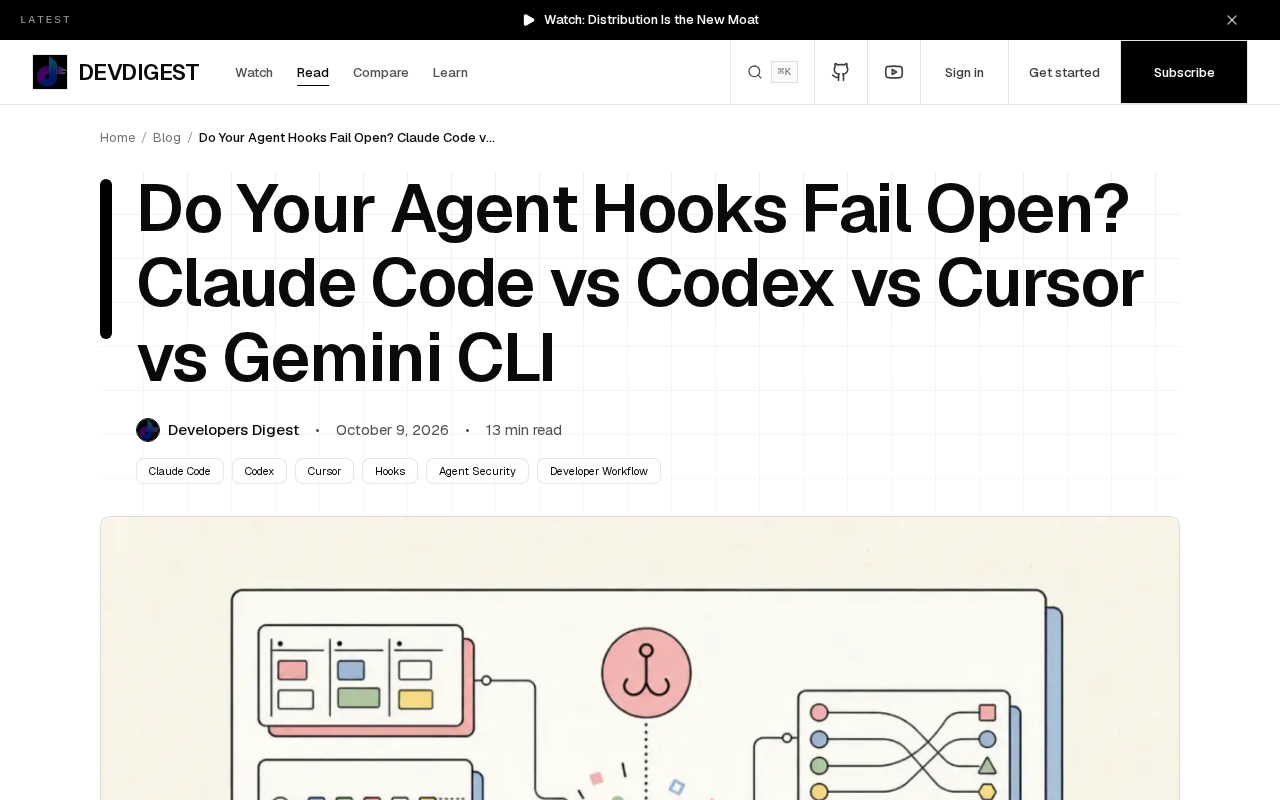
Key Finding: Most Agents Default to Fail-Open
"Fail-open" means that when a security mechanism fails, the system chooses to let the operation through; "fail-closed" is the opposite — when it fails, it blocks by default. In the coding agent context, this choice directly determines whether policy hooks can actually provide protection.
Test results show that when a hook crashes, times out, or the script is missing, Claude Code's default behavior is to let the tool call pass through. In other words, your carefully configured protection rules become useless at the very moment they're needed most — when the hook itself runs into trouble.
This finding isn't isolated. According to the tester's hands-on records, Codex, Cursor, and Gemini CLI each behave differently in hook failure scenarios, but a fail-open tendency dominates across most tools.
Policy hooks are an extension mechanism provided by coding agents: developers attach custom scripts or functions before and after the agent executes tool calls (such as reading/writing files, running shell commands, or making network requests) to audit, modify, or even veto the operation. Typical use cases include blocking reads of .env, preventing git push --force, or logging every operation to an audit trail.
A hook's reliability depends on the external script itself, and scripts can crash due to syntax errors, time out due to network or resource issues, or become unfindable due to path changes. Once a hook can't return a valid "allow/deny" verdict, the agent must choose between "default allow" and "default block" — this is the root of the fail-open vs. fail-closed debate. Understanding this is the prerequisite for evaluating each tool's security: a hook only constitutes a truly enforced policy if it can still block when it fails.
Claude Code v2.1.295: New onFailure:block Option
Claude Code introduced the onFailure: block configuration in v2.1.295, allowing developers to explicitly specify that hook failure behavior should be blocking. This can be seen as a remediation of the security default.
But note: this is an opt-in option, meaning you need to actively configure it to get fail-closed behavior. For users who haven't upgraded or configured it, the default remains to let things through.
From a design philosophy perspective, Claude Code's choice is understandable — overly aggressive blocking could frequently interrupt normal workflows and hurt user experience. But when hooks are used for security policies (such as blocking access to sensitive files or restricting network requests), the fail-open default deserves reconsideration.
opt-in vs. secure by default is a pair of key concepts in security design. Opt-in means secure behavior requires the user to actively enable it, with the default state being insecure; secure by default requires the system to maintain the most conservative, safest posture even when the user configures nothing.
By making onFailure: block opt-in, Claude Code's practical effect is: the vast majority of users — especially those who haven't upgraded or aren't aware of the option — still run in a fail-open state. The security community generally holds that access-control-related capabilities should follow the secure by default principle, treating "turning off security" as a decision that requires explicitly accepting risk, rather than treating "turning on security" as an extra burden. This trade-off also explains why this version is seen as a "remediation" rather than a "fix."
Hands-On Comparison: Behavioral Differences Across Four Tools
The test covered three typical failure scenarios: hook script crashes, execution timeout, and nonexistent script path.
Different tools respond differently in each scenario. Some tools choose to let things through on timeout (to avoid blocking workflows), but abort with an error when the script is missing (since this usually indicates a configuration error). Others uniformly adopt a fail-open strategy.
This inconsistency is itself a problem: when teams switch between multiple coding agents, a hook with the same name may produce completely different security behavior.
The reason three failure scenarios lead to different responses comes down to different design trade-offs. Script crashes usually mean the hook logic itself has a bug; letting things through avoids blocking but may also mask a protection that should have been in effect. Execution timeouts mostly occur when the hook calls external services or does heavy computation; if the default were to block, a single network hiccup could freeze the entire session, so some tools lean toward letting things through. Nonexistent script paths are almost always configuration errors, and aborting with an error is more developer-friendly here because it immediately surfaces the problem instead of letting a "fake security" run silently.
It's precisely these differentiated treatments for different scenarios that create cross-tool behavioral inconsistency. When the same hook configuration is migrated between Claude Code, Codex, Cursor, and Gemini CLI, developers can hardly predict intuitively whether a failure will block or let through, adding extra cost to establishing a unified security baseline across teams.
Practical Impact on Developers
If you're using hooks for the following tasks, fail-open behavior is worth watching out for:
- Sensitive file access control: Blocking agents from reading
.env, key files, or credential directories - Dangerous command interception: Blocking high-risk operations like
rm -rforgit push --force - Compliance policy enforcement: Ensuring agent operations comply with team or industry standards
In the above scenarios, a silently failing hook can bring real data leakage or irreversible operation risks.
The recommended approach: regularly test your hook's failure behavior to ensure it still blocks as expected under abnormal conditions. For Claude Code users, upgrading to v2.1.295 and configuring onFailure: block is the most direct improvement.
Industry Reflections on Secure Defaults
This set of tests reveals a broader issue: in an era of rapid AI coding agent iteration, security mechanism design often prioritizes "usability" over "security." Fail-open as a default may be reasonable at a stage when the toolchain is still immature and users don't rely heavily on hooks, but as agents are given more and more autonomy, this default may need to be flipped.
At minimum, tools should make it crystal clear to developers: when my hook fails, what exactly happens?
One-line Summary
Most coding agents default to letting operations through when hooks fail; Claude Code adds an opt-in blocking option.
Paragraph Summary
An independent developer tested the policy hook failure behavior of four coding agents — Claude Code, OpenAI Codex, Cursor, and Gemini CLI — finding that when hooks crash, time out, or scripts are missing, most tools default to fail-open, letting operations through, rendering security checks that should block dangerous actions useless when they're needed most. Claude Code added the onFailure: block configuration in v2.1.295 to achieve fail-closed behavior, but it's opt-in; unconfigured users still default to letting things through. The four tools respond inconsistently across the three scenarios of crashes, timeouts, and missing scripts, meaning the same hook may produce different security behavior when teams switch between tools. For scenarios like sensitive file access control, dangerous command interception, and compliance policy enforcement, silently failing hooks can bring data leakage or irreversible operation risks.
Related articles

iPhone Duo vs Z Fold 8: Which Foldable Nails Cover Screen and Form Factor Experience Better?
Based on a YouTube comparison, we analyze the iPhone Duo vs Samsung Z Fold 8 in cover screen ratio, one-handed grip, pocketability, app adaptation, multi-posture use, and keyboard input.

Why Tech Media Always Gets Accused of "Shilling"? The Verge Editor-in-Chief Responds to Bias Allegations
After The Verge's Duo review drew accusations of bias, Editor-in-Chief Nilay Patel responds: no paid reviews, no brand deals, editorial independent of sales, and details the ethics policy.

Claude Code 3x Speedup: Thanks to 1997's GZip Technology
Claude Code achieves 3x faster local sessions and 2.8x faster cloud sessions by enabling GZip compression. This article analyzes how this classic technology optimizes message transmission efficiency in AI coding tools and what it means for developers.