Why Tech Media Always Gets Accused of "Shilling"? The Verge Editor-in-Chief Responds to Bias Allegations

The Verge editor-in-chief responds to bias claims, revealing the operational boundaries and trust dilemma of editorial independence.
After The Verge scored the Duo 7, it was accused of taking Samsung's money to smear Apple. Editor-in-Chief Nilay Patel noted the same accusations appear in reverse for Samsung reviews, a self-contradictory logic. He disclosed The Verge's ethics policy: no reading ad copy, no brand partnerships, editorial fully separated from sales—the core being "you can't pay us to say anything." The article argues a public ethics policy offers a testable standard even if it can't eliminate doubts, and distinguishes news media from independent creators on monetization.
There's a persistent conspiracy theory in tech review circles: when a media outlet gives a product a high score, is it because they took money from the manufacturer? After The Verge published its review of the Duo with a score of 7, the comments section once again saw accusations of "taking Samsung's money to smear Apple." Editor-in-Chief Nilay Patel addressed these concerns head-on in a video, and in doing so, also pulled back the curtain on the business model of tech media.
The "Double-Dipping" Accusation Logic
The phenomenon Patel mentions is quite interesting: when The Verge reviews Apple products, some people accuse them of taking Samsung's money to deliberately belittle Apple; then when they review Samsung products, the same group turns around and accuses them of taking Apple's money to smear Samsung.

The absurdity of this accusation lies in its self-contradiction—if a media outlet really could be bought off by two bitter rivals at the same time, its business model would be far too successful. Patel's quip hits the mark: "If that were true, I'd probably be sailing around the world running The Verge from a boat."
However, the trust crisis behind such comments deserves serious attention. When users have strong emotional identification with a brand they love, any score below expectations is easily interpreted as "being bought off by a competitor." This is a structural dilemma in the review industry, and it won't be solved by a single response.
Where Are the Boundaries of the Business Model?
Patel's response reveals several specific practices that outline the operational boundaries of The Verge's editorial independence:
Not reading ad copy. Even for ads in their own podcasts, Patel himself doesn't participate in voiceovers. His stance: "You can't pay me to read ad copy."
No brand partnerships or sponsorships. This isn't uncommon in tech media, but few explicitly list it as a principle and publicly explain it.
Complete separation between editorial and sales teams. This is the most critical point—there is no reporting relationship or business collaboration between the team that sells ads and the team that produces content.
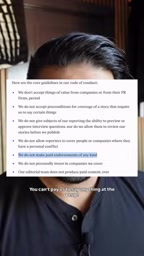
Patel emphasized that these practices are written into The Verge's ethics policy. He was careful to note that this isn't meant to disparage other creators or media outlets—"This industry is hard, and I want everyone to be able to make money and build an audience in their own way"—but rather to explain that The Verge operates differently, with the core difference being "you can't pay us to say anything."
Editorial Independence is a core principle in journalistic ethics, meaning that decisions about media content production are not subject to interference from advertisers, sponsors, owners, or external political forces. In the context of tech media, it typically manifests as three specific rules: organizational separation between advertising and editorial content (the so-called "separation of church and state"), journalists not participating in ad sales, and not accepting commercial partnerships conditioned on positive coverage. The Society of Professional Journalists (SPJ) Code of Ethics explicitly requires journalists to "refuse gifts, favors, fees, free travel and special treatment" and to "avoid conflicts of interest." But the code itself has no enforcement power, and enforcement varies widely across outlets. The reason The Verge's publicly disclosed operational details (the editor-in-chief doesn't read ads, no reporting relationship between sales and editorial) are noteworthy is that they translate abstract principles into specific behavioral constraints that can be externally observed.
Can Ethics Policies Solve the Trust Problem?
What needs to be viewed objectively is that a public ethics policy cannot automatically eliminate readers' doubts. For ordinary users, organizational commitments like "editorial is independent of the sales team" are neither directly verifiable nor easily quantifiable.

But Patel's response at least provides a testable standard: whether a media outlet publicly acknowledges that it accepts paid content, brand partnerships, or sponsorships. Readers can use this standard to examine any tech media outlet—including The Verge itself. If a media outlet has a clear ethics policy and can provide specific operational details when questioned (such as the editor-in-chief not reading ads, sales and editorial being separated), then its credibility has a basis for discussion.
Conversely, outlets that never explain their business model, mix advertising with content, and respond only emotionally when questioned are the ones truly worth being wary of.
Sponsored Content / Native Advertising and brand partnerships are among the main forms of media monetization today, and the ethical controversy centers on the word "disclosure." The U.S. Federal Trade Commission (FTC)'s advertising endorsement guidelines require that when ads resemble editorial content in form, they must be labeled in a clear and conspicuous manner to avoid consumer confusion. The problem is that "conspicuous" lacks a unified standard: some outlets write "presented by [brand]" in a font identical to the body text, while others explain it in small print in the footer. For readers, a low-cost way to judge whether a media outlet is trustworthy is to check whether it has a dedicated "ethics policy" or "conflicts of interest" page, whether paid content has a consistent and prominent label, and whether it is willing to disclose specific commercial relationships when questioned. This information reflects a media outlet's operating logic better than the scores themselves.
Implications for Content Creators
Patel specifically mentioned "this isn't directed at creators," which actually points to an industry reality: the monetization methods of YouTubers and independent creators (brand partnerships, sponsored voiceovers) are indeed different from the ethical standards of news media. This doesn't mean independent creators are untrustworthy, but it does mean readers need to know what they're looking at—editorially independent content, or commercially partnered content.

Transparent disclosure is more valuable than pretending to be pure. The Verge's approach may not suit all media outlets, but by putting the question of "how to separate money from content" on the table, it is itself more meaningful than avoiding the question. For readers, rather than agonizing over whether a media outlet is "shilling," it's better to first see whether it dares to explain its business model clearly.
One-line Summary
The Verge editor-in-chief responds to accusations of taking money, revealing the operational boundaries and trust dilemma of editorial independence in tech media.
Paragraph Summary
After The Verge gave the Duo a score of 7, it faced accusations of "taking Samsung's money to smear Apple." Editor-in-Chief Nilay Patel pointed out that similar accusations appeared in reverse when reviewing Samsung, making the logic self-contradictory. He used this opportunity to publicly disclose The Verge's ethics policy: not reading ad copy, no brand partnerships or sponsorships, complete separation between editorial and sales teams, with the core being "you can't pay us to say anything." The article argues that while a public ethics policy cannot fully eliminate reader doubts, it provides a testable standard—whether a media outlet discloses its own business model. The article also distinguishes between the different monetization standards of news media and independent creators, emphasizing that transparent disclosure is more valuable than pretending to be pure.
Related articles

Cursor AI Programming in Practice: Build a Student Management System from Scratch in 30 Minutes
A Bilibili creator demonstrates Cursor AI programming: generating a student management system in 30 minutes with natural language. Details on Agent mode, Claude selection, prompt techniques, and thresholds.

Top 20 AI Coding Tools Ranking: From Rock-Solid to Lackluster, a Scored Matrix
Bilibili creator releases top 20 AI coding tools ranking, tiered T0–T4 from rock-solid to lackluster, with Claude Code and Codex tied at T0. This article details the scoring dimensions (capability, reliability, robustness, durability, cost, domestic availability) and tool performances to help developers choose the right AI coding assistant.

Vibe Coding Systematic Tutorial: Master AI-Assisted Programming from Zero
A three-month Vibe Coding tutorial from a Bilibili creator covering Codex, ClaudeCode, and Cursor, from core logic to commercial project practice for beginners.