Agent Loop Interview Essential: The Fundamental Difference from a Single LLM API Call

A four-dimension framework — lifecycle, tools, memory, deliverable — to explain Agent Loop vs. single LLM API call.
Using the first question from a popular "Agent Loop Interview: Ten Questions" series as a starting point, this article addresses a key shift in AI engineering interviews — from concept recall to implementation depth. It introduces a structured four-dimension framework to answer "What's the fundamental difference between an Agent Loop and a single LLM API call?": lifecycle (instantaneous vs. continuous loop), tool calling (text generation vs. active external resource use), memory (stateless vs. cross-step state accumulation), and deliverable (text output vs. task result). The four dimensions follow a logical progression that explains why an Agent is a system, not just a call.
The Interview Landscape Has Shifted: From "Do You Know It" to "How Would You Do It"
If you've been preparing for AI engineer or large model-related interviews recently, you've probably noticed a clear shift in what's being tested. Interviewers used to focus on whether you were familiar with a concept or had used certain frameworks. Now, the questions are increasingly focused on implementation details — How do you design an Agent Loop? Why should Maker and Checker be separated? How do you define the exit condition for a loop?
These questions are hard to answer well because they don't test memorization — they test whether you genuinely understand how Agent systems work under the hood. A weak answer here can stall an entire interview. This article focuses on the first question from an "Agent Loop Interview: Ten Questions" series compiled by a Bilibili creator, breaking down a question that seems simple but is surprisingly easy to fumble.

Question One: What Is the Fundamental Difference Between an Agent Loop and a Single LLM API Call?
This is the opening question of the entire series. On the surface, it looks basic — but precisely because it seems simple, it's the best at exposing the depth of the respondent's understanding.
A lot of people immediately say: "One can call tools, the other can't." That's not wrong, but it's too thin to demonstrate systematic thinking. What the interviewer actually wants to hear is whether you can articulate the differences in a structured way.
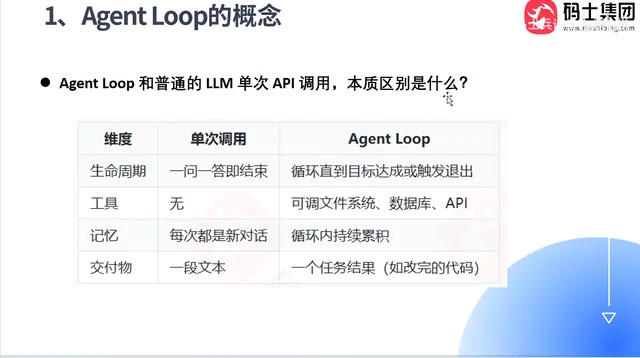
Build Your Answer Around Four Dimensions
Rather than offering a one-sentence conclusion, break the differences down into four dimensions and compare them one by one. This kind of answer is both clear and well-organized.
1. Lifecycle
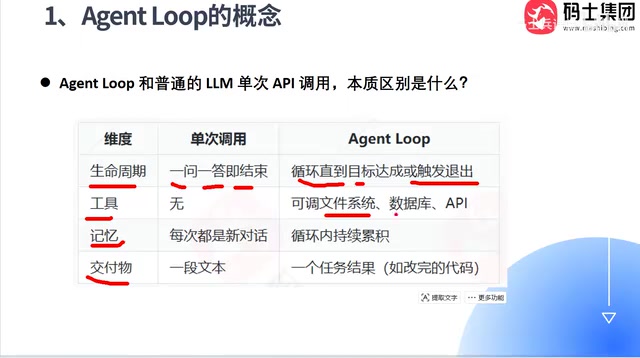
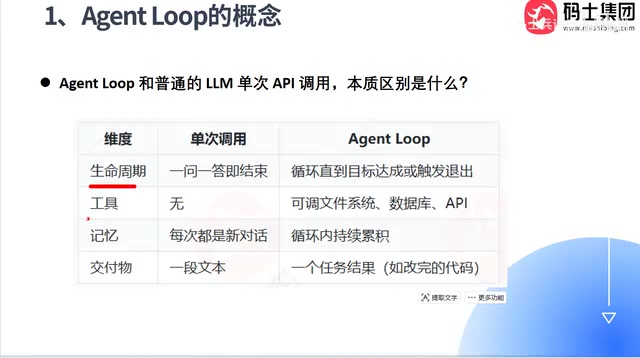
A standard single LLM call follows a "one question, one answer" pattern — a request is sent, a response is returned, and the cycle is complete. An Agent Loop, by contrast, is fundamentally a looping structure that keeps running until a goal is achieved or a predefined exit condition is triggered. The difference in lifecycle is the most fundamental distinction between the two — one is instantaneous, the other is continuously evolving.
2. Tool Calling
A single call typically doesn't involve external tools — the model simply generates text based on its existing knowledge. An Agent Loop can actively call external tools such as file systems, databases, and various APIs, using these capabilities to sense its environment, retrieve information, and execute actions. Tools are the key to how an Agent breaks free from the limitations of pure text generation.
3. Memory
Each single-call interaction is independent and starts fresh — context doesn't naturally carry over. An Agent Loop, however, can continuously accumulate state within the loop. It remembers what it did in the previous step and what results it obtained, allowing subsequent decisions to be grounded in accumulated information rather than starting from scratch.
4. Deliverable
The output of a single call is generally a piece of text. An Agent Loop delivers a task result — it might be fixed code, a completed report, or a successful database operation. In other words, the former gives you an answer; the latter gives you an outcome.
An Agent Loop refers to an autonomous task execution loop driven by a large language model. Its basic operating pattern is typically summarized as the iterative cycle of "Perceive–Plan–Act–Observe." In each iteration, the model formulates the next action based on the current state and goal, executes it, observes the result, and feeds that result as new input into the next round — until the task is complete or a predefined constraint is hit (such as a maximum step count or token budget). This architecture was first systematically articulated in the ReAct (Reasoning + Acting) paper and has since been widely implemented in mainstream frameworks such as AutoGPT, LangChain Agent, and the OpenAI Assistants API. Understanding the looping nature of an Agent Loop is a prerequisite for distinguishing it from a single API call — the latter only completes the "planning" step of the loop, with neither the ability to act nor the capacity to accumulate state across steps.
Why This Framework Works in Interviews
Breaking an open-ended question into four dimensions — lifecycle, tools, memory, and deliverable — works because it demonstrates structured thinking about Agent systems rather than scattered impressions. The interviewer can tell from your answer whether you truly understand why an Agent is a system rather than a single call.
These four dimensions actually share an underlying logical progression: because the system needs to run continuously (lifecycle), it needs tools to advance the task; because it progresses in a loop, it needs memory to maintain continuity; and the ultimate purpose of all of this is to deliver a complete task result, not a one-shot text output.
Once you understand this progression, you'll not only be able to answer this question well — you'll also have the foundation to tackle deeper questions about Maker/Checker separation, exit condition design, and more.
Maker/Checker separation is a reliability pattern in Agent system design: one Agent (the Maker) is responsible for generating or executing the task, while a separate, independent Agent (the Checker) is responsible for verifying the correctness and safety of the output. The core motivation for this separation is that large language models have a self-verification blind spot — when a model produces an error, it often also assigns high confidence to that error, making it difficult for the model to catch its own mistakes. Introducing an independent Checker breaks this "self-reinforcing" bias, analogous to code review in software engineering. In practice, the Maker and Checker can be different instances of the same base model, or two models with different capability profiles — the key is that they have independent contexts and evaluation perspectives. This pattern is a critical basis for designing Agent Loop exit conditions: only when the Checker passes verification is the loop allowed to terminate and deliver its result.
Summary
Agent Loop has become a high-frequency interview topic precisely because it is the core skeleton of Agent engineering in practice. When faced with questions like "What's the difference between an Agent Loop and a single API call?" don't stop at the level of "can it call tools or not." Instead, answer systematically across lifecycle, tools, memory, and deliverable. Mastering this framework is both a template for acing interviews and a genuine entry point into understanding how Agent systems actually work.
Related articles

How Big Can Stars Really Get? The Physical Limits of the Largest Stars
Red supergiants are the largest stars by volume, with radii up to 2,000 times the Sun, engulfing the inner solar system. But there is no precise upper limit on stellar size—models predict up to 15,000 solar radii. The most massive blue stars are far smaller than red supergiants—biggest and heaviest are two different things.

Apple HomeView Smart Display Full Feature Breakdown: Wall-Mount or Desktop, $299
Apple launches HomeView, a $299 smart display with wall-mount and desktop options, 12MP camera for facial recognition, smart home control, music playback, and recipe step-by-step cooking. Full breakdown of watch faces, apps, privacy, and cooking integration.

Where Did the Promised New Studio Go? Craft Computing Answers After Five Years
Craft Computing's host responds to viewer questions: the new studio promised five years ago was shelved as construction costs soared from $30,000 to $75,000, and was replaced by a 168-square-foot garage conversion.