Agent Memory Needs Its OpenTelemetry Moment

Agent memory layers are fragmented, and the community calls for a unified protocol standard modeled on OpenTelemetry.
The article centers on the Hacker News thread "Agent memory needs its OpenTelemetry moment", noting that current AI Agent memory layers lack a unified abstraction, with working, factual, and external knowledge memory stored and retrieved differently, causing severe framework lock-in and near-zero-basis cross-system migration. The community suggests adopting OpenTelemetry's protocol-first approach to define standard memory entry structures, read/write semantics, and observable events, making backends freely replaceable. Disagreements focus on timing: some fear premature consolidation stifles innovation, others argue protocol and implementation can be separated as fragmentation already wastes real costs.
Why Agent Memory Systems Urgently Need a Unified Standard
A remarkably insightful discussion thread recently appeared on Hacker News: "Agent memory needs its OpenTelemetry moment". With just 16 points and 10 comments, it points to a long-overlooked infrastructure gap — the memory layer of AI Agents is stuck in a fragmented, wild-west phase where everyone is fighting their own battle.
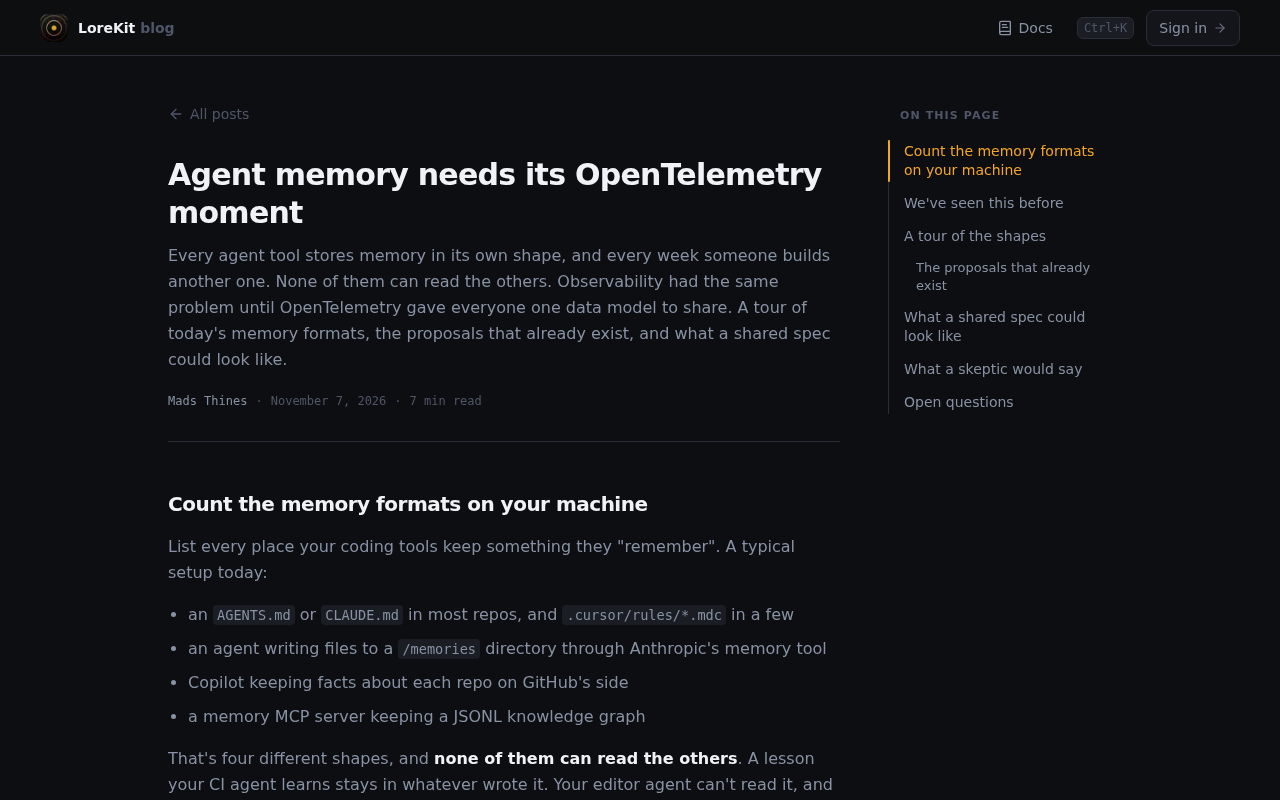
The analogy is so precise it makes you flinch. In the observability world, OpenTelemetry ended the chaos of incompatible data formats across APM tools with a single open telemetry protocol. Today's Agent memory systems are in exactly the state OpenTelemetry was in on the eve of its birth: every framework, every product, and every team stores, retrieves, and forgets memory in its own way, with no way to talk to each other.
Memory Is the Capability Foundation of Agents — and Also the Most Chaotic Layer
To understand why this matters, you first need to see where memory sits in the Agent architecture. For an Agent to complete complex tasks, it needs short-term working memory (the current conversation context), long-term factual memory (user preferences, historical decisions), and retrievable external knowledge memory. These three types of memory have completely different storage media, retrieval strategies, and lifecycle management.
The problem is that there is currently no common abstraction to describe them. When a developer switches to a different Agent framework, the memory layer has to be rewritten from scratch; migrating a user's accumulated memory from one Agent to another system is almost equivalent to starting from zero. This lock-in effect seriously slows down the iteration speed of Agent applications and makes cross-platform, cross-model Agent collaboration extremely difficult.
In the context of Agents, the engineering implementation of these three types of memory differs enormously. Short-term working memory is usually just the LLM's context window, constrained by the token limit and requiring strategies like sliding windows and summary compression; long-term factual memory is generally externalized as a vector database or key-value store, retrieved by semantic similarity, and needs to handle write deduplication, time decay, and conflict resolution; external knowledge memory often connects to a RAG pipeline, involving chunking, embedding, and reranking. All three share the word "memory", but their lifecycles range from a single conversation turn to several months, and their consistency requirements are completely different. Most current frameworks hardcode these three types of memory into their respective runtimes without replaceable abstract interfaces — this is precisely the root cause of the difficulty in cross-framework migration.
The Model Left by OpenTelemetry: Protocol First, Ecosystem Follows
One point repeatedly mentioned in community discussions is that OpenTelemetry's success lies not in how powerful an implementation it provides, but in that it defined a set of minimal yet complete interface semantics — trace, span, metric, log — and any implementation that conforms to these semantics can interoperate.
The Agent memory layer can fully adopt this approach: define the standard structure of a memory entry (content, source, timestamp, confidence, scope), define the semantics of read/write interfaces (write, retrieve, update, forget), and define observable events for memory (memory hit, memory pollution, memory conflict). With this layer of protocol, the memory backend can be a vector database, a knowledge graph, or a simple KV store, and the upper-layer Agent code does not need to be aware of the difference.
One detail worth noting: someone in the discussion pointed out that the observability of memory is as important as memory itself. When an Agent makes a decision based on erroneous historical memory, troubleshooting is nearly impossible without a standardized memory tracing mechanism. This is exactly where the value of the OpenTelemetry-style approach lies — it solves not only interoperability, but also observability.
OpenTelemetry is an open-source observability project under CNCF, formed in 2019 by the merger of OpenTracing and OpenCensus, with the goal of unifying the collection and transmission of telemetry data (Traces, Metrics, Logs) in distributed systems. Its core design is the three-layer separation of "API/SDK/protocol": the API only defines the interfaces for producing telemetry data, the SDK provides concrete implementations along with sampling and export strategies, and the OTLP protocol specifies the encoding format of data on the network. This layering allows application code to depend only on the API, so the backend can be swapped from Jaeger to Tempo, or from a commercial APM to a self-built stack, without changing a single line of business logic. The lesson for the Agent memory layer is that what truly needs to be standardized is not the storage engine or retrieval algorithm, but the three layers of contract — "what the data looks like, how operations are expressed, and how events are reported" — leaving the rest to free competition in the ecosystem.
Disagreement: Will Standardization Stifle Innovation?
The comment section is not unanimously in favor. Some argue that Agent memory is still in a phase of rapid evolution, and premature standardization may solidify immature designs into standards, thereby constraining innovation. After all, there is still a lot of unexplored space in memory retrieval strategies, compression methods, and forgetting mechanisms, and once the standard is fixed, the cost of implementing new ideas will rise.
Those supporting standardization counter that the protocol layer and the implementation layer can be separated — the standard only constrains interfaces and semantics, not internal implementations. OpenTelemetry itself does exactly this; it does not dictate which backend or which sampling strategy you must use. The essence of this disagreement is a difference in judgment about the "timing of standardization": should we consolidate after the landscape stabilizes, or establish the contract first amid the early chaos? Judging from the leanings in the HN comment section, most people believe that the fragmentation of the memory layer has already caused substantial waste of development costs, and the benefits of standardization are rapidly outweighing the benefits of waiting.
"Premature standardization stifles innovation" does have precedents in the history of technology, but there are also counterexamples. HTTP/1.1 was standardized early in the Web's life and did not hinder the explosion of the browser and application ecosystem, because it constrained only message semantics, not server implementations. To judge whether a domain is suitable for early standardization, two things are usually considered: whether the interfaces are already sufficiently stable, and whether the cost of fragmentation has become explicit. The read/write semantics of Agent memory (write, retrieve, update, forget) are already relatively stable, and the duplication of development effort and migration costs caused by fragmentation are being felt firsthand by more and more teams — this constitutes the argument for "establishing the contract first". The key is that the standard must be thin enough, covering only the semantic layer, and explicitly excluding the parts still evolving significantly, such as retrieval algorithms, compression strategies, and forgetting curves.
Several Possible Paths to Implementation
Judging from the direction of the discussion, the standardization of Agent memory is most likely to advance along a few paths. First, it could be jointly initiated by mainstream Agent frameworks, similar to the model in which OpenTelemetry was initially co-built by multiple vendors; second, a protocol layer could be abstracted on top of existing open-source memory libraries, allowing the community to converge naturally; third, cloud vendors could drive it out of the need for interoperability and migration, since memory lock-in is a major concern for customers moving to the cloud.
Whichever path is taken, the core is to first clarify three things: "what a memory entry looks like", "how read/write operations are expressed", and "how memory events are tracked". Once these three things are settled, the remaining retrieval algorithms, storage engines, and compression strategies can all flourish freely.
Conclusion
Agents are moving from demos to production, and the chaos of the memory layer will become an increasingly obvious bottleneck. The phrase "needs its OpenTelemetry moment" resonates because it points out a simple truth: the value of infrastructure lies not in showing off technical prowess, but in allowing upper-layer applications to confidently not care about it. Agent memory is due for its own common language.
One-line Summary
Agent memory layers are fragmented, and the community is calling for a unified protocol standard modeled on OpenTelemetry.
Paragraph Summary
The article centers on the Hacker News discussion thread "Agent memory needs its OpenTelemetry moment", pointing out that the memory layer of current AI Agents lacks a unified abstraction, and that short-term working memory, long-term factual memory, and external knowledge memory are stored and retrieved in different ways, leading to severe framework lock-in and cross-system migration that starts almost from zero. The community suggests adopting OpenTelemetry's protocol-first approach, defining standard structures for memory entries, read/write interface semantics, and observable events, so that backend implementations can be freely replaced. Disagreement in the comment section centers on the timing of standardization: one camp worries that premature consolidation will constrain innovation in memory retrieval, compression, and forgetting mechanisms, while the other believes that the protocol layer and implementation layer can be separated and that fragmentation has already caused substantial cost waste. Implementation paths may be driven by co-building among mainstream frameworks, convergence within the open-source community, or cloud vendors.
Related articles
 Tech Frontiers
Edge AI on Microcontrollers: When Is It Actually Worth Deploying?
Drawing on Reddit discussions and Arm case studies, this article analyzes the real-world use cases for edge AI on microcontrollers: when each device needs independent inference, when a gateway or cloud is more reasonable, and the costs and boundaries of specialized hardware.
 Tech Frontiers
Pushing the Limits of Extreme Sudoku on a 16GB GPU: Insights from Depth and Flow Matching
A researcher trained a 16.54M-parameter model on a 16GB GPU to solve extreme Sudoku, finding effective depth breaks the 60% plateau and flow matching with improved sampling pushes accuracy past 99% with ~50× lower layer-evaluation budget.
 Tech Frontiers
AI Agent Approval Workflows: Why Human Confirmations Always Get Mindlessly Clicked
Why do AI agent approval workflows always get mindlessly clicked? A Reddit discussion shows that separating rules from keys, low-frequency high-risk approvals, and GitHub Environments-style gates are the keys to effective approvals.