Agent Pets: Turn Coding AI into Browser Pets and Manage Claude Code Sessions Across Tabs
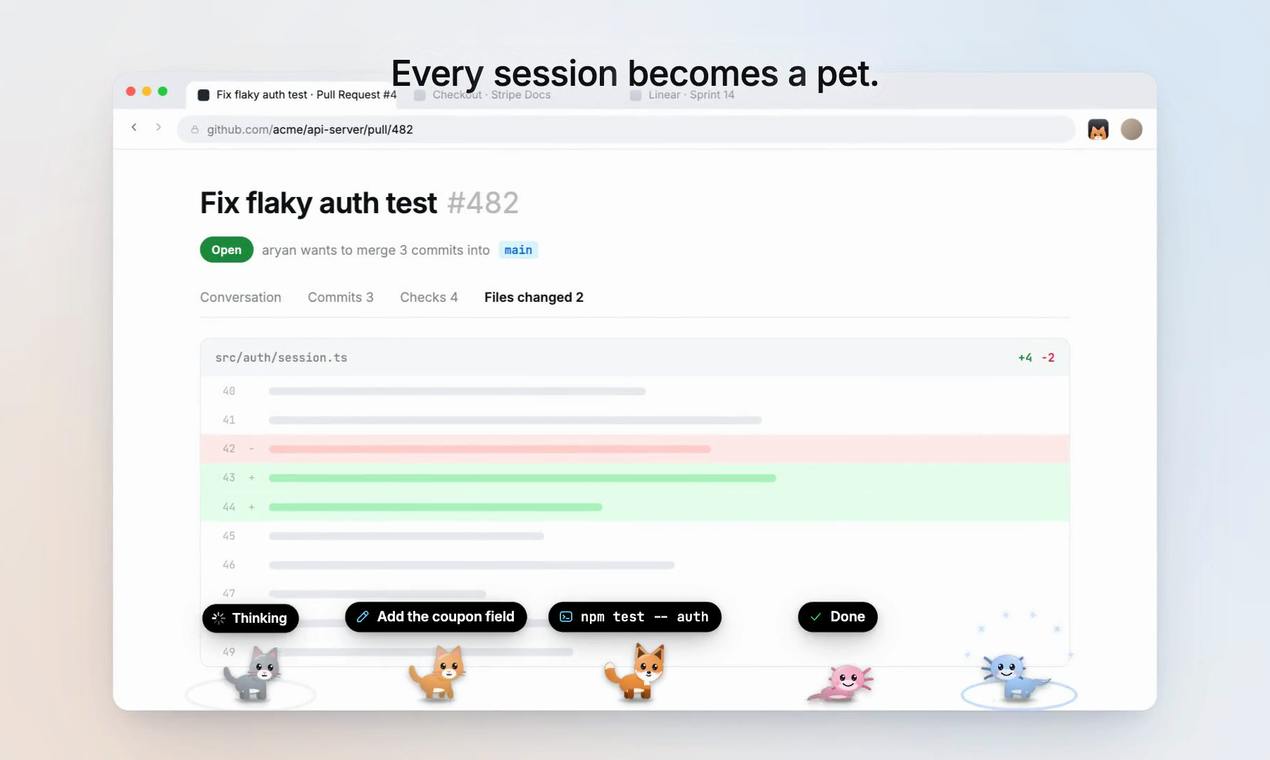
Agent Pets turns coding agent sessions into browser pets, enabling cross-tab monitoring and approvals.
Agent Pets is a Chrome extension by Aryan Thakor that maps coding agent sessions like Claude Code, OpenCode, and omp into "pets" at the bottom of the browser, letting developers see which session is waiting for input while browsing and approve commands or reply from any tab. It emphasizes local execution, no account, and no cloud uploads, priced at a one-time $6. It received 76 upvotes and 9 comments on Product Hunt, ranking 11th for the day. Its core value is a micro-innovation in interaction design—moving agent status from the terminal to the browser to reduce context-switching costs for multitasking monitoring—but the product is still early-stage, and ecosystem support and long-term maintenance remain to be validated.
A Chrome extension that brings coding agents "to life" in your browser
On Product Hunt, a Chrome extension called Agent Pets has caught developers' attention. Its core idea is straightforward: turn each Claude Code, OpenCode, or omp session into a "pet" that walks along the bottom of your Chrome browser. Instead of constantly switching between terminal windows, you can see at a glance which agent needs your input and approve commands or reply to messages directly from any tab.
The tool was built by Aryan Thakor and is priced at a one-time $6 purchase. It emphasizes local execution, no account required, and no cloud uploads. On Product Hunt, it received 76 upvotes and 9 comments, ranking 11th for the day, with categories covering Chrome extensions, developer tools, and artificial intelligence.
"Pet-ifying" coding agent management
Agent Pets solves a very concrete pain point: when developers run multiple coding agents simultaneously, they often need to switch back and forth between the terminal and editor, making it hard to quickly determine which session is waiting for confirmation or input. Agent Pets maps each session to a pet at the bottom of the browser, presenting agent status visually.
The design borrows the interaction metaphor of desktop pets, but the goal isn't entertainment—it's reducing the monitoring cost of multitasking agents. While browsing the web, reading docs, or writing code, you can glance at the pet status at the bottom of the screen to decide whether you need to switch to a particular session to handle command approvals.
According to the product description, users can approve commands and reply directly from any tab, eliminating the need to switch windows. For developers who are used to researching in the browser while running multiple agent sessions in the background, this interaction path is indeed shorter.
Claude Code, OpenCode, and omp are three different types of coding agent session tools. Claude Code is a command-line agent from Anthropic that can read codebases in the terminal, execute commands, and complete multi-step programming tasks; OpenCode is an open-source terminal coding assistant that supports connecting to various LLMs; and omp is another agent session tool aimed at developers. What they share is that they run as sessions and typically require user confirmation before performing sensitive operations (such as writing files or running shell commands). Agent Pets works by monitoring the status of these local sessions and mapping states like "waiting for confirmation," "running," and "completed" to pet animations. In essence, it's a browser-based visualization layer for local session status, not a replacement for these agents themselves.
Local-first and one-time payment
Agent Pets explicitly states "Runs on your computer: no account, no cloud," meaning session data and interactions all happen locally without passing through third-party servers. For a tool that handles code and command approvals, this is an important trust signal—commands executed by agents can involve sensitive operations, and localization reduces concerns about data leakage.
At $6 for a one-time purchase, the pricing is a low barrier among developer tools. Compared to subscription products, one-time payment is friendlier to individual developers, though it also means the business model for ongoing updates and maintenance needs to be watched. Currently, the Product Hunt page doesn't reveal more about update frequency or long-term support plans.
"Local execution, no cloud uploads" carries special significance for command-approval tools. When executing tasks, coding agents often need to read project source code, environment variables, or even key files, and the commands awaiting approval may contain sensitive paths or parameters. If such information were relayed through third-party servers, it would essentially expose code context and operational intent to the outside. Agent Pets claims that data and interactions all happen on the local machine, meaning the extension only needs to read session status through local process communication (such as localhost interfaces or native messaging), and approval instructions are sent directly back to the local agent process. The premise of this architecture is that the extension needs appropriate local access permissions, so users should still check whether its permission declarations are consistent with the "purely local" description when installing.
Points worth noting
Multi-agent support: Compatible with three types of sessions—Claude Code, OpenCode, and omp—covering the currently active coding agent ecosystem. However, the specific level of support and configuration methods aren't detailed in the original materials.
Cross-tab interaction: This is the core differentiator between Agent Pets and terminal management tools. The browser is one of the interfaces where developers spend the most time daily, and embedding agent status into it fits the product logic of "reducing context switching."
Limited user feedback: 76 upvotes and 9 comments indicate the product is still in its early stages, with limited community discussion. Developers considering trying it should first assess whether the number of agent sessions they run truly requires this kind of visual management.
The permission model of browser extensions is an easily overlooked aspect when evaluating such tools. For a Chrome extension to display a persistent interface across "any tab" and receive interactions, it typically needs to request broad host permissions or use content script injection; to communicate with local agents, it may also involve local network access or native messaging permissions. Broader permissions mean a larger potential attack surface and greater privacy risk. Agent Pets emphasizes local execution, but the extension's own permission scope, whether it's open source, and whether the code is auditable all affect its usability in enterprise or sensitive project environments. For teams with strict permission management, it's advisable to check the extension's permission list and update mechanism before trying it.
Who it's for
If you frequently run multiple Claude Code or other coding agent sessions simultaneously and spend a lot of time in the browser during your workflow, Agent Pets offers a lightweight monitoring solution. The $6 trial cost is low, and local execution reduces privacy concerns.
But if you mainly focus on a single session in one terminal window, or have strict restrictions on browser extension permissions, this tool may not be essential. Product information disclosure is currently limited, so it's advisable to check the official website's detailed documentation and demos before purchasing.
Conclusion
Agent Pets uses an interesting "pet" metaphor to enter the niche scenario of coding agent management. Its value lies not in technological innovation but in a micro-innovation in interaction design—moving agent status from the terminal to the bottom of the browser, letting developers handle approvals and replies casually during daily browsing. Local execution and one-time payment are pluses, but product maturity and ecosystem support still need time to be validated.
Related articles

Remote Compose: A New Document-Driven Paradigm for Cross-Platform UI on Android
Remote Compose transmits compact binary documents instead of screen pixels, enabling efficient UI rendering on remote surfaces like Wear OS and widgets. This article covers its document creation API, expression animations, size optimization techniques, and Wear OS progress.

How Crashlytics Eliminates Android Memory and Responsiveness Issues
Through the Chroma Clip case study, this article explains how Firebase Crashlytics uses Application Exit Info, Profiling Manager, GWP ASAN, and ARM MTE to pinpoint ANRs, OOMs, memory limit terminations, and native memory corruption—solving the challenge of stack traces that don't point to the real culprit.

Googlebook's First Developer Case Studies: How Notability and Logitech Built Desktop-Class Android Experiences
Notability and Logitech share first-hand experience building for Googlebook: using Jetpack Compose, Navigation 3, and Jetpack Ink for desktop-class Android, plus how the peripheral customization API bridges hardware and OS.