Agent Skills Architecture Explained: A New Paradigm for Modular AI Agent Development

A comprehensive guide to Agent Skills architecture for modular AI agent development.
This article provides an in-depth explanation of the Agent Skills architecture, a modular development paradigm for AI agents first introduced by Anthropic. It clarifies the common misconception of comparing Skills with MCP, details the core components of Skills (LLM instructions, metadata, resources), and offers practical guidance on choosing between Skills and Multi-Agent architectures for enterprise projects.
Introduction: Why You Need to Understand Agent Skills
In the field of AI agent development, your choice of technical architecture directly determines whether a project succeeds or fails. As the industry evolves, interview questions about agent architecture are getting increasingly in-depth — simply knowing how to call an LLM API is no longer enough. One of the most frequently tested topics, and the focus of today's deep dive, is the Agent Skills architecture.
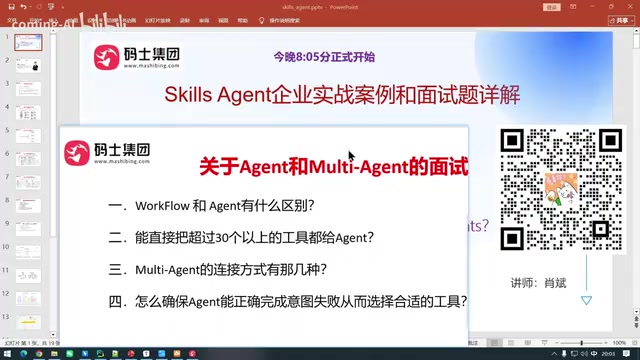
According to interview experiences shared by content creators on Bilibili, current AI job interviews typically last 1–2 hours and include over 15 questions, with agent architecture questions being almost guaranteed to appear. The difference between Workflow and Agent, how to ensure an Agent correctly performs intent recognition and selects the right tool — these questions seem simple, but the number of people who can truly answer them correctly might not exceed 1%.
What Are Agent Skills?
Clarifying the Concept: Skills Are Not a Protocol — They're an Architecture
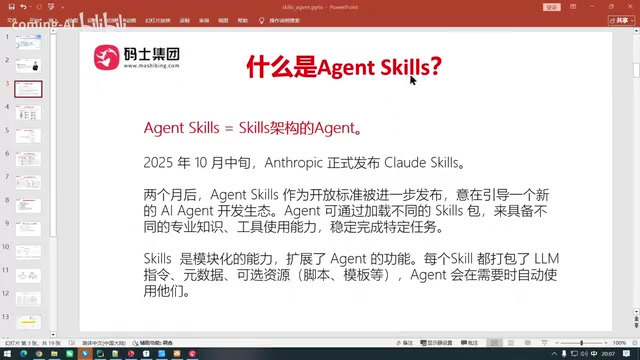
Skill, as the English word suggests, refers to an ability or competency. Agent Skills (also known as Skill Agent) refers to a development architecture for AI agents — a technical solution that enterprises can adopt when building agent-based software.
There's a widespread misconception online that needs to be addressed: Numerous articles compare Skills with MCP (Model Context Protocol), which is fundamentally wrong. Skills is a technical architecture for agents, while MCP is a network protocol used during agent development. They exist on entirely different dimensions and aren't directly comparable.
To understand this, we need to first clarify what MCP actually is. MCP (Model Context Protocol) is a standardized communication protocol that defines how LLMs interact with external tools and data sources. It's similar to the HTTP protocol in web development — it specifies the format of requests and responses, the standards for tool descriptions, the mechanisms for context passing, and so on. MCP solves the problem of "how an agent communicates with the outside world," while the Skills architecture solves the problem of "how an agent organizes and manages its own capabilities." In fact, a Skill can absolutely use the MCP protocol internally to call external tools — the two have a collaborative relationship, not a competitive one.
This is like trying to compare a senior LLM architect with a kindergarten math teacher on professional competency — they operate on completely different levels. Meaningful comparisons should be made within the same category, such as Skills architecture vs. Multi-Agent architecture — that's a discussion worth having.

Origins and Development Timeline of Skills
The Agent Skills architecture has a clear development trajectory:
- Mid-October 2025: First officially released by Anthropic (the company behind the Claude series of LLMs), under the name Cloud Skills
- December 2025: Released further as an open standard, aimed at shaping a new AI development ecosystem
It's worth noting that the MCP protocol also came from Anthropic. Anthropic was founded in 2021 by former OpenAI Research VP Dario Amodei and his sister Daniela Amodei, with "AI safety" as its core philosophy. The company has not only launched the Claude series of LLMs (Claude 3.5, Claude 3.7, etc.) but has also been continuously investing in agent infrastructure — first releasing the MCP protocol, then introducing the Cloud Skills architecture standard. This three-layer strategy of "model + protocol + architecture" has steadily expanded its influence in the AI developer ecosystem, creating a differentiated competitive landscape against OpenAI.
The Core Mechanism of Skills: A Modular Revolution for Agents
Loading Capabilities Like Java Packages or Python Modules
The core idea of Agent Skills can be summarized in one sentence: An agent gains different specialized knowledge and tool-usage capabilities by loading different Skills packages, enabling it to complete specific tasks.

If you have a programming background, this concept is very intuitive:
- It's like importing different dependency packages (jar files) in a Java project
- It's like importing different modules in a Python project
- Each Skill is an independent functional module that can be loaded by the agent on demand
The modular philosophy behind the Skills architecture isn't an AI-first invention — it's deeply rooted in decades of software engineering evolution. From the Unix philosophy of "do one thing well," to the Single Responsibility Principle in object-oriented programming, to service decomposition in microservices architecture, modularity has always been the core strategy for managing system complexity. The Skills architecture brings this thinking into agent development: each Skill is like a microservice with a well-defined interface contract (metadata description), independent business logic (LLM instructions), and self-contained dependencies (resources). This design allows agent capabilities to be discovered, installed, and managed just like npm packages or Maven dependencies.
Components of a Skill
Each Skill can be packaged with the following core elements:
| Component | Description |
|---|---|
| LLM Instructions | Defines the behavioral logic and prompts for the skill |
| Metadata | Describes the skill's name, version, applicable scenarios, etc. |
| Resources | External data or tool interfaces required for the skill to run |
At runtime, the agent automatically and dynamically loads and uses the corresponding Skills based on the current task's requirements. This design brings several significant advantages:
- Strong decoupling: Each skill is developed, tested, and deployed independently
- High reusability: The same Skill can be shared across multiple agents
- Good extensibility: Adding new capabilities only requires developing a new Skill package — no changes to the agent's core logic
- Low maintenance cost: Updating a single Skill doesn't affect the overall system
Skills Architecture vs. Multi-Agent Architecture: How to Choose?
In real enterprise projects, agent development typically faces two main architectural choices:
Multi-Agent Architecture
Multiple agents each handle their own responsibilities and collaborate to complete complex tasks. Each Agent is an independent "individual" with its own reasoning capabilities and toolset. This is best suited for complex scenarios with long task chains that require multi-role coordination.
Multi-Agent Systems (MAS) originate from distributed artificial intelligence research. Their core characteristic is that multiple autonomous Agents collaborate or compete through communication protocols. Typical implementation frameworks include Microsoft's AutoGen, CrewAI, and LangGraph. In a multi-agent system, each Agent usually has its own system prompt, memory space, and toolset, and Agents coordinate through message passing. For example, in a software development scenario, there might be a Product Manager Agent, a Programmer Agent, and a Tester Agent, each reasoning independently and reaching consensus through dialogue. The challenges of this architecture lie in inter-Agent communication overhead, consistency maintenance, and error propagation control.
Skills Architecture (Skill Agent)
A single agent extends its capabilities by dynamically loading different Skills modules. The agent itself is a "platform," and Skills are pluggable "plugins." This is best suited for scenarios with diverse functional requirements but a relatively centralized core decision-making chain.
Recommendations for choosing:
- If your business scenario requires multiple roles to make independent decisions and negotiate with each other, prioritize the Multi-Agent architecture
- If your business scenario involves a single core Agent that needs to flexibly invoke a variety of capabilities, the Skills architecture is more appropriate
- In practice, the two architectures are not mutually exclusive — you can absolutely have each Agent in a Multi-Agent system use the Skills architecture to manage its own capabilities
Frequently Asked Interview Questions
What's the difference between Workflow and Agent?
This is a question that seems basic but very few people can answer accurately. A Workflow is a predefined, deterministic execution flow where each step's direction is determined at design time. An Agent, on the other hand, has autonomous decision-making capabilities and can dynamically adjust its execution path based on the environment and task. Simply put, Workflow is "orchestration," while Agent is "autonomy."
From a technical implementation perspective, a Workflow typically manifests as a DAG (Directed Acyclic Graph) structure, where connections between nodes are fixed before deployment and execution follows preset conditional branches at runtime. Typical Workflow engines like Apache Airflow and Prefect excel at handling deterministic tasks such as ETL pipelines and approval processes. An Agent's execution path, however, is dynamically generated at runtime by the LLM based on the current context — the model observes the environment state, reasons about the next action, executes it, then observes the result, forming a "perceive-reason-act" loop (the ReAct pattern). This means that given the same input, an Agent might take completely different execution paths.
How do you ensure an Agent correctly performs intent recognition and selects the right tool?
This gets to the heart of the Skills architecture's design — each Skill's metadata contains clear capability descriptions and applicable scenarios. Through carefully designed Skill descriptions combined with the LLM's reasoning capabilities, an Agent can more accurately match user intent with the corresponding skill. Additionally, techniques like intent classifiers and few-shot examples can be used to improve matching accuracy.
Looking deeper, Intent Recognition is a core task in Natural Language Understanding (NLU) and is especially critical in agent scenarios. Current mainstream implementations include: direct matching through LLM semantic understanding, similarity retrieval based on embedding vectors, and multi-level routing based on classifiers. Function Calling is a native tool selection mechanism provided by LLM vendors, where the model decides which function to call based on the tool's JSON Schema description. Few-shot examples provide a small number of input-output examples in the prompt to help the model understand the correct behavior patterns for specific scenarios. In the Skills architecture, each Skill's metadata is essentially a carefully crafted "capability résumé," and the LLM reads these résumés to decide which Skill to "hire" for the current task. When the number of Skills is large, RAG (Retrieval-Augmented Generation) can be introduced to first narrow down the candidate Skill pool through vector retrieval, then let the LLM make the final decision — striking a balance between accuracy and response speed.
Conclusion
The Agent Skills architecture represents a significant trend in agent development — the shift from "monolithic applications" to "modular assembly." It's not a replacement for MCP, nor a competitor to Multi-Agent architecture. Rather, it's an entirely new paradigm for managing agent capabilities. For engineers currently working in or about to enter AI development, understanding and mastering the Skills architecture is not only a plus in interviews but also an essential skill for building high-quality agent applications.
Key Takeaways
Related articles

Disaster and Glory of the Apollo Program: The History We Must Revisit Before Returning to the Moon
From the fatal Apollo 1 fire to Apollo 8's daring lunar orbit to Apollo 11's successful landing—revisiting the disasters, fears, and compromises of the Apollo program and their lessons for today's return to the Moon.

Netflix Trust Exercise Turns Into Firing Trap: Where Are the Boundaries of Corporate Trust?
A Netflix employee was fired after sharing private info in a trust exercise. We analyze the risks of corporate trust exercises and how employees can protect themselves.

AMD CDNA5 Architecture Deep Dive: Technical Evolution and the AI Computing Competition Landscape
Deep analysis of AMD's CDNA5 architecture covering Chiplet packaging upgrades, HBM memory evolution, and low-precision compute optimization, examining how AMD challenges NVIDIA's AI chip dominance.