Agent Skills Architecture Explained: From Concepts to Practice, a Must-Read for Interviews and Development
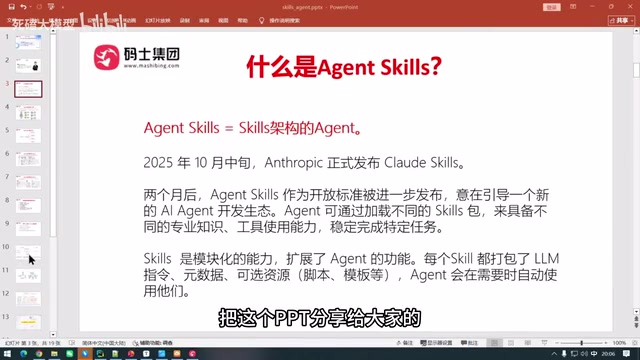
Agent Skills is a modular, dynamically loaded agent architecture first launched by Anthropic and opened as a standard.
Based on a Bilibili course by Xiao Bin, this article outlines the emerging Agent Skills architecture. Agent Skills is not a protocol or specific technology but a modular capability-loading architecture. First launched by Anthropic in October 2025 as Claude Skills and released as an open standard two months later with broad vendor support, its core is that Skills packages encapsulate specialized knowledge, tools, and optional resources, which agents dynamically load on demand. The article also discusses the high-frequency interview question of Workflow vs. Agent, noting that Agent Skills is a compromise between deterministic processes and autonomous decision-making, and analyzes its value in enterprise projects for reducing coupling and reusing the agent foundation, while leaving open questions about intent recognition and tool selection accuracy.
Agent development is moving from "monolithic large models" toward "modular capability loading." As an emerging architecture, Agent Skills aims to solve the problem of dynamically composing specialized capabilities for agents in complex tasks. Based on the course content by Bilibili creator Xiao Bin, this article outlines the core concepts of Agent Skills, its differences from traditional workflows, and its practical value in enterprise projects.
What Are Agent Skills: An Architecture, Not a Protocol
According to the definition given by Bilibili creator Xiao Bin in the course, Agent Skills is not a protocol, nor a specific technology, but rather an architecture approach for agents—a technical framework or solution used during project development. People usually don't say "Skills" alone; they add the prefix and call it "Agent Skills."
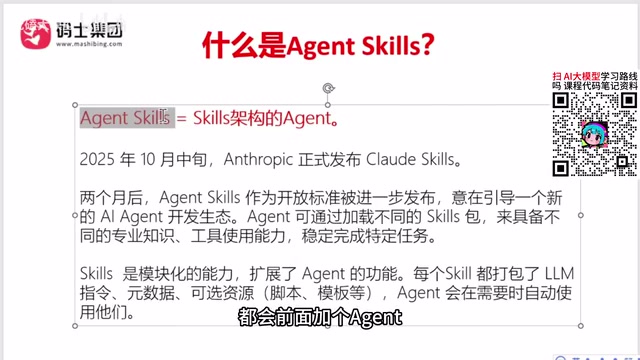
According to the course, this architecture was first introduced by Anthropic in mid-October 2025 under the name Claude Skills; two months later, Agent Skills was released as an open standard and received simultaneous support from almost all vendors domestically and internationally. It is essentially a new ecosystem for AI agent development.
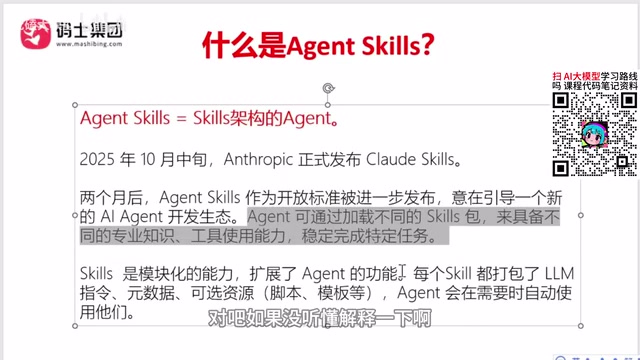
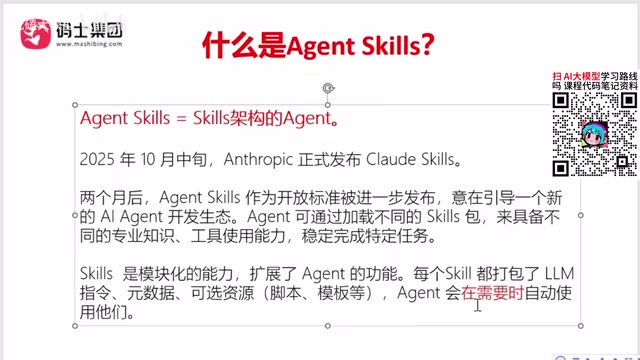
From a capability perspective, Agent Skills allows an agent to acquire different specialized knowledge and tool-usage abilities by loading different Skills packages, thereby completing specific tasks reliably. A Skills package contains specialized knowledge, tools (functions), and optional resources, which the agent automatically loads and uses when needed.
Background on Anthropic and Claude Skills: Anthropic is the company behind the Claude series of large models and has long focused on AI safety and agent controllability. Claude Skills, released in October 2025, is its capability-packaging mechanism for agent scenarios, allowing prompts, tool-calling logic, and supporting resources to be packaged into reusable units. Two months later, the mechanism was opened as an industry standard under the name Agent Skills, meaning that other vendors' models and frameworks could also follow the same Skill description and loading conventions, preventing capability packages from being locked into a single platform. This opening step is the key prerequisite for Agent Skills to quickly gain simultaneous support from vendors domestically and internationally.
Modular Dynamic Loading: Differences from Traditional Development Approaches
A key point in the course is that before Agent Skills emerged, agent development was not modular. In traditional approaches, an agent's capabilities were often hard-coded in prompts or code logic and difficult to compose on demand. Agent Skills introduces an "on-demand loading" mechanism—the agent dynamically loads Skill packages relevant to the current task based on context and user instructions, while unrelated packages are not loaded.
For example, when a user asks to book a ticket, the agent loads the ticket-booking Skill; when the user further asks to plan a travel route and recommend restaurants in a specific area, the agent then dynamically loads the corresponding recommendation and planning Skills. This mechanism transforms the agent from "fixed functionality" into "composable capability modules," improving flexibility and maintainability.
On-Demand Loading and Context Window Constraints: The context window of large models is limited. If all tool descriptions and domain knowledge are stuffed into the prompt at once, it not only consumes tokens but also dilutes the model's attention to the current task. The dynamic loading of Agent Skills is essentially a context management strategy: the agent first determines which capabilities are needed based on user intent, and then injects only the instructions and tool descriptions of those Skills into the context. This is similar to the "retrieve first, then inject" approach in retrieval-augmented generation (RAG), except that Skill loading involves executable capability packages (including function definitions) rather than just reference text.
High-Frequency Interview Question: The Difference Between Workflow and Agent
At the beginning of the course, it is mentioned that agent architecture is a topic interviewers particularly like to ask about, including multi-agent architectures, Agent Skills architecture, and so on. Among these, "What is the difference between Workflow and Agent" is described by the creator as a question "almost no one on the internet can answer correctly," with fewer than 1% answering it correctly.
Although the course does not provide a complete answer in the given material, the posing of this question itself reflects the industry's strong attention to the boundary between "deterministic process orchestration" and "autonomous decision-making agents." Workflow usually refers to a predefined sequence of steps, while Agent emphasizes autonomously choosing actions based on goals and environment. The Agent Skills architecture can be seen as a compromise between the two: it has modular capability packaging while retaining the agent's autonomy to load capabilities on demand.
Typical Dimensions for Distinguishing Workflow and Agent: The industry usually distinguishes the two by the source of control flow. In a Workflow, the control flow is pre-orchestrated by the developer, and the steps, branches, and call order are basically determined at runtime; its advantages are predictability, testability, and controllable cost. In an Agent, the control flow is autonomously generated by the model at runtime based on goals; it is flexible but carries uncertainty and the risk of loops. A common compromise in practice is "Workflow skeleton + Agent nodes," i.e., embedding autonomous decision-making agent steps within a deterministic process. Understanding this spectrum helps answer follow-up interview questions about the boundary between the two and their applicable scenarios.
Value and Selection Considerations in Enterprise Projects
The course points out that adopting the Agent Skills architecture in enterprise projects mainly addresses the modularization and dynamic expansion of agent capabilities. Each Skill packages instructions (prompts), tools, and optional resources, and the agent automatically uses them when needed. This means development teams can split different business capabilities into independent Skills and combine them on demand, reducing coupling.
In comparison with multi-agent architectures, Agent Skills provides a lightweight expansion path: instead of building a separate agent for each scenario, the same agent foundation can be reused through dynamic Skill loading. However, the course also leaves an open question—how dynamic loading of Skills can ensure the accuracy of intent recognition and tool selection, which remains a key area to verify in engineering practice.
A Comparative Perspective on Multi-Agent Architectures: Multi-agent architectures typically deploy separate agents for different roles (such as planner, executor, and reviewer) that collaborate through message passing. Their advantage is clear responsibility isolation, while their disadvantages are complex orchestration, long call chains, and high cost. Agent Skills, by contrast, favors a single agent foundation plus pluggable capability packages, reducing the number of agents and communication overhead, but it requires additional design for capability conflicts, permission isolation, and loading priorities. When selecting an approach, enterprises should weigh the two based on task coupling, compliance isolation requirements, and operational costs, rather than defaulting to the more complex multi-agent solution.
Conclusion
As a modular agent architecture, Agent Skills enables agents to compose capabilities on demand by dynamically loading specialized knowledge and tool packages. It was first launched by Anthropic and developed into an open standard with broad vendor support. For developers and interview candidates, understanding its boundary with Workflow and mastering the dynamic loading mechanism are key knowledge points in the current agent architecture discussion.
One-line Summary
Agent Skills is a modular, dynamically loaded agent architecture first launched by Anthropic and opened as a standard.
Paragraph Summary
Based on the course by Bilibili creator Xiao Bin, this article outlines the emerging Agent Skills architecture. Agent Skills is not a protocol or a specific technology but an architecture approach for modular capability loading. It was first launched by Anthropic in October 2025 as Claude Skills and released as an open standard two months later with broad vendor support. Its core is that Skills packages encapsulate specialized knowledge, tools, and optional resources, which the agent dynamically loads on demand according to user instructions, changing the previous non-modular development approach in which capabilities were hard-coded in prompts or code. The article also discusses the high-frequency interview question of the difference between Workflow and Agent, pointing out that Agent Skills is a compromise between deterministic processes and autonomous decision-making, and analyzes its value in enterprise projects for reducing coupling and reusing the agent foundation, while leaving open questions about the accuracy of intent recognition and tool selection.
Related articles
AI Transition Guide for Programmers: Learning Order from AI Coding to Agents
A Bilibili creator's learning roadmap for programmers in the AI era: mindset shift, AI tools, Agent development, and fine-tuning, plus how project-driven learning replaces process-driven study.

Tech Giants Pour Money Into Politics: Even Wilder Election Spending in 2028
The Vergecast talks with Molly White: AI and crypto spent big on elections and lost—New York's 12th District backfired, crypto burned $64M—yet both plan to spend more in 2028.

Former Mafia Member Reveals How New York Gangs Make Money: Gambling, Loan Sharking, and the Underground Economy
Former Gambino family member Larry Lawton reveals on the Lex Fridman podcast how the New York Mafia profits from underground gambling, loan sharking, and robbery, and reflects on how the U.S. justice system creates more criminals.