Agent Skills Architecture Explained: High-Frequency Multi-Agent Interview Topics and Enterprise-Level Practice

Agent Skills is a modular agent architecture solution that achieves capability decoupling and autonomous planning through dynamic loading of skill packages.
Agent Skills is not a protocol or technical standard, but an agent architecture solution that addresses dynamic capability orchestration in project development. Its essence is that agents gain specialized knowledge and tool-usage capabilities by loading different Skills packages. Each skill package encapsulates prompts, metadata, and optional tool resources, activated on demand based on user instructions and context, avoiding context bloat caused by full injection. In enterprise applications, Skills packages enable capability decoupling and reuse, reducing multi-team collaboration costs. In interviews, the core difference between Workflow and Agent lies in decision autonomy—an Agent can nest a Workflow but not vice versa; in multi-agent systems, Skills packages serve as capability units supporting role division and are foundational to autonomous planning and task decomposition. Mastering this architecture is becoming a key capability for enterprise-level AI development.
What Are Agent Skills? From Concept to Enterprise Application
When interviewing for agent-related positions, interviewers often probe into multi-agent architecture and the difference between Workflow and Agent, and Agent Skills is becoming a high-frequency topic. According to an analysis by Bilibili creator Xiao Bin (an instructor at Mashibing Education who has been teaching Python and AI since 2021), the correct answer rate for such questions is less than 1%, primarily because most developers confuse the boundary between "skill packages" and "tool calling."
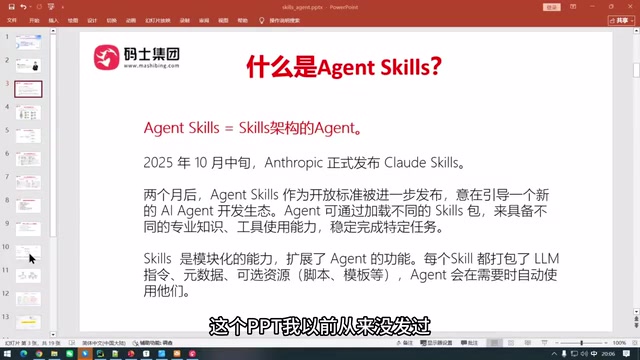
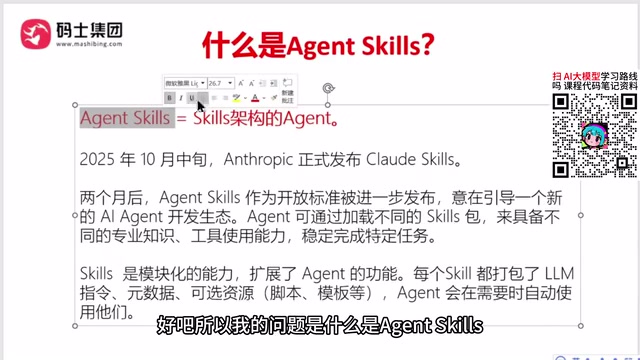
Agent Skills is not a protocol or technical standard, but rather an agent architecture solution—it addresses the problem of "dynamic capability orchestration" in project development. It is typically not referred to simply as "Skill," but as "Agent Skills," emphasizing that it serves the overall design of the agent. Its essence is: the agent gains specialized knowledge and tool-usage capabilities by loading different Skills packages, thereby reliably completing specific tasks.
A skill package contains LLM instructions (prompts), metadata, and optional tool resources. The agent automatically loads and invokes them when needed.
How Does Agent Skills Achieve Dynamic Loading?
On-Demand Activation: From "Full Loading" to "Context-Driven"
In traditional agent development, developers often inject all tools or instructions into the prompt at once, leading to context bloat and decision interference. Agent Skills introduces a modular mechanism: each Skills package independently encapsulates instructions and tools for a specific scenario, and the agent dynamically selects what to load based on user instructions and context.
For example, if a user says "Help me book a ticket," the agent loads the ticket-booking skill package; if the user adds "Also recommend Hunan restaurants within one kilometer of Wuyi Square in Changsha," the agent dynamically loads the restaurant recommendation skill package while irrelevant skill packages remain dormant. This mechanism shifts the agent from "big and comprehensive" to a compositional capability of "small and refined."
Context Bloat is a common pitfall in agent development. Although LLM context windows continue to expand, bigger is not always better: when a prompt is stuffed with large amounts of irrelevant tool definitions and instructions, the model's attention is diluted, leading to "tool selection drift"—calling the wrong tool even when a matching one exists, or missing key constraints. Research shows that once the number of tools exceeds a certain threshold, the model's selection accuracy drops significantly. The modular loading of Agent Skills is precisely an engineering response to this problem: by splitting tool sets into independent skill packages, only a small number of tools relevant to the current task enter the context at any given time, thereby maintaining decision accuracy within a limited attention budget. This also explains why "skill packages" are more suitable for enterprise-level scenarios than "universal tool sets."
Enterprise Value: Decoupling, Reuse, and Stable Delivery
The most direct benefit of adopting Agent Skills architecture in enterprise projects is capability decoupling. Different business lines can independently develop and maintain Skills packages, integrating them into the agent through unified standards. This reduces the coupling between prompt engineering and tool calling, and also improves multi-team collaboration efficiency.
In his course, Xiao Bin points out that Skills packages are essentially "modular capability extensions." When an agent needs to complete complex tasks, it can chain multiple Skills packages together to form a temporary workflow—this dynamic orchestration capability is precisely the foundation for multi-agent systems to achieve autonomous planning.
High-Frequency Interview Question: The Difference Between Workflow and Agent
Why Do 99% of People Get It Wrong?
Xiao Bin emphasizes that the core difference between Workflow and Agent lies in decision autonomy. Workflow is the orchestration of predefined paths, where each step is explicitly specified by the developer; Agent, on the other hand, has the ability to dynamically choose the next step based on environmental feedback. But most people overlook one point: an Agent can contain a Workflow, but the reverse does not hold.
The introduction of Agent Skills gives the Agent pluggable Workflow modules at the "skill layer." The agent decides when to invoke which skill package, and the skill package may internally encapsulate a fixed process. This nested relationship is the key differentiator in interviews that distinguishes candidate depth.
Decision Autonomy is the theoretical core that distinguishes Workflow from Agent, and its origins can be traced back to the debate between "reactive architecture" and "deliberative architecture" in classical AI. Workflow is essentially an engineering expression of a finite state machine or DAG (Directed Acyclic Graph), where paths are exhaustively enumerated by developers before runtime; Agent introduces a "perceive-decide-act" loop, where the output of each step depends on environmental feedback and LLM reasoning. The key point is the nested relationship: an Agent can internally invoke a fixed Workflow as the execution body of one of its sub-skills, where the Agent is responsible for "when to use it and which one to use," and the Workflow is responsible for "how to do it step by step." Conversely, a pure Workflow cannot change its own topology at runtime, so it is impossible for it to "contain" a true Agent. Understanding this asymmetry is the watershed for depth in interview answers.
How Are Intent Recognition and Tool Selection Ensured?
Interviewers often ask "How do you ensure the agent selects the right tools." The Agent Skills solution is: delegate tool selection to the metadata descriptions and loading strategies of skill packages. The agent first matches skill packages through intent recognition, and then internal instructions within the skill package guide tool invocation. This achieves higher accuracy than relying solely on the LLM to pick from a massive set of tools.
From Single Agent to Multi-Agent: How Skills Support Autonomous Planning
Skill Packages as "Capability Units" for Multi-Agent Systems
In Multi-Agent architecture, each agent can be equipped with different Skills packages to form role division. For example, a planning agent loads a "task decomposition" skill package, an execution agent loads an "API calling" skill package, and a review agent loads a "quality verification" skill package.
This design gives multi-agent systems scalability: adding new capabilities only requires adding new Skills packages, without restructuring the overall architecture. Xiao Bin mentions that domestic and international vendors have already widely supported the Agent Skills standard, and the ecosystem is rapidly taking shape.
In Multi-Agent architecture, collaboration patterns between agents are generally divided into two categories: "centralized orchestration" and "decentralized collaboration." The introduction of Agent Skills provides a unified capability encapsulation layer for both models: each agent no longer needs to build in all business logic, but instead declares its own role by mounting different Skills packages. This design draws on the "composition over inheritance" principle from object-oriented programming—adding a new capability only requires developing a new skill package and mounting it, without modifying the agent's core code. At the same time, the metadata of skill packages (such as input/output formats and permission declarations) provides a contract for task handoff between agents, enabling planning agents to automatically match execution agents based on metadata and reducing dependence on manual orchestration.
The Implementation Path of Autonomous Planning
Autonomous planning depends on the agent's awareness of its own capabilities. Agent Skills uses metadata descriptions to let the agent clearly know "what skills I have and when to use them." When task complexity exceeds the scope of a single skill package, the agent can trigger multi-agent collaboration, with the planning agent decomposing the task and distributing it to execution agents corresponding to the relevant skill packages.
This path has been validated in enterprise-level projects: by managing tool permissions, instruction templates, and resource dependencies through Skills packages, agents can autonomously complete composite tasks such as ticket booking, itinerary planning, and local recommendations within security boundaries.
Summary: The Development Paradigm Shift Brought by Agent Skills
Agent Skills pushes agent development from "prompt stacking" to "capability engineering." Developers no longer need to rewrite full instructions for every scenario; instead, they achieve capability reuse and dynamic composition through standardized skill packages. For job seekers, understanding the loading mechanism of Skills packages, the nested relationship between Workflow and Agent, and skill division in multi-agent systems is the key to passing interviews.
As open standards advance, developers who master Agent Skills architecture will gain a head start in enterprise-level AI agent projects.
One-line Summary
Agent Skills is a modular agent architecture solution that achieves capability decoupling and autonomous planning through dynamic loading of skill packages.
Paragraph Summary
Agent Skills is not a protocol or technical standard, but an agent architecture solution that addresses dynamic capability orchestration in project development. Its essence is that agents gain specialized knowledge and tool-usage capabilities by loading different Skills packages. Each skill package encapsulates prompts, metadata, and optional tool resources, activated on demand based on user instructions and context, avoiding context bloat caused by full injection. In enterprise applications, Skills packages enable capability decoupling and reuse, reducing multi-team collaboration costs. In interviews, the core difference between Workflow and Agent lies in decision autonomy—an Agent can nest a Workflow but not vice versa; in multi-agent systems, Skills packages serve as capability units supporting role division and are foundational to autonomous planning and task decomposition. Mastering this architecture is becoming a key capability for enterprise-level AI development.
Related articles

How Big Can Stars Really Get? The Physical Limits of the Largest Stars
Red supergiants are the largest stars by volume, with radii up to 2,000 times the Sun, engulfing the inner solar system. But there is no precise upper limit on stellar size—models predict up to 15,000 solar radii. The most massive blue stars are far smaller than red supergiants—biggest and heaviest are two different things.

Apple HomeView Smart Display Full Feature Breakdown: Wall-Mount or Desktop, $299
Apple launches HomeView, a $299 smart display with wall-mount and desktop options, 12MP camera for facial recognition, smart home control, music playback, and recipe step-by-step cooking. Full breakdown of watch faces, apps, privacy, and cooking integration.

Where Did the Promised New Studio Go? Craft Computing Answers After Five Years
Craft Computing's host responds to viewer questions: the new studio promised five years ago was shelved as construction costs soared from $30,000 to $75,000, and was replaced by a 168-square-foot garage conversion.