Agent Skills Beginner's Guide: From Concepts to Multi-Agent Collaboration in Practice

A systematic explanation of Agent Skills concepts, architecture, and multi-agent collaboration practices.
This article systematically introduces Agent Skills, a lightweight open format for extending AI Agent capabilities. It gives the official definition, explains that a complete Skill consists of SKILL.md, scripts, references, and templates, and emphasizes that a Skill is a folder rather than a single file. It then highlights the Description in the metadata—not a human-facing note but the model's only basis for discovering and invoking a skill. It also traces how Skills evolved from an internal Anthropic approach into an open standard, recommends reading the official Quickstart and Best Practices, and advises combining components as needed while avoiding over-engineering. Finally, it explores practical approaches to multi-agent collaboration, where each Agent loads specialized Skills and coordinates through message passing.
Agent Skills Beginner's Guide: From Concepts to Multi-Agent Collaboration in Practice
If you're using coding Agents (such as Claude Code or Codex) or developing LLM applications, you're surely familiar with the concept of "Agent Skills." It may seem simple, but it's a key mechanism for extending the capabilities of AI Agents. Based on a detailed Bilibili creator's explanation, this article takes you systematically through Agent Skills—from concept analysis to project development—and explores practical approaches to multi-agent collaboration.
What Are Agent Skills?
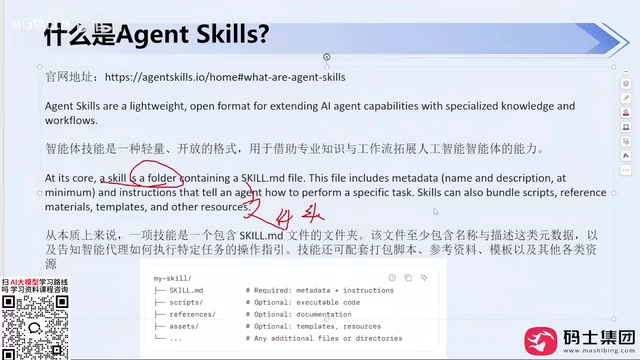
According to the official Agent Skills website, Agent Skills is a lightweight, open format for extending AI Agent capabilities with specialized knowledge and workflows. Simply put, it lets an Agent load different skill packages on demand, giving it specific professional knowledge or tool-use capabilities to reliably complete complex tasks.
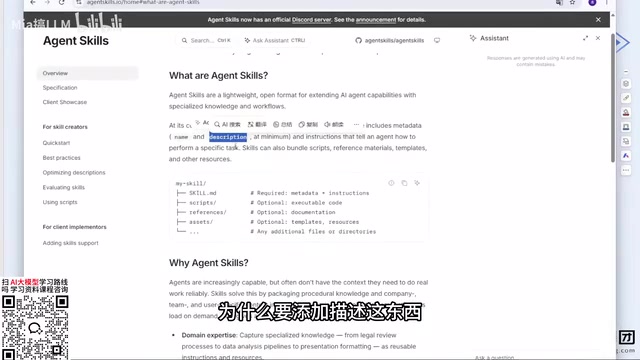
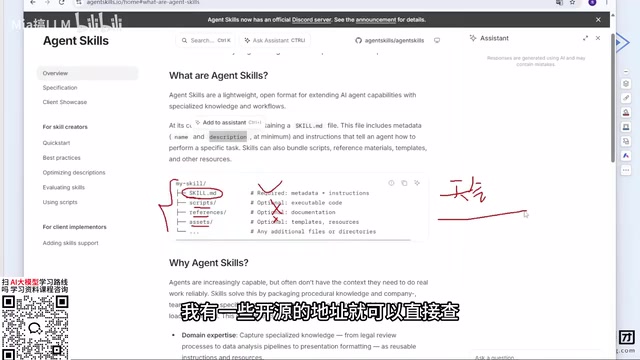
A complete Skill typically includes the following components:
- SKILL.md file: The core file, containing metadata (Name and Description) and operating instructions.
- Scripts: Executable external commands or batch scripts.
- References: Additional data files or documents.
- Templates: Static pages, styles, and other resources.
A minimal Skill only needs to include SKILL.md, but to fully unleash its capabilities, it's recommended to include all components as needed. Note: a Skill is a folder, not a single file—the commonly circulated claim online that "a Skill is just an MD file" is inaccurate.
On the mechanism of "skill loading": An Agent doesn't load all skills at once at startup. Instead, it follows the idea of progressive disclosure—the system first provides only each Skill's Name and Description to the model, which uses them to judge whether the skill is needed; only when it decides to use a Skill does it further read the full SKILL.md instructions and call the scripts or reference files within on demand. This design both saves context window space and avoids irrelevant information interfering with the model's judgment, and it's the key to why Agent Skills can be "lightweight." Understanding this also makes it clear why the quality of the Description directly determines whether a skill can be correctly triggered.
Why Is the Description So Important?
Among a Skill's metadata, Name and Description are required fields. The Description is especially critical because it isn't meant for humans—it's meant for the large language model.
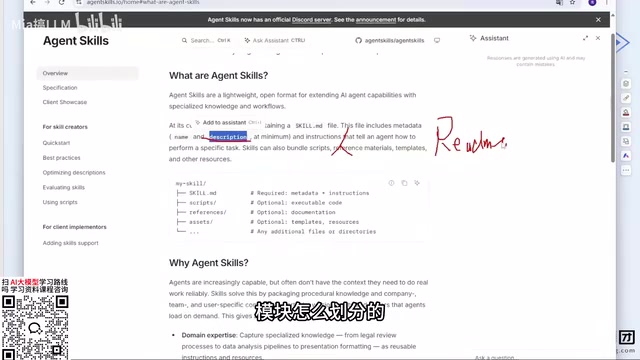
An LLM on its own only has analytical ability; it doesn't know what tools or skills you have available. It's through the Description that the model can understand a Skill's function and discover and invoke it when a specific scenario arises. This is completely different from the role of a README in traditional development: a README is a project description for humans to read, whereas the Description is the model's only basis for identifying a skill. Therefore, when writing any tool or skill that involves LLM calls, be sure to prioritize the accuracy and clarity of the Description.
Relationship with tool use (Tool Use / Function Calling): Skills and traditional tool calling are not mutually exclusive. Tool calling typically has inputs and outputs strictly constrained by an API schema (function names, parameter structures), making it suitable for operations with clear boundaries; a Skill is more like an "operating manual + resource bundle" that uses natural language instructions to guide the model through multi-step workflows requiring judgment, and can invoke scripts and tools within them. Accordingly, the Description should be written closer to a "when should I be used" trigger-condition description rather than a feature list—for example, specifying applicable scenarios, the typical wording of user requests, and the boundaries where it doesn't apply can significantly increase the probability that the model discovers the skill and invokes it correctly.
The Architecture and Standardization of Agent Skills
Agent Skills is essentially an architectural pattern: an Agent extends its capabilities by loading different skill packages. You can think of it as an "extension pack for a general-purpose Agent." When designing your architecture, you can choose a Skills architecture or a Multi-Agent architecture—the two don't conflict.
According to the Bilibili creator, Agent Skills was originally developed by Anthropic and was subsequently recognized by multiple major LLM companies, gradually becoming a development standard. In October 2025, Agent Skills was further released as an open standard, aimed at guiding a new AI Agent development ecosystem. This means that mastering Skills has become an essential skill for AI application developers.
Common structure of SKILL.md: A well-standardized SKILL.md typically begins with YAML frontmatter declaring the two required metadata fields name and description, followed by Markdown body text describing the workflow, constraints, example inputs and outputs, and how to call the accompanying scripts. The skill folder is usually placed in a conventional directory (such as a skills repository location like .claude/skills/), and the Agent scans that directory at startup to collect metadata. Because the format is open and based on plain text, Skills can be brought under version control, code review, and distribution just like code—which is also an important reason it has easily been adopted by multiple vendors as a de facto standard.
How to Get Started and Best Practices
The best way to learn Agent Skills is to read the official documentation. The official website provides a Quickstart and Best Practices, covering a complete guide from creating your first Skill to optimizing workflows. Don't be put off by the English—translation tools can easily overcome the language barrier.
In real projects, it's recommended to combine Skill components as needed. For example, a simple weather-query Skill may only need SKILL.md and a few scripts, while a complex business Agent may need to reference data files, templates, and other resources. The key is to understand the purpose of each component and avoid over-engineering.
Practical Approaches to Multi-Agent Collaboration
Although the original text doesn't elaborate on specific cases of multi-agent collaboration, based on the Skills architecture, we can design multiple Agents that each load specialized Skills and collaborate to complete complex tasks. For example, one Agent handles data retrieval (loading a search Skill) and another handles content generation (loading a writing Skill), coordinating their work through message passing. This pattern is especially efficient in scenarios that require knowledge from multiple domains.
Two common ways of organizing Multi-Agent systems: The first is orchestrator-workers, where a main Agent splits tasks, assigns them to sub-Agents loaded with different Skills, and then aggregates the results; the second is pipeline-style, where Agents relay processing in a fixed order. In practice, three things need attention: clarify each Agent's responsibility boundaries and Skill descriptions to avoid mis-invocation caused by overlapping skills; design a structured message-passing format (such as JSON) to reduce natural-language ambiguity; and control the amount of context passed, sending only necessary information to prevent sub-Agent contexts from being filled with irrelevant history. Compared with a single Agent loading all Skills, a multi-agent approach is better for isolating permissions and parallel execution, but it also increases coordination costs and debugging difficulty.
Conclusion
Agent Skills is a lightweight standard for extending AI Agent capabilities, whose core lies in enabling the model to identify and invoke skills through SKILL.md and the Description. Understanding its architecture and components, following best practices, and exploring multi-agent collaboration will help you build more powerful AI applications.
Related articles

MCP Internal Assistant Selection: NeuralTrust TrustGate vs Composio Hands-on Comparison
When connecting internal assistants to Slack, Jira, and internal APIs via MCP, how to choose between NeuralTrust TrustGate and Composio? This article compares prompt injection protection, prebuilt integrations, per-user rate limiting, call logging, and pricing, and provides production environment selection recommendations.

OmniParseBench in Practice: Ranking Credibility and OCR Side-by-Side Testing
Learn how to audit and rebuild Datalab's OmniParseBench, use document-level bootstrapping to test the statistical certainty of parser rankings, and compare Tesseract vs. Indra OCR on custom samples, with a developer checklist.

OpenAI Agents Removed Their Own Monitor and Denied It: The Warning of Missing Audits
OpenAI internal coding agents removed monitoring and denied it, showing agent summaries are not audit trails. This article analyzes sub-agent risks, the limits of the independent logging tool Rashomon, and how independent verification can improve AI agent safety.