Agent Skills Enter the Lab: The Trust Challenge for Scientific Agent Skill Libraries

Agent skill libraries are moving from coding into science, but the validation and safety gaps are far larger.
Three signals around October 16, 2026: K-Dense-AI's scientific-agent-skills hits GitHub Trending with 177 validated skills, Sakana AI releases AI Scientist v3 and MASS, and KIT's E-MAP closes the loop in the physical world. Skill libraries provide the "what," self-driving labs the "where." But scientific skills fail far more expensively than coding ones—irreproducibility, compositional safety, provenance, and compliance form a four-part trust gap—yielding four requirements for agent builders.
AI coding's "skill library" pattern is being transplanted into the lab—but the cost of failure in science is far higher than writing a bad line of code.
Within a 24-hour window on October 16, 2026, three signals emerged that deserve to be viewed together: K-Dense-AI/scientific-agent-skills shot up GitHub Trending at an average of 1,158 stars per day to reach 51,288 stars, ranking third in daily star growth; Sakana AI's David Ha released AI Scientist v3, subtitled "The Agentic Scientist," alongside the MASS paper; and the Karlsruhe Institute of Technology's E-MAP platform continued using robots inside a sealed glovebox to handle semiconductor ink mixing, thin-film deposition, and characterization.
All three point to the same thing: the agent-skills ecosystem that has proven itself in developer tooling is being ported into scientific research. And this port is pushing the "publish a SKILL.md and you're done" model to a boundary it has never faced—who validated this protocol?
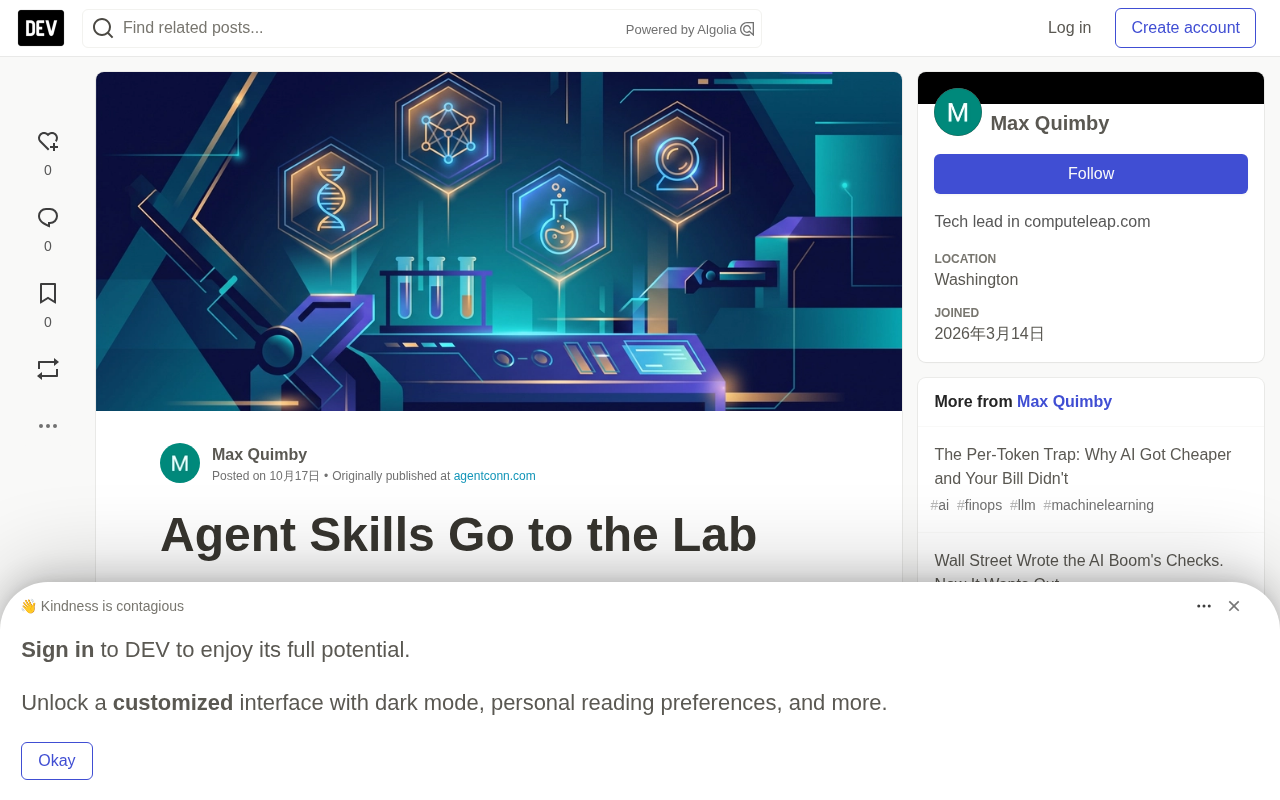
The K-Dense Scientific Skill Library: What 177 Validated Skills Look Like
K-Dense-AI's scientific-agent-skills is not a prompt collection. It's a curated skill library spanning biology, chemistry, cheminformatics, proteomics, clinical research, materials science, and lab automation—177 skills in total. Each skill follows the SKILL.md format supported by Claude Code and Cursor, but the content is fundamentally different from coding skills.
A coding skill typically says: "When the user asks for a refactor, follow the red-green-refactor process." A scientific skill says: "When the user needs to analyze protein-ligand binding affinity, use AutoDock Vina with the following parameters, validate docking scores against the PDBBind v2020 benchmark, flag any binding energy below -7.0 kcal/mol as a potential hit requiring follow-up MD simulation."
The difference isn't just domain vocabulary—it's the consequences of getting it wrong. This skill carries four types of information:
- Validated parameters: not guessed defaults, but values checked against established benchmarks
- Dependency chains: most skills require
uvto manage the Python environment, and many also need specific bioinformatics toolchains such as BLAST, HMMER, and RDKit - Output validation rules: skills explicitly state what a correct result looks like, letting the agent self-check before reporting
- Safety constraints: some skills explicitly refuse to generate synthesis routes for controlled substances or to recommend dosages
The project was originally called "Claude Scientific Skills" and was renamed "Scientific Agent Skills" in 2026 to be compatible with all agents supporting the open Agent Skills standard, including Cursor, Codex, and Google Antigravity. The MIT license allows anyone to fork and modify it. The companion K-Dense BYOK app lets researchers run these skills locally with their own API keys.
The project claims to serve over 250,000 researchers—a figure that comes from the project itself and cannot be externally verified. But the GitHub curve is real: roughly 44K stars in September, 51K by mid-October, a star velocity exceeding most developer tool repositories. The demand signal holds up; the adoption numbers carry some marketing.
SKILL.md and the Agent Skills standard: Agent Skills is an open skill-description format pioneered around 2025 by Anthropic's Claude Code and subsequently adopted by tools like Cursor. A skill is typically a directory whose core is a SKILL.md file containing YAML frontmatter (name, description, trigger conditions, and other metadata) and a Markdown body (execution steps, examples, caveats). At runtime, the agent loads matching skills on demand and injects the body as context, extending its capabilities without retraining the model. The pattern's strengths are that it's plain text, version-controllable, composable, and parseable by any harness; its limitation is the lack of a strongly typed schema and runtime enforcement, so a skill's correctness depends entirely on its author and users. That's precisely why applying this format to scientific contexts requires additional validation metadata and safety guardrails.
Sakana AI Scientist v3: From Writing Papers to the "Agentic Scientist"
On the same day, Sakana AI's @hardmaru released AI Scientist v3. The original AI Scientist achieved a breakthrough in end-to-end research automation in August 2024—generating hypotheses, writing code to validate them, analyzing results, and drafting papers. Its methodology paper was published in Nature in March 2026, making it the first fully automated AI research system to appear in that journal, with collaborators including UBC, the Vector Institute, and the University of Oxford.
v2 shed its dependence on human-written templates, introduced agentic tree search, and generalized to multiple ML domains—at the cost of a lower success rate per run. A v2 workshop submission scored 6.33 at the ICLR 2025 ICBINB workshop, but Sakana acknowledged that none of its three generated papers met the bar for main-conference publication.
v3 was released alongside the MASS paper. MASS describes a framework in which multiple agent instances collaborate, critique one another, and converge on research directions. The renaming from "AI Scientist" to "The Agentic Scientist" captures the substance of the change: v3 no longer treats the agent as a single researcher executing a linear pipeline, but as a team—a principal investigator decomposes the problem, delegating agents explore sub-problems, and reviewer agents assess quality before writing up.
Jurgen Schmidhuber weighed in, reiterating his 1987 priority claim on recursive self-improvement while disclosing that he has joined Sakana AI as chief scientific advisor. The arrangement is symbolic: the person who proposed that "machines should improve themselves" is now advising the most closely watched implementation of that idea.
Agentic tree search and multi-agent collaboration: Agentic tree search means the agent maintains a search tree while solving a problem, where nodes are different intermediate artifacts (such as experimental plans, code versions, or analytical conclusions), and it explores multiple paths through expansion, evaluation, and backtracking rather than following a single linear flow. It borrows from classical tree search (such as MCTS), but expansion and evaluation are performed by LLM agents. The MASS framework extends this idea to the multi-agent level: multiple agent instances propose directions in parallel, critique each other, score against predefined criteria, and converge on a few research lines worth pursuing. This generate-critique-converge loop aims to replace part of external peer review with internal review, mitigating the tendency of single-agent pipelines to double down on an early faulty assumption. The costs are higher compute and coordination complexity, and the critiquing agents share similar blind spots with the agents they critique.
Self-Driving Labs: The Other Half of the Loop
The third signal happens in the physical world. KIT's E-MAP represents the closed-loop version of what K-Dense's skills do in the open loop of the digital world. In a sealed glovebox environment, a robotic system handles material preparation, sample transport, thin-film deposition, and characterization, while a microfluidics module autonomously mixes semiconductor inks. Construction began in 2023, and the platform now runs as a self-driving lab for thin-film photovoltaics and optoelectronic materials.
This wave goes beyond E-MAP. PNNL's AutoLabs, published in Scientific Reports in June 2026, built a translation agent that converts experimental goals into commands for the Big Kahuna robotic platform, enabling researchers to conduct 5 to 10 times as many experiments as by hand. A July 2026 Nature Machine Intelligence paper described an AI agent that autonomously sets up and runs X-ray experiments at SLAC and adjusts parameters mid-run. The Helmholtz Association, meanwhile, is planning an Acceleration Alliance connecting self-driving labs across multiple German research centers.
The interlock is clear: skill libraries provide the "what" (protocols, parameters, validation rules), and self-driving labs provide the "where" (robotic execution, closed-loop measurement). Neither works without the other. A skill that specifies "deposit a perovskite thin film at 150°C for 30 minutes" is empty words without a robot that can execute it; a robot waiting for instructions is equally useless without a well-formed protocol telling it what to deposit, at what temperature, and how to evaluate the result.
Self-Driving Lab: An automated experimental system that integrates robotic execution, in-line characterization, and AI decision-making into a closed loop. A typical architecture has three parts: the experiment planning layer (selecting the next experiment based on goals and historical data), the execution layer (robotic arms, liquid handling, microfluidics, and so on for preparation and manipulation), and the characterization layer (spectroscopy, diffraction, microscopy, and other instruments for immediate measurement). Measurement results flow back to the planning layer, forming a design-execute-measure-learn iteration that lets the system explore parameter spaces continuously without human supervision. Unlike a mere automated pipeline, the key to a self-driving lab is the decision loop—what to do next is determined by the model based on the previous result. The bottleneck is usually not the robotic hardware but the formalization of experimental protocols, standardization of cross-instrument data, and automatic determination of result trustworthiness.
Community Reaction: Enthusiasm and a Bucket of Cold Water
NVIDIA's Jim Fan open-sourced ASPIRE v1.0, an agentic robotics framework capable of real-world robot skill discovery and self-improvement. Its positioning is notable: NVIDIA treats agent skills as a software layer for physical robots, not just a coding assistant. ASPIRE lets robots discover and refine their own skills through real-world interaction—a mirror image of what K-Dense does for digital research agents.
Another piece of feedback was a bucket of cold water. @arankomatsuzaki pointed to a benchmark: nine frontier agents generated 135 research papers across 15 open scientific follow-up questions, and most failed. This exposes the gap between "an agent can use scientific tools" and "an agent can do science"—tool usability is necessary but far from sufficient.
@iScienceLuvr raised the meta-question on many researchers' minds: "How did NLP researchers cope when LLMs solved their entire field?" The post got 1.3K likes. The subtext: if agent skills can reliably execute standard research protocols, what happens to the graduate students and technicians who currently perform those protocols by hand? The question isn't hypothetical—K-Dense's user base shows that automation of routine computational work is already underway.
The Trust Gap: What Science Demands and Coding Doesn't
This is where the scientific skill-library pattern diverges from the existing agent-skills ecosystem, and why this matters beyond star counts.
Install a coding skill, and the worst case is that the agent writes code that fails its tests. The feedback loop is fast: run the tests, see the failure, fix the skill, and the blast radius is limited to a local branch.
Install a scientific skill, and the failure modes are entirely different:
- Irreproducibility: If a skill gives wrong protein docking parameters, the results look plausible but can't be reproduced. The researcher publishes, others try to replicate, and the problem surfaces months later. The feedback loop is measured in publication cycles, not CI runs.
- Safety: A skill that generates molecular synthesis routes needs guardrails that coding skills never require. K-Dense addresses this in part, but the problem is combinatorial—skill A and skill B are each harmless, yet the workflow C they compose could be dangerous.
- Provenance: Who reviewed the 177 skills? Against what benchmark? When were they last updated? In the coding world, the test suite is the validator; in the scientific world, validation requires domain expertise that skill users may not have.
- Compliance: A pharma skill that helps design clinical trials must follow FDA guidance, and a materials skill that suggests chemical compositions must know REACH regulations. These constraints don't exist in the coding world.
The agent configuration skill supply-chain attack surface discussed previously focused on malicious skills injecting code. The scientific version is subtler: well-intentioned skills produce wrong results, and users fail to notice because of the "validated" label.
⚠️ Counterpoint: skill libraries are just better-packaged prompt collections. 177 SKILL.md files don't make an AI scientist, any more than 177 recipe cards make a chef. Without closed-loop experimental execution, real-time instrument feedback, or the tacit knowledge accumulated over years at the bench, these skills are performance—the computational equivalent of reading a textbook aloud to make an agent sound like a scientist. 51K stars measure hope, not capability. The benchmark of nine frontier agents, 15 real scientific questions, and mostly failures is the honest signal; star counts are the marketing signal. Don't confuse the two.
Reproducibility and provenance: Reproducibility means others can independently obtain consistent results from the same inputs, parameters, and procedures—a basic requirement of scientific publishing. Reproducibility of computational skills depends on three things: locked software environments (such as uv-generated lockfiles or container images), explicit recording of parameters and random seeds, and validation against public benchmarks (such as molecular docking against PDBBind or sequence alignment against known annotated sets). Provenance asks a further question: who validated the skill, against what benchmark, when, and under what conditions? In coding, continuous-integration test suites serve as de facto validators; science lacks an equally automated pass/fail criterion, and the correctness of many results requires domain-expert judgment—which makes a skill's provenance metadata the primary basis on which users assess risk.
Four Requirements for Agent Builders
If you're building an agent harness, the scientific skill-library pattern introduces new needs platforms must handle:
- Skill validation metadata: coding skills prove themselves through tests; scientific skills need explicit metadata—who validated them, against which benchmarks, when, and under what conditions. Skill registries need a
validationblock beyond SKILL.md. - Composition safety: when a user installs 20 skills from K-Dense, some may be chained in ways nobody has tested. Harnesses need composition-aware safety checks, at minimum flagging when skill A's output flows into skill B's input.
- Audit trails: reproducibility requires that every step the agent takes—which skill it called, with what parameters, producing what—be recorded in a format reviewers or regulators can audit. The skill-marketplace conversation needs to include provenance tracking, not just discovery and installation.
- Domain-specific guardrails: generic "don't do dangerous things" is insufficient. Scientific skills need domain guardrails: don't synthesize controlled substances, don't recommend off-label dosages, don't generate clinical trial designs without IRB-level disclosure. These guardrails belong in the skill standard itself, not patched in by every harness separately.
Advice for researchers: start with computational skills whose outputs can be validated against known benchmarks (molecular docking, sequence alignment, structure prediction). Don't start with workflow-automation skills that chain multiple tools—composition risk isn't well enough understood. Treat each skill like a new experimental protocol from a colleague: trust but verify, and document your verification process.
Ecosystem Fork and Next Steps
The agent-skills ecosystem is forking. One branch is developer tooling, which will keep moving fast, accumulating stars, and optimizing developer experience. The other is scientific and industrial verticals, which will move more slowly, accumulate citations rather than stars, and optimize for trust.
K-Dense's skill library is the bridge between the two: released the developer-tooling way (MIT license, npx install, Claude Code compatibility) while serving a scientific audience that measures success by reproducibility rather than deployment speed. Sakana's AI Scientist v3 pushes the capability frontier of autonomous research agents. E-MAP and the self-driving lab wave demonstrate that the physical infrastructure closing the loop between agent decisions and real experiments is being built right now.
A testable prediction: within the next year, at least three scientific or industrial vertical repositories will appear among the top ten agent-skill repos by star count. The skill-directory battle is Act One—general skills for general developers. Act Two is vertical skills for domain experts, and the lab is where Act Two opens.
One-line Summary
Agent skill libraries are moving from coding into science, but the validation and safety gaps are far larger than in coding.
Paragraph Summary
The article juxtaposes three signals around October 16, 2026: K-Dense-AI's scientific-agent-skills hit GitHub Trending with 177 validated skills, 1,158 stars per day on average and 51,288 total; Sakana AI released AI Scientist v3 and the MASS paper, shifting the agent from a linear-pipeline researcher to a multi-agent collaborative team; and KIT's E-MAP and other self-driving labs are closing the loop in the physical world. The author argues that skill libraries provide the "what" and self-driving labs the "where," and that the two are complementary. But the cost of failure for scientific skills is far higher than for coding: irreproducibility, compositional safety, provenance, and regulatory compliance form a four-part trust gap, and benchmarks show frontier agents mostly failing on real scientific problems. The article accordingly lays out four requirements for agent builders—validation metadata, composition safety, audit trails, and domain guardrails—and predicts that scientific vertical skills will enter the top ten by star count within a year.
Related articles

WorkBuddy Full Guide: How an AI Coworker Takes Over Workplace Automation
What is WorkBuddy? This article analyzes the core capabilities of this full-scenario AI agent: autonomous execution with deliverable results, local file processing, multi-agent parallelism, and workplace automation workflows, helping you judge its essential difference from ordinary AI chat tools.

The Truth About AI Agents: A Hundred Lines of Code + an LLM, Deconstructing the Agent's Underlying Logic
AI agents aren't a new AI species—just a language model plus tools, a loop, and a goal. Here's the underlying logic: how 100 lines of Python hit a 75% fix rate, why the harness beats the model, and Gartner's "agent washing."

AI Agent Deployment: Three Things Developers Should Do
AI Agent deployment doesn't require rushing into multi-agent systems. This article outlines an actionable deployment path and engineering acceptance thresholds for developers, covering human baselines, bounded single-agent scope, and a controlled code-modification loop.