Agent Skills Explained: Plug-and-Play Professional Capabilities for AI Agents

Agent Skills is an open standard giving AI agents plug-and-play professional capabilities via modular, mountable skill packs.
Agent Skills, released as an open standard in 2025, packages specialized knowledge, prompts, and tool resources into SKILL.md-based folders that AI agents can mount and unmount on demand. Rather than retraining a model or spinning up additional agents, a single agent dynamically loads the right skill pack for each task. A progressive disclosure mechanism ensures only relevant skill details are injected into the context window as needed. Compared to Multi-Agent architectures, Skills is lighter and more cost-efficient for extending a single agent's capabilities, though hybrid approaches exist for tasks requiring true parallel decision-making.
What Are Agent Skills
Imagine an AI agent as a highly capable office secretary. She has solid general knowledge and handles everyday tasks well — but run into anything specialized, and the cracks start to show. Ask her to draft a legal contract and she's lost; ask her to design a poster and she's never touched Photoshop; ask her to book corporate travel and she's unfamiliar with the systems. Agent Skills is a design pattern built specifically to address this kind of limitation.
By the official definition, Agent Skills is a lightweight, open-source format that extends an AI agent's capabilities with specialized knowledge and workflows. In concrete terms, a Skill is essentially a folder containing a SKILL.md file — which holds metadata and instructions that guide the agent through specific tasks — along with optional resources like scripts, reference materials, and templates.
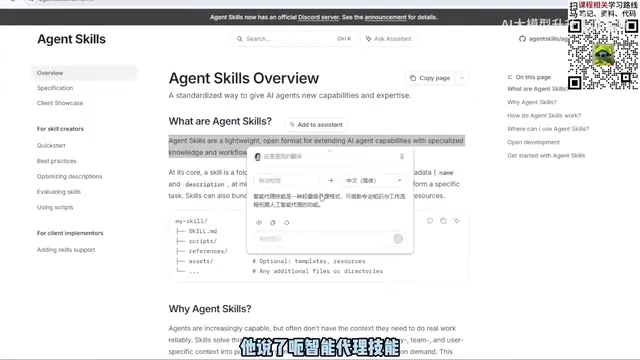
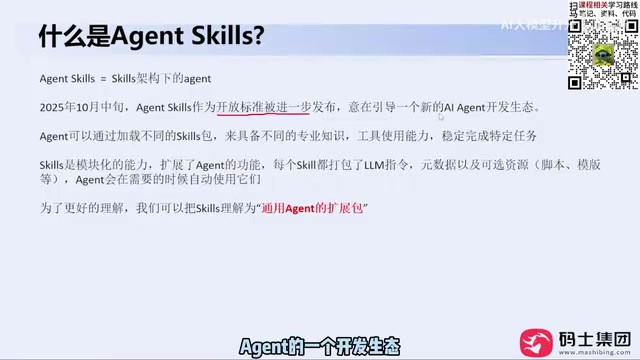
Put plainly: Agent Skills equals "an Agent built on the Skills architecture." When designing an intelligent agent system, you can go with a single-agent architecture, a multi-agent architecture, or this third pattern — "Agent + Skills." Skills itself was released as an open standard in mid-October 2025, with the goal of building a new ecosystem for agent development. Agents gain access to different areas of expertise and tooling simply by loading the corresponding skill packages.
What Problem Does Agent Skills Actually Solve
Back to the secretary analogy. When a secretary lacks expertise in a certain area, managers traditionally have two options:
Option one: send her off for months of specialized training — law school, Photoshop courses, whatever's needed. Time-consuming and resource-intensive. Option two: hire dedicated specialists — bring in a lawyer to handle contracts, a designer for visuals. That works, but at a real cost.
Agent Skills offers a third path: no training, no new hires. Instead, professional capabilities are packaged into ready-to-use plugins — plug in what you need, unplug when you're done. Need to handle a legal dispute? Load a legal expert skill pack. Need to create marketing materials? Attach a design skill pack. Planning a business trip? Mount a travel-booking skill pack.
The key insight is that these capabilities are mounted onto the agent and can be unloaded when no longer needed, freeing up the corresponding resources. The manager never has to invest time in learning new skills or money in building a talent bench.
The Core of Modular Design
The value of Agent Skills can be distilled into three keywords: modular, low-cost, and highly flexible.
Each Skill bundles the prompts for calling a large language model, metadata, and optional resources. The agent automatically invokes them when needed. This "load what you need, unload when done" mechanism fundamentally changes how capabilities are acquired.
Traditionally, a developer building project capabilities has to start from scratch — programming syntax, databases, frameworks, practical projects — working through the entire pipeline before they're productive. With Skills, as long as a pre-built skill pack exists on the market (or you can define a custom Skill), you can immediately access the corresponding capability, bypassing the lengthy learning and accumulation process.
This explains why more and more agent products are shipping with a built-in library of Skills — it achieves flexible capability expansion at the lowest possible cost.
Progressive Disclosure and Skill Invocation
To fully understand how Skills work at runtime, you also need to grasp the concept of Progressive Disclosure. Simply put: the agent doesn't load the full details of every skill all at once. Instead, it progressively surfaces relevant information based on task needs — first seeing a brief description of a skill to determine whether it's needed, then loading the more detailed instructions and resources only if it decides to invoke it. This ensures the agent always "knows what capabilities it has" without stuffing everything into the context window at once, which would waste resources.
In practice, developers define a Skills list so the agent knows which skills are available, then use a Skills invocation tool to trigger the corresponding capability. This forms the core operational loop of the "Agent + Skills" architecture.
Progressive Disclosure originated as a UX design concept — the idea that an interface should only reveal more detail when the user actually needs it, preventing information overload. Transplanted into agent systems, this approach addresses a fundamental constraint of large language models: the context window. There's a hard limit on how many tokens a model can process in a single inference pass. Stuffing the complete documentation for every skill into the prompt at once would rapidly exhaust the context budget, while simultaneously flooding the model with noise irrelevant to the current task — degrading reasoning accuracy.
For this reason, SKILL.md files typically use a layered structure: the top level contains only the skill name and a one-to-two-sentence functional description, which the agent uses to decide whether to invoke it. Once the decision is made, the full instructions, examples, and resource files are dynamically injected. This "expand on demand" mechanism means a single agent can theoretically mount dozens or more skill packs without the sheer volume of available skills dragging down inference performance.
Multi-Agent vs. Skills Agent: What's the Difference
One common point of confusion: what's the difference between a Multi-Agent architecture and a Skills Agent architecture?
The secretary analogy clarifies this well. Multi-Agent is more like "hiring multiple specialist secretaries" — each agent handles its own domain, and they collaborate to complete tasks, but that also means higher coordination overhead and resource costs. Skills Agent is more like "equipping one secretary with interchangeable skill packs" — a single entity handles different tasks by dynamically loading modular capabilities. It's lighter and more flexible.
Neither architecture is inherently superior; it depends on the use case. For complex tasks requiring multiple roles making independent decisions in parallel, Multi-Agent may be the better fit. For scenarios where you need to rapidly extend a single agent's capabilities while keeping costs down, the Skills architecture is often the stronger choice.
From an engineering perspective, the overhead difference between the two architectures is substantial. In a Multi-Agent system, each independent agent typically maintains its own conversation history, tool permissions, and scheduling queue. Message passing between agents introduces additional network or inter-process communication overhead. Deploying multiple concurrent agent instances in the cloud translates directly to higher compute and token costs.
The Skills architecture consolidates all of this under one entity. Switching between skills happens at the prompt level — no new inference processes need to be spun up. The tradeoff is real, though: a single agent can only "focus" on one execution path at a time and can't truly parallelize independent sub-tasks the way a Multi-Agent system can.
In practice, hybrid approaches are common: a small number of specialized agents handle core modules that genuinely require parallel decision-making, while the remaining functionality is mounted as Skills on each agent. This strikes a balance between collaboration density and resource cost.
Summary
As an open standard, Agent Skills gives AI agents a plug-and-play approach to acquiring professional capabilities. It replaces the traditional "train someone" or "hire someone" model with a modular plugin paradigm — agents load what they need, unload when done, achieving low-cost and highly flexible capability management. For developers just getting started with agent development, understanding the design philosophy behind Skills before diving into hands-on projects is a far more efficient path than grinding through documentation alone.
Related articles

Felix Rieseberg Personal Homepage
Felix Rieseberg's personal homepage sparks attention on Hacker News. This article covers the Slack engineer's technical background, the rise and fall of nativefier, and the value of a developer homepage as a tech calling card.

@ai-sdk/vue 3.0.306 Patch Release Syncs with [email protected] Update
@ai-sdk/vue 3.0.306 released, synced with [email protected]. A routine patch release for the Vercel AI SDK ecosystem with no public API changes; the Vue adapter layer stays version-aligned with the core package.

Gemini 4 Argon API Launches: The Era of Million-Token Output Begins
Google launches Gemini 4 Argon with sparse MoE architecture, up to 1M output tokens, and a 68.90% Vals Index score, available across API, AI Studio, and the Gemini app.