Agent Skills Explained: Structure, Core Principles, and Practical Application Guide

Agent Skills are structured configuration modules that grant AI Agents specialized professional capabilities.
Agent Skills are core components of the AI Agent ecosystem, essentially integrating prompts, reference documents, tool scripts, and static resources into reusable, structured capability packages. A complete Skill consists of four parts: skill.md (the required workflow file), references (documentation), scripts (tool scripts), and assets (static resources). Skills far exceed the capabilities of plain prompts and can be applied to diverse scenarios including marketing material generation, front-end development, and PPT creation.
What Are Agent Skills?
With the explosive popularity of AI Agent tools like OpenCloud, Cloud Code, and Hermes Agent, Skills have become an indispensable core component of the Agent ecosystem. Simply put, a Skill is a configuration module that grants an AI Agent specific professional capabilities.
AI Agent Technical Background: An AI Agent is an intelligent system capable of autonomously perceiving its environment, formulating plans, and executing multi-step tasks — fundamentally different from traditional single-turn Q&A interactions with AI. Unlike the interaction pattern where you ask ChatGPT a question and get a single response, Agents possess two core capabilities: "Tool Use" and "Planning & Reasoning." These enable them to automatically decompose complex goals into executable sub-task sequences and continuously iterate until the objective is achieved. As the capability encapsulation layer of an Agent, Skills are essentially structured constraints and enhancements to this planning-execution ability — they tell the Agent "in what scenario, following what process, and using which resources" to complete specific types of tasks.
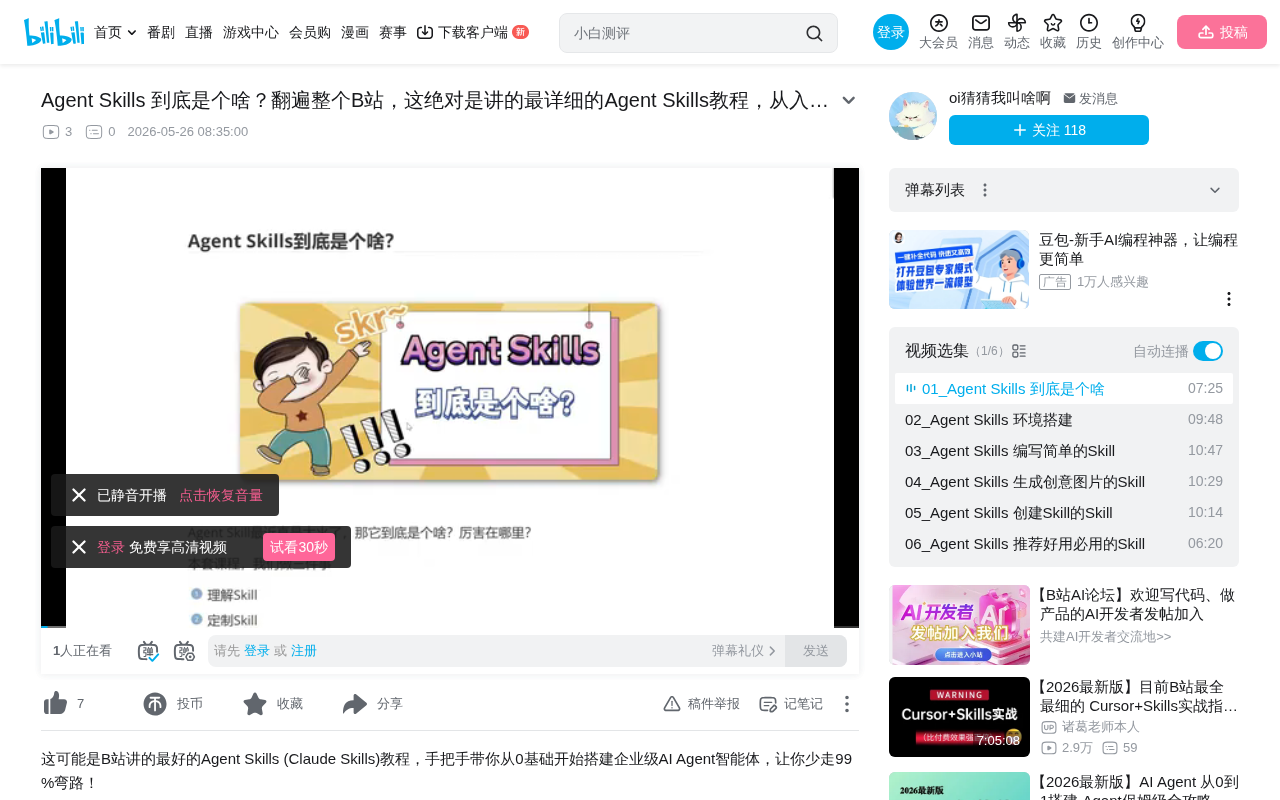
Here's a simple analogy: every person has professional skills corresponding to their occupation — students know how to do homework, programmers know how to write code and debug, and doctors know how to diagnose and treat patients. An Agent's Skill is equivalent to a human's professional expertise, giving the AI the specialized ability to perform specific tasks.
Core Structure of Agent Skills
A complete Skill is essentially a folder containing four core components:
1. skill.md (Development Workflow) — The Only Required File
skill.md is the only required file in the entire Skill. It defines the complete workflow and specifications for the Agent to execute tasks. In programming terms, this is like a development workflow — what to do first, what to do next, and how different business processes relate to each other all need to be clearly outlined here.
2. references (Reference Documentation)
This is equivalent to API documentation or requirements documents in a programmer's workflow. It provides the Agent with background knowledge and technical specifications needed during task execution, helping the Agent understand and complete tasks more accurately.
RAG Technology Foundation: Behind the references component lies the engineering application of Retrieval-Augmented Generation (RAG) technology. RAG allows large language models to dynamically retrieve relevant content from external knowledge bases as contextual supplements when generating responses, breaking through the timeliness limitations of model training data and significantly reducing the probability of "hallucination" phenomena. Within the Skills framework, documents in the references folder are retrieved and cited by the Agent on demand during task execution, essentially equipping the Agent with a professional knowledge base that can be consulted at any time. This approach is far more efficient and precise than cramming all information into a prompt.
3. scripts (Development Tool Scripts)
These correspond to a programmer's IDE tools (such as IntelliJ IDEA, VS Code, etc.). Scripts provide the Agent with callable scripts and tools, enabling it to perform more complex operations beyond mere text generation.
Tool Use Mechanism Explained: An Agent's tool-calling capability (Function Calling / Tool Use) is a key feature of modern large language models, first introduced by OpenAI in 2023 and widely adopted across the industry. The core principle is: when the model identifies the need for external capabilities during reasoning, it generates a structured "invocation instruction" that is captured by the runtime environment, which then executes the corresponding function or script and returns the results to the model for continued reasoning. The scripts component in Skills is the concrete implementation vehicle for this mechanism — through predefined script files, the Agent can execute code, read/write file systems, access databases, call third-party APIs, and more, extending AI capabilities from pure text generation to real-world operational execution. This represents the most revolutionary capability leap that Skills offer over ordinary prompts.
4. assets (Static Resource Files)
These include static files such as images, audio, and video. For example, image assets needed for building web pages, or brand logos needed for generating posters — all fall under the category of static resources.
Important Note: Not every Skill needs to include all four components. references, scripts, and assets are optional, and whether they're needed depends on the Skill's intended functionality. Some simple Skills may only need a single skill.md file.
Writing skill.md Files in Detail
A typical skill.md file contains two core sections:
Meta Information
Located at the top of the file, it includes:
- Skill Name: Identifies what this Skill is
- Functional Description: Explains what this Skill can specifically do
For example: "Generate brand-aligned material design concepts for a restaurant. When users need to create posters, roll-up banners, packaging boxes, and other materials, output corresponding design concept proposals."
Instructions Section
This is the main body of skill.md, defining the Agent's behavioral specifications in detail:
- Core Brand Elements: Brand name, style, IP characters, primary colors, slogan, etc.
- Task Trigger Conditions: Under what circumstances to execute this Skill
- Output Format Specifications: Theme concepts, visual style, composition, detail suggestions, etc.
The more detailed the description, the more closely the Agent's generated content will match expectations. This aligns perfectly with the principles of prompt engineering — the clearer the instructions, the higher the output quality.
Core Principles of Prompt Engineering: Prompt engineering is the technical practice of carefully designing input text to guide large language models toward desired outputs. It has developed several mature paradigms including Chain-of-Thought, Few-Shot Learning, and Role Prompting. Research shows that prompts with clear structure, explicit constraints, and included examples can significantly improve the accuracy and consistency of model outputs. Writing instructions in skill.md is essentially the systematized practice of prompt engineering — upgrading ad-hoc prompts scattered across chat boxes into polished, continuously iterable, standardized instruction documents. This approach allows a team's AI usage experience to accumulate and be passed on, rather than starting from scratch with every conversation.
The Essential Difference Between Agent Skills and Prompts
Many people wonder: doesn't skill.md just look like a prompt?
Indeed, the content in skill.md is formally similar to a carefully crafted prompt, but Skills' capabilities far exceed those of mere prompts:
| Dimension | Prompts | Agent Skills |
|---|---|---|
| Composition | Single text | Multi-file collaboration |
| Extensibility | Limited | Extensible via scripts |
| Resource Access | Not supported | Can reference assets |
| Knowledge Reference | Context only | Can link to references documents |
| Reusability | Requires repeated input | Configure once, reuse continuously |
Skills are essentially a structured capability package that integrates prompts, reference documents, tool scripts, and static resources into a reusable, shareable skill unit.
The Paradigm Shift from Prompts to Capability Packages: This evolution has a clear parallel in software engineering — just as code evolved from standalone scripts to reusable function libraries and then to standardized software packages (npm packages, pip packages), the way we use AI is also undergoing a structural upgrade from "one-off prompts" to "reusable capability modules." The emergence of Skills enables individuals or teams to encapsulate their accumulated AI usage experience, manage it with version control, distribute and share it within organizations, and potentially trade it in future Agent marketplaces. This marks an acceleration of AI application development toward engineering-driven, product-oriented approaches.
Practical Application Scenarios for Skills
With properly configured Skills, Agents can handle a wide variety of professional tasks:
- Marketing Material Generation: Input simple requirements (e.g., "Create a promotional poster for Wellington steak at only $38"), and the Agent generates professional proposals based on brand style, positioning, target audience, and other dimensions
- Front-end Page Development: Configure front-end development Skills to give the Agent page-building capabilities
- Automated PPT Creation: Automatically generate presentation slides that meet specifications
- Batch Document Processing: Format conversion, content extraction, structural organization, etc.
- Data Spreadsheet Processing: Data analysis, report generation, visualization output, etc.
The Future Vision of Multi-Agent Collaboration: As the Skills ecosystem matures further, the model of a single Agent calling a single Skill will evolve into multi-Agent collaborative networks. In this architecture, Agents with different specialized Skills can collaborate like different functional departments within an enterprise — one Agent handles requirements analysis, another handles content generation, a third handles quality review — completing complex end-to-end workflows through message passing and task orchestration. This is the cutting-edge research direction of Multi-Agent Systems in the current AI field, and the ultimate technical form that the Skills ecosystem is heading toward.
Summary: Agent Skills Learning Path
Learning Agent Skills can be divided into three stages:
- Understand Skill Structure: Master the composition and working principles of skill.md, references, scripts, and assets
- Customize Your Own Skills: Write and debug Skill configurations based on your specific business needs
- Apply Skills Flexibly: Combine and leverage various Skills in real work to boost efficiency
For beginners, it's recommended to start by understanding the writing conventions of skill.md files, then gradually expand to using references, scripts, and assets in combination. The core value of Skills lies in distilling scattered prompt experience into reusable, standardized capability modules — a key direction for the future development of the AI Agent ecosystem.
Key Takeaways
- Agent Skills are structured configuration modules that grant AI Agents specific professional capabilities, composed of four parts: skill.md, references, scripts, and assets
- skill.md is the only required file, containing meta information and instructions that define the Agent's behavioral specifications and output formats
- Skills far exceed plain prompts, enabling advanced features like resource access, tool extension, and knowledge referencing through multi-file collaboration
- Practical applications of Skills span marketing material generation, front-end development, PPT creation, document processing, spreadsheet handling, and more
- The learning path progresses through three stages: understanding Skills, customizing Skills, and applying Skills
Related articles
 Tutorials
ChatGPT Plus Subscription Guide: Are GPT-5.5, image-2, and Codex Worth the Upgrade?
A detailed look at ChatGPT Plus features — GPT-5.5, image-2, and Codex — with a Plus vs Pro comparison and a complete step-by-step subscription guide for users outside the US.
 Tutorials
Harness AI Engineering in Practice: Using Claude Code to Master Enterprise-Level E-Commerce Development
Deep dive into Harness AI Engineering: master enterprise e-commerce development with Claude Code using the Rules, Skills, Wiki, and Changes framework.
 Tutorials
Cursor + Codex Dual-IDE Collaboration: A Practical Methodology for Open-Source Project Customization
A complete methodology for open-source project customization based on real-world experience, detailing the Cursor+Codex dual-IDE workflow, seven-stage process, MVP validation, and AI source code reading techniques.