Agent Skills Progressive Disclosure Architecture Explained: Giving LLMs Unlimited Capabilities
Agent Skills encapsulate specialized capabilities in SKILL.md, enabling on-demand loading and modular extension via progressive disclosure.
Based on a Bilibili live class, this article systematically breaks down Agent Skills and the progressive disclosure architecture. Agent Skills is a lightweight open-source format that packages skill instructions, metadata, and optional resources in a folder containing SKILL.md, letting an Agent load different skill packages on demand to gain specialized capabilities. The article uses a "boss and secretary" analogy to illustrate its value: no retraining, no adding Agents—instead turning capabilities into pluggable plugins. Progressive disclosure is the core mechanism: the Agent first reads skill metadata to judge relevance, then loads the full content, saving context window and improving skill routing reliability. The article also compares single Agent, Multi-Agent, and Skills Agent, noting they are not mutually exclusive and that Skills can be embedded in different architectures as a way of organizing capabilities. Finally, it stresses that understanding Skills architecture is becoming a plus for engineering competence in the LLM era.
Large model application development is moving from "piling up prompts" to "modular capability assembly." In a live-streamed class by Bilibili creator "码士集团AI大模型" (Mashi Group AI Large Models), instructor Lian Pengju spent a full session breaking down Agent Skills and the progressive disclosure architecture, positioning it as an "era-defining" technical milestone. This article, drawing on that class and the official documentation, lays out the core concepts of Skills, the problems it solves, and how to implement it in engineering practice.
What Are Agent Skills
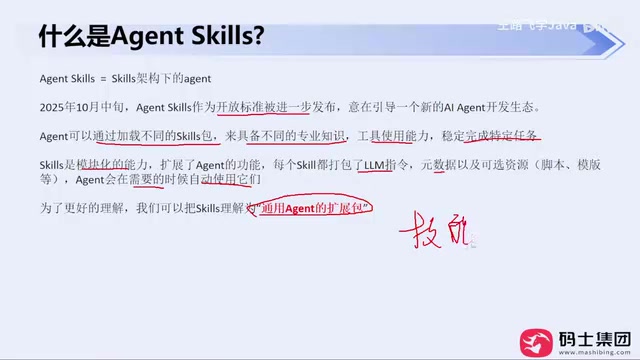
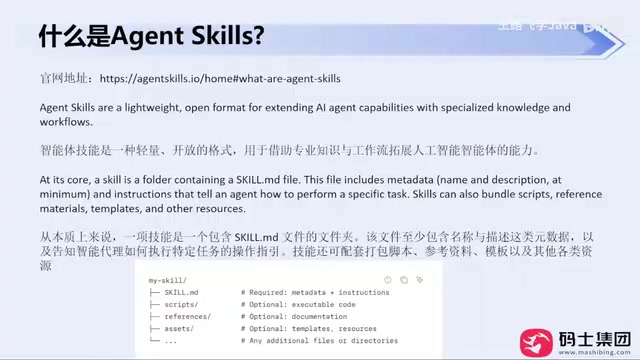
The official documentation describes Agent Skills as a lightweight, open-source format that extends AI agent capabilities with specialized knowledge and workflows. Concretely, a skill is a folder containing a SKILL.md file, which holds metadata plus instructions that guide the agent through a specific task, and may also bundle scripts, reference materials, templates, and other resources.
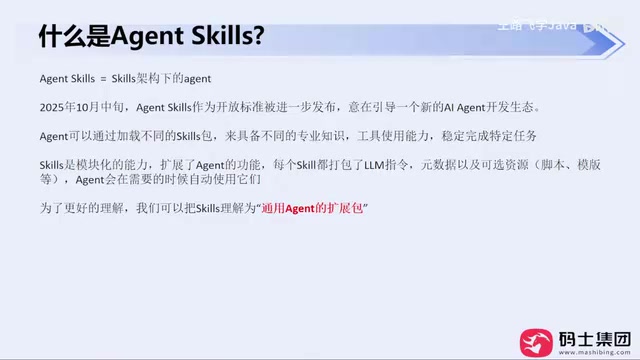
That description isn't beginner-friendly. In plainer terms: Agent Skills equals "an Agent under the Skills architecture." It lets an Agent gain different specialized knowledge and tool-use capabilities by loading different skill packages. Each skill package encapsulates instructions, metadata, and optional resources, and the Agent invokes them automatically when needed.
During the class, the instructor noted that this open standard was released in mid-October 2025, intended to guide a new Agent development ecosystem.
SKILL.md is the entry file for Agent Skills, typically written in Markdown, with YAML front matter declaring the skill's metadata (such as name, description, version, and applicable scenarios), while the body describes operational steps, constraints, and examples in natural language. Beyond SKILL.md, a skill folder may also contain subdirectories like scripts/, references/, and assets/, holding executable scripts, reference documents, and template resources respectively. At runtime, the Agent parses the SKILL.md metadata to decide whether to load the skill, then reads the body and attached resources to execute the task. This convention-over-configuration design based on the file system lets skill packages be version-controlled, distributed, and reused like ordinary code repositories—no extra registry or complex protocol required.
An Everyday Analogy: The Secretary and Skill Packages
The instructor used a "boss and secretary" analogy to explain the value of Skills. Suppose you have a secretary with decent baseline skills but some gaps: he doesn't understand law when drafting contracts, can't use Photoshop to make posters, and isn't familiar with the booking system for flights. You have two traditional solutions: spend months sending him to professional training, or hire a dedicated lawyer—the former costs time and effort, the latter adds headcount cost.
Agent Skills offers a third way: don't train the person, don't add headcount—instead package specialized capabilities as pluggable plugins. When you need a contract drafted, mount the legal expert skill package; when you need a poster, mount the Photoshop skill package; when the task is done, unmount it to release resources.
In engineering terms, this analogy maps to a capability extension mechanism that is modular, low-cost, and highly flexible. As the instructor put it, "load what you need, unload it when you're done."
What Problem Do Agent Skills Solve
Traditional Agent development faces a structural contradiction: a single Agent usually has a narrow responsibility, so extending its capabilities requires retraining, fine-tuning, or piling on large amounts of prompts and tool descriptions—all of which drive up cost and context overhead.
Skills' solution is to decouple capabilities from the Agent itself. The Agent stays lightweight, while skills exist independently as folders and are loaded on demand. This means an Agent originally capable of only a single task can gain a significantly expanded capability boundary by mounting different skill packages—what the instructor calls "the secret to unlimited capabilities."
From an engineering perspective, this brings three direct benefits: skills are reusable, independently iterable, and dynamically assemblable per task. For multi-Agent systems, skill packages can also serve as capability units shared across Agents, reducing redundant building.
Progressive Disclosure: The Core Mechanism of Skills
"Progressive disclosure" in the course title is the key to understanding Skills. Its core idea: the Agent doesn't need to load the full content of all skills at startup. Instead, it first grasps the metadata of skills (name, description, applicable scenarios), and only after determining that a skill is relevant to the current task does it load that skill's complete instructions and resources.
This layered loading has two effects. First, it saves context window—the more skills there are, the greater the cost of loading everything, and progressive disclosure keeps overhead confined to what's actually needed. Second, it improves decision quality—routing skills based on concise metadata is more reliable than searching through lengthy descriptions.
In the course outline, the instructor lists "how to define the Skills list and the tool for invoking Skills" as a separate chapter, indicating that the interface design for skill registration and invocation is a key implementation focus. The skills list is essentially the Agent's capability catalog, while the invocation tool handles skill loading and execution at runtime.
The context window is the maximum number of tokens an LLM can process in a single inference, including the input prompt and output. When an Agent mounts many skills, stuffing the full descriptions of all of them into the prompt at once easily hits the window limit, causing key information to be truncated or inference costs to spike. Progressive disclosure borrows from how humans consult a manual: check the table of contents first (metadata), then turn to the relevant chapter (full instructions), and only consult the appendix (scripts and reference materials) when necessary. In engineering implementation, this usually corresponds to two-stage retrieval—the first stage uses skill names and descriptions for lightweight matching or vector recall, and the second stage injects the full SKILL.md of matched skills into the context. This mechanism shares the same lineage as RAG's "retrieve first, then generate" approach, except the retrieval target shifts from document chunks to structured skill definitions.
Differences Between Agent, Multi-Agent, and Skills Agent
The course concludes by comparing three architectural forms. A single Agent is an execution unit with a single responsibility; Multi-Agent handles complex workflows through division of labor and collaboration among multiple Agents, but at higher coordination cost and communication overhead; Skills Agent layers pluggable skills on top of a single Agent, achieving capability extension in a lighter way.
The three are not mutually exclusive. The instructor's view is that Skills can be embedded in single-Agent or multi-Agent architectures as a way of organizing capabilities. Which form to choose depends on task complexity, skill reuse requirements, and resource constraints.
Multi-Agent systems typically include an orchestrator and multiple specialized Agents, where the orchestrator handles task decomposition, routing, and result aggregation, and Agents collaborate through message passing or shared state. Their advantage lies in responsibility isolation and parallel processing, but the cost is complex coordination logic, many communication rounds, high end-to-end latency, and a tendency for errors to propagate and amplify between Agents. Skills Agent instead pushes "specialized capabilities" down into pluggable skill packages loaded on demand by a single Agent at runtime, reducing inter-Agent communication overhead, but it requires that single Agent to have reliable skill routing. In practice the two can be combined: use Multi-Agent for high-level task decomposition, and within each Agent use Skills to organize specific capabilities, striking a balance between coordination cost and capability extension.
Why Pay Attention to Skills Now
The instructor repeatedly emphasized one judgment at the opening: large models are a deterministic trend, and in interviews—whether for frontend, backend, or mobile positions—LLM-related knowledge will come up to some degree. Simply being able to use basic web coding tools is no longer enough; understanding architectures like Skills is becoming a plus.
This judgment has a real basis. Skills turns "capability extension" from a heavy investment at the model level into light assembly at the engineering level, lowering the barrier to building specialized Agents. For teams that need to quickly build vertical-scenario Agents, this is a path worth evaluating.
It should be noted that the standard's release date and architectural details described in this article come from the course presentation; for specific specifications, refer to the official documentation.
One-line Summary
Agent Skills encapsulates specialized capabilities in SKILL.md, enabling on-demand loading and modular extension through progressive disclosure.
Paragraph Summary
Based on a Bilibili live class, this article systematically breaks down Agent Skills and the progressive disclosure architecture. Agent Skills is a lightweight open-source format that packages skill instructions, metadata, and optional resources in a folder containing SKILL.md, letting an Agent load different skill packages on demand to gain specialized capabilities. The article uses a "boss and secretary" analogy to illustrate its value: no retraining, no adding Agents—instead turning capabilities into pluggable plugins. Progressive disclosure is the core mechanism: the Agent first reads skill metadata to judge relevance, then loads the full content, saving context window and improving skill routing reliability. The article also compares single Agent, Multi-Agent, and Skills Agent, noting they are not mutually exclusive and that Skills can be embedded in different architectures as a way of organizing capabilities. Finally, it stresses that understanding Skills architecture is becoming a plus for engineering competence in the LLM era.
Related articles

GPT-6 Designs Proteins, Claude Creations Become Apps with One Click, DeepMind Releases New Benchmark
OpenAI says GPT-6 can design protein 3D structures, Anthropic lets Claude creations install as desktop apps, DeepMind's HIP benchmark tests stability on simple questions, Google Workspace opens agent MCP interfaces.
OpenAI Weekly Roundup: GPT-6.2 Rolls Out to ChatGPT, GPT-6 Designs Proteins
OpenAI's week: GPT-6.2 rolls out to ChatGPT, GPT-6 claims independent protein design, agent research share surges, perplexity proposed as a shared metric, and internal safety concerns surface.

Is the Crypto Industry About to "Turn Blue"? The Truth Behind Tech and Politics' Shifting Allegiances
Vergecast discusses whether the crypto industry will shift from the right to the Democrats, revealing the pragmatic nature of tech's politics and the costs of a crypto pivot.