GPT-6 Designs Proteins, Claude Creations Become Apps with One Click, DeepMind Releases New Benchmark
Four updates from OpenAI, Anthropic, DeepMind, and Workspace show AI shifting toward solving concrete problems.
This news brief covers four AI developments: OpenAI says GPT-6 can design protein 3D structures and sequences using only reasoning and general code, though specialized models still help provide sequences and screen candidates; Anthropic is testing Install as App, which installs Claude creations as standalone Mac/Windows apps with three permission tiers and no pre-review; DeepMind released the HIP benchmark, using 544 elementary-level image-text questions and an all-24-runs-pass rule to measure stability, with GPT-6.2 Astra at 90.7% on the public leaderboard; Google Workspace opened MCP services and command-line tools for agents, with managed interfaces mandatory from 2027. All four point to AI shifting from capability demos to reliable use, with specialized tools, permission governance, and stability evaluation still key to deployment.
Quick Overview: AI Capability Boundaries Expand Again
This edition of AI News Briefs brings four important updates from OpenAI, Anthropic, Google DeepMind, and Google Workspace. Together, these developments point to a common trend: AI is moving from "answering questions" to "solving concrete problems," accelerating real-world adoption in areas such as protein design, application delivery, foundational capability evaluation, and agent integration.
According to a roundup by Bilibili creator X6 Daily Briefs, OpenAI announced GPT-6's capabilities in protein design, Anthropic launched a test feature that installs Claude creations directly as desktop apps, DeepMind released a new benchmark measuring stability on simple questions, and Google Workspace officially opened its MCP service and command-line tools for agents.
GPT-6 Can Design Proteins?
In an official blog post, OpenAI stated that the GPT-6 series models can design new protein 3D structures and amino acid sequences using only reasoning and general-purpose code, without needing to call specialized biological models. The company also posted a preprint titled "GPT-6 as a universal foundation model for protein biology beyond specialized models." According to the official announcement, an internal research model matched or exceeded specialized models on multiple protein design tasks, and researchers can use prompts to specify binding sites and shapes.
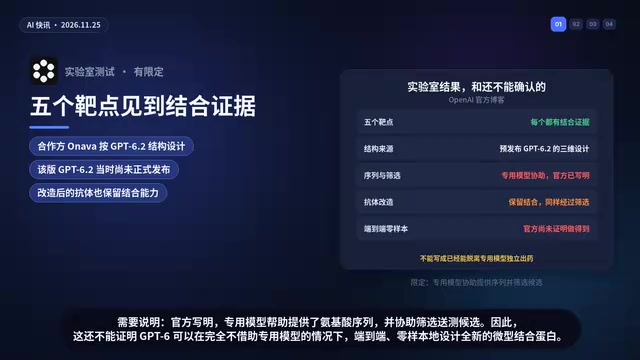
However, complete protein structure prediction remains a clear weakness. OpenAI conducted lab tests with partner Onava, which produced small proteins based on 3D structures designed by a not-yet-officially-released GPT-6.2. Across five selected targets, at least one protein per target showed binding evidence, and engineered antibodies retained binding capability.
It is worth noting OpenAI's own caveat: specialized models helped provide amino acid sequences and assisted in screening candidates, so this does not yet prove that GPT-6 can design entirely new mini-binding proteins end-to-end without any contact with specialized models. In other words, general-purpose models show promise in protein design, but they are still some distance from "fully脱离" (breaking free from) specialized tools.
Protein design typically involves two directions: generating entirely new amino acid sequences based on a target function, and predicting what 3D structure a given sequence will fold into. Previously, such tasks relied heavily on specialized models like RoseTTAFold and AlphaFold, along with extensive physical simulations and experimental screening. The key to general-purpose large models participating in protein design lies in encoding sequence and structure knowledge into language models, enabling them to complete parts of the workflow through reasoning and writing code to call general-purpose tools. But whether a protein can actually bind to a target and whether it is stable and expressible ultimately still requires wet-lab validation; model outputs can only be treated as candidate hypotheses, which is why evaluations must distinguish between "computational metrics" and "experimental evidence."
Claude Creations Become Standalone Apps with One Click
Anthropic announced that the test feature Install as App is rolling out to Claude's Mac and Windows clients. Users can install creations generated by Claude as standalone desktop applications with their own icons and windows, no longer needing to run them inside Claude. Installed apps can continue to call Claude and connected tools, and apps update automatically when the underlying creation is modified.
Permissions come in three tiers: the default is equivalent to browser capabilities; app permissions can request notifications, global shortcuts, and more; and full access allows running programs and reading, writing, and deleting files. The official documentation states that this feature is rolling out as a beta across plan tiers, but organizations meeting HIPAA readiness requirements and hybrid deployments cannot use it. The Team plan has full access enabled by default, while Enterprise has it disabled by default until the owner enables it. Using apps requires being online and logged into Claude; documents, slides, and spreadsheets cannot currently be installed.
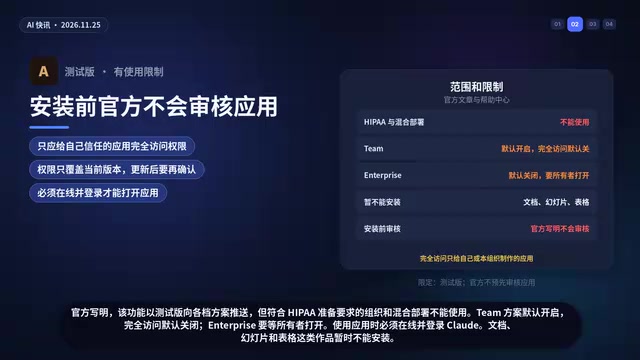
Anthropic explicitly states that it will not review these apps before installation; users should only grant full access to apps they trust, permissions only cover the current version, and confirmation is required again after an app updates. This means "one-click to app" lowers the delivery barrier, but more security responsibility shifts to the user.
MCP (Model Context Protocol) is an open protocol proposed by Anthropic for connecting models to external tools and data sources in a standardized way. Clients expose available tools, resources, and prompt templates to the model, which then calls them as needed, avoiding the need to write separate integration code for each service. Install as App lets generated creations run as desktop applications, still fundamentally driven by Claude in the background, so apps can continue to use connected tools. Permission tiers mean the same creation can perform very different operations at different trust levels; "full access" in particular involves file read/write/delete, which is a high-risk capability requiring per-use confirmation and post-hoc auditing.
DeepMind's New Exam: Testing Whether Simple Questions Can Be Answered Consistently
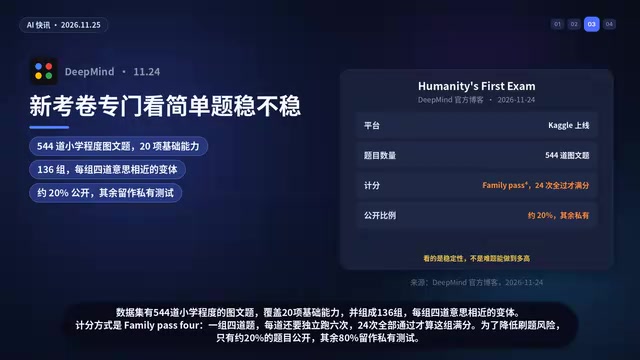
Google DeepMind released a new benchmark called Humanities First Exam, or HIP, to measure whether large models can consistently answer simple questions that humans almost always get right, rather than only looking at how well they handle difficult problems. The dataset contains 544 elementary-school-level image-and-text questions covering 20 foundational capabilities, organized into 136 groups of 4 semantically similar variants each.
The scoring method is noteworthy: in each group of 4 questions, each question must also be run independently 6 times, and all 24 runs must pass for the group to receive full marks. To reduce the risk of benchmark gaming, only about 20% of questions are public, with the rest in a private test set. As of the morning of November 25, the public leaderboard showed GPT-6.2 Astra's HIP setting at 90.7%, GPT-6.2 SO at 87.5%, and Gemini 4 Neon's HIP setting at 85.6%. These numbers carry error margins, and the rankings update in real time.
The team also invited the community to join a three-week competition running until December 15, submitting everyday questions that current models still get wrong. Accepted questions have a chance to be recorded in the benchmark, and participants can share in $50,000 worth of merchandise rewards. The design philosophy is clear: rather than chasing the ceiling on difficult problems, first test the stability of foundational capabilities.
Large model evaluation has long suffered from "leaderboard gaming": public questions easily end up in training data, inflating model performance on fixed questions. HIP's approach is to publish only about 20% of questions, converting the rest into a private test set, and to increase difficulty through "semantically equivalent variants + multiple samples all passing" rules. All 24 runs passing means the model must not only know the answer but remain consistent when wording and image-text combinations change—closer to real-world reliability requirements. The presence of error margins shows that confidence intervals in small-sample evaluations cannot be ignored; when rankings are close, specific percentage-point differences should not be over-interpreted.
Workspace Agent Integration Moves to Managed Interfaces
Google Workspace announced the official opening of its Workspace MCP service and command-line tools for agents. Cloud and web agents can use Gmail, Drive, Docs, Sheets, Slides, Calendar, Chat, and Tasks via MCP, with Keep to follow; local and desktop agents use the command-line tools.
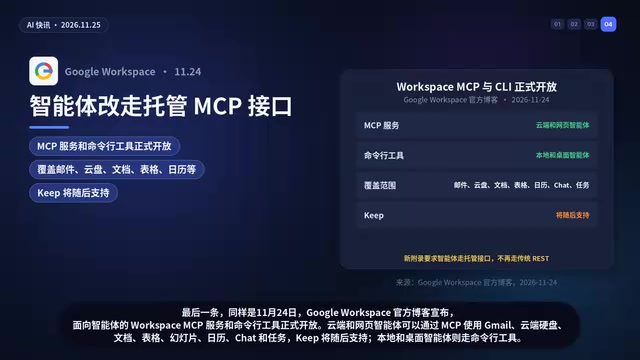
The new Workspace AI tools addendum requires agents to access through these managed MCP or command-line interfaces, no longer through traditional REST APIs. Technical enforcement begins February 1, 2027; external agents will also need separate OAuth client identifiers, and usage quotas will be adjusted starting April 1, 2027. Google emphasizes that high-impact operations such as sending external emails, changing sharing permissions, or bulk editing require user confirmation per enterprise policy, and admins can view audits and revoke agent permissions in the admin console.
The feature to restrict external agents' access to specific emails and files is listed as "coming soon" and is not yet fully in effect; specific terms are subject to the official addendum and product pages.
OAuth client identifiers distinguish different application identities. With separate identifiers for external agents, admins can authorize, rate-limit, and audit each agent individually rather than mixing them with regular users or internal apps. Moving from REST APIs to managed MCP or command-line interfaces aims in part to unify permission boundaries and operation logs, so high-impact operations can be intercepted by policy and require user confirmation. The technical enforcement date is set for 2027, leaving a migration window for existing integrations, but quotas and terms may still change; enterprises should map out automation workflows that depend on legacy interfaces in advance.
The Common Signal Behind All Four Announcements
Taken together, these four announcements show that AI competition is shifting from "demonstrating model capabilities" to "how capabilities can be used reliably." GPT-6's protein design emphasizes the possibility of general-purpose models replacing specialized workflows, but the official statement also acknowledges that specialized models are still involved. Claude's Install as App turns generated results into deliverable software forms while bringing permissions and security confirmations to the fore. DeepMind's HIP benchmark tests stability through multiple passes on simple questions rather than chasing high scores on difficult problems. And Workspace's interface changes are infrastructure and governance preparations for large-scale agent integration.
For developers and enterprises, the practical implications are: the capability boundaries of general-purpose models are expanding, but specialized tools, permission governance, and stability evaluation remain unavoidable parts of the deployment process.
Related articles
OpenAI Weekly Roundup: GPT-6.2 Rolls Out to ChatGPT, GPT-6 Designs Proteins
OpenAI's week: GPT-6.2 rolls out to ChatGPT, GPT-6 claims independent protein design, agent research share surges, perplexity proposed as a shared metric, and internal safety concerns surface.

Is the Crypto Industry About to "Turn Blue"? The Truth Behind Tech and Politics' Shifting Allegiances
Vergecast discusses whether the crypto industry will shift from the right to the Democrats, revealing the pragmatic nature of tech's politics and the costs of a crypto pivot.

Stop Waking Up All Your AI Agents: The Token Trap of Multi-Agent Collaboration
Waking up 100 AI agents for the same message causes chaotic replies and rapid token depletion. This article analyzes this multi-agent anti-pattern and its implications for wake-up strategies and token budget design.