Agent Skills Specification: Standardization and Reusability Practices for AI Agent Capabilities

Agent Skills specification tackles AI agent ecosystem fragmentation through standardized, portable, composable skill definitions.
The agentskills/agentskills open-source project proposes a universal specification for AI agent skills, addressing ecosystem fragmentation across frameworks like LangChain, AutoGPT, and CrewAI. By defining standardized metadata, input/output contracts, and execution logic, it enables skill portability, composability, discoverability, and verifiability — drawing parallels to OCI container standards and REST API conventions as historical precedents for successful standardization.
What Are Agent Skills?
As AI agents driven by large language models (LLMs) rapidly evolve, a core question has emerged: how can we standardize, modularize, and reuse agent capabilities? An open-source project on GitHub called agentskills/agentskills is attempting to answer this question.
Background: LLM-Driven AI Agents LLM-driven AI agents are software systems that use large models like GPT-4, Claude, and Gemini as their "brain," capable of autonomous planning, tool invocation, and multi-step task execution. Unlike traditional chatbots, agents can perceive their environment, formulate action plans, invoke external tools (such as search engines, code executors, and databases), and iteratively make decisions based on feedback. This paradigm emerged around 2023 with the explosion of research and projects like ReAct and AutoGPT, marking a significant leap from AI as "passive responder" to "active executor."
From a technical evolution perspective, agent capabilities matured through three key phases: The first phase, represented by the ReAct (Reasoning + Acting) paper, established the foundational framework of alternating reasoning and action through "chain-of-thought + tool calling." The second phase, represented by projects like AutoGPT and BabyAGI, introduced task decomposition and autonomous loop execution mechanisms, enabling agents to continuously execute long-horizon tasks. The third phase, marked by the maturation of frameworks like LangChain and CrewAI, saw agents deployed at scale in enterprise production environments. It is precisely this rapid evolution and resulting framework diversity that has created an urgent need for cross-framework skill standardization — every framework is "reinventing the wheel," and the cost of ecosystem fragmentation grows dramatically as agent applications scale.
The project focuses on providing specifications and documentation for "Agent Skills," and in a short time has garnered over 21,000 stars with 86 new stars in a single day, clearly reflecting the community's intense interest in this direction.
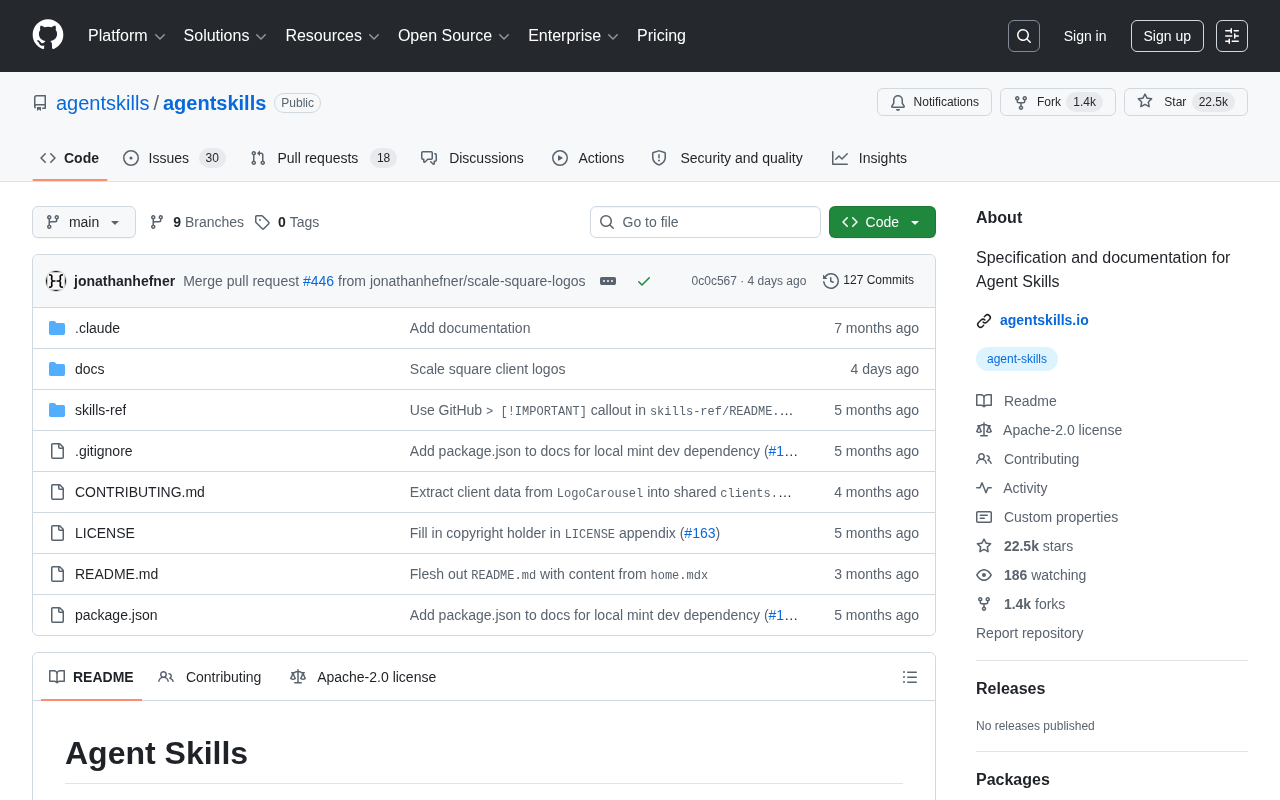
The core philosophy of Agent Skills is to abstract a specific capability of an agent into a "skill" unit. Just as humans can learn and combine multiple skills to accomplish complex tasks, AI agents similarly need a standardized way to define, encapsulate, and invoke various skills. The project uses Python as its primary language, providing developers with a unified skill description format and calling conventions.
Why Do We Need Standardized Agent Skill Specifications?
The current AI Agent ecosystem has an obvious pain point: various frameworks (such as LangChain, AutoGPT, CrewAI, etc.) each have their own tool or skill definition approaches, lacking interoperability. Capability modules written for one framework often cannot be directly migrated and reused in another.
The Current State of Mainstream Agent Frameworks LangChain is currently the most widely adopted agent framework, with its Tool abstraction allowing developers to wrap any Python function as a callable tool — but it's incompatible with other frameworks. AutoGPT is known for its autonomous loop execution and has its own independent plugin system. CrewAI focuses on multi-agent collaboration, introducing concepts of Role and Task to organize skill allocation. Microsoft's AutoGen and Anthropic's Claude tool-calling mechanisms each differ. This ecosystem fragmentation means a search tool written in LangChain cannot be directly recognized and called by a CrewAI agent — developers must rewrite wrapper code for each framework.
The deeper reason for this fragmentation lies in fundamental philosophical differences in each framework's architecture: LangChain centers on "chain-based invocation" as its core abstraction, where a Tool is a node in the chain; AutoGen centers on "conversation-driven" design, where skills are triggered through message passing between multiple agents; CrewAI centers on "role-based division of labor," where skills belong to specific roles rather than being globally shared. These different abstraction levels lead to divergent tool description formats, calling conventions, and error handling mechanisms. Statistics show that if an enterprise-level agent application simultaneously depends on three mainstream frameworks, the maintenance cost of its tool adaptation layer can account for over 30% of total development effort — this is the real-world motivation behind the community's call for a unified specification.
The Redundancy Cost of Fragmentation
This fragmentation leads to severe duplication of effort. Developers are forced to repeatedly write functionally similar skill modules for different platforms, and it also hinders the possibility of community collaboration on high-quality skill libraries. When skills cannot be reused across platforms, the pace of ecosystem accumulation is significantly reduced.
The Core Value of Standardization
The agentskills project aims to establish a universal specification that gives skill definitions the following key properties:
- Portability: Define once, run anywhere — not bound to any specific agent framework
- Composability: Multiple atomic skills can be combined into more complex capabilities
- Discoverability: Through unified metadata descriptions, agents can dynamically discover and select appropriate skills
- Verifiability: Clear input/output specifications facilitate testing and security audits
Composability and Modular Design Principles Composability is an extension of the software engineering principle "composition over inheritance" into the agent domain. Atomic Skills are similar to pure functions in functional programming — deterministic input, predictable output, no implicit side effects. Multiple atomic skills composed through pipelines or directed acyclic graphs (DAGs) can build composite skills for handling complex business workflows. This design philosophy was long established in Unix philosophy: "Do one thing well, and cooperate with other programs." In the agent context, composability also means skills need to share a unified context-passing format, similar to the event structure standardization problem in message queues — only when data contracts are unified can the "baton" between skills be passed smoothly.
From an engineering practice perspective, DAG-based skill orchestration is highly similar in design philosophy to Apache Airflow's task dependency management and Netflix's Conductor workflow engine. DAG structures naturally support parallel execution — atomic skills without dependency relationships can be scheduled concurrently, significantly reducing end-to-end latency of composite skills. More importantly, the directed acyclic property of DAGs mathematically guarantees that workflows won't fall into infinite loops, which is an important safety property for autonomously executing agent systems. When skill compositions are described in DAG form, debugging and explainability also improve dramatically: developers can precisely locate which atomic skill node a failure occurred at, rather than facing a black-box "complex skill execution failed" error message.
Skill Discovery Mechanisms and Semantic Retrieval "Discoverability" is one of the most technically challenging properties in the Agent Skills specification. Traditional software achieves service discovery through API documentation or service registries (like Consul or Eureka), but agent skill discovery requires models to understand semantic descriptions of skills and perform semantic matching. This has spawned a new technical direction: vectorizing skill metadata and storing it in vector databases (like Pinecone or Weaviate), where agents retrieve the most suitable skill sets through semantic similarity during task planning. This "RAG for Skills" pattern scales skill libraries from dozens to thousands while avoiding stuffing all skill descriptions into limited context windows — it's the key technical pathway for scaling skill ecosystems.
This approach is similar to interface standardization in software engineering — through the principle of "Convention over Configuration," integration costs are effectively reduced. This design philosophy was popularized by Ruby on Rails, with its core being to reduce the number of explicit decisions developers need to make by presetting reasonable default conventions. Similarly, REST API HTTP verb conventions, GraphQL query specifications, and gRPC Protobuf definitions are all classic examples of achieving interoperability between different systems through unified interface contracts. The Agent Skills specification draws on this approach, aiming to become the "universal contract" for the AI skill layer.
Design Philosophy of the Agent Skills Specification
From its positioning, agentskills leans more toward the "specification and documentation" level rather than being a heavyweight runtime framework. This lightweight positioning has its own unique considerations: the specification itself should not be bound to specific implementations but rather serve as an abstraction contract layer that allows different runtimes to follow the same set of standards.
Basic Components of a Skill
A standardized Agent Skill typically contains three key elements. First is metadata, which describes the skill's name, purpose, applicable scenarios, and other information to help agents make informed choices during task planning. Second is input/output definitions, which clearly specify what parameters the skill accepts and what results it returns — this is crucial for automated agent invocation. Finally, there is the execution logic, the actual code implementation that accomplishes the task.
Version Management and the Engineering Challenges of Skill Evolution Version management for skill specifications faces more complex challenges than traditional API versioning. When a skill's input/output format changes, other composite skills and agent workflows depending on it may experience cascading failures. Drawing from Semantic Versioning experience, skill versions need to clearly distinguish breaking changes (Major), feature additions (Minor), and bug fixes (Patch). The deeper challenge lies in the fact that agent invocations of skills are often made through natural language descriptions rather than precise function signatures — this means that even if the API signature remains unchanged, subtle wording changes in skill description text may affect the model's invocation decisions. This is a new problem domain not yet covered by traditional software version management theory, requiring the specification to proactively provide solutions at the design level.
This challenge is already supported by real-world cases. Researchers have found that merely replacing "retrieve" with "fetch" in a function description can cause invocation success rates to drop by approximately 15% on certain models — meaning a skill's "language version" and "code version" need to be managed as two independent dimensions. Drawing from the content hash approach, semantic fingerprints can be generated for a skill's natural language description text, automatically triggering compatibility assessment processes when description text changes, and verifying through A/B testing whether model invocation behavior is consistent under old and new descriptions. There is currently no industry consensus on this engineering practice, and if the Agent Skills specification can be the first to offer a standardized solution, it will fill an important engineering gap.
From Tool Calling to a Skill Ecosystem
The concept of Agent Skills goes a step beyond traditional "Function Calling."
Function Calling: Technical Principles Function Calling is a core mechanism introduced by OpenAI in GPT models in 2023, allowing developers to declare available functions' names, parameter types, and descriptions to the model in JSON Schema format. When generating responses, the model can choose to "call" a function and output structured calling parameters, with the host program responsible for actual execution and returning results to the model. This mechanism solves the interface problem for model interaction with the external world and is the technical cornerstone of modern agent frameworks. However, Function Calling only specifies "how to trigger a call" and does not address higher-level engineering problems like skill encapsulation formats, version management, and cross-framework reuse — this is precisely the gap the Agent Skills specification aims to fill.
From a broader technical architecture perspective, Function Calling addresses the communication protocol problem between the "model layer" and the "execution layer," similar to defining an RPC call format. The Agent Skills specification addresses the encapsulation and governance problem at the "skill layer," similar to building service registration, version management, and permission control systems on top of RPC. The two operate at different abstraction levels with a complementary rather than competitive relationship. The ideal tech stack should be: the bottom layer provides communication protocols between models and tools via Function Calling or similar mechanisms; the middle layer defines skill encapsulation standards and metadata formats via the Agent Skills specification; the top layer provides skill discovery and orchestration services via skill registries and semantic retrieval engines — this three-layer architecture closely corresponds to the communication, service, and governance layers of modern microservice architectures, indicating that the engineering path for agent skill ecosystems has clear historical precedents.
Function Calling solves the problem of how models trigger external tools, while skill specifications focus on the encapsulation, distribution, and reuse of skills themselves — more like building the underlying infrastructure for an "app store" for AI agents.
The Far-Reaching Significance of Agent Skills for the AI Ecosystem
The attention of over 20,000 stars reflects the developer community's urgent need for unified standards. At a time when AI Agents are moving from concept to large-scale deployment, standardization is an important marker of industry maturation.
Lessons from Historical Analogies
Looking back at computing history, from operating system syscall specifications to the Web's HTTP protocol to the OCI standard in the container domain, each instance of standardization has dramatically propelled ecosystem flourishing.
OCI Container Standard: The Most Relevant Success Case The Open Container Initiative (OCI) is an excellent reference for understanding the prospects of AI skill standardization. Before 2016, Docker nearly monopolized the container ecosystem, but its proprietary format hindered multi-runtime support for platforms like Kubernetes. OCI was led by the Linux Foundation, uniting major vendors like Docker and CoreOS to establish container image format and runtime specifications, ultimately achieving standardized container ecosystem flourishing — any OCI-compliant image can run on any compatible runtime. This journey shows that the key to standardization success lies in "neutral organization leadership + mainstream vendor endorsement + open governance." If Agent Skills is to replicate this path, ecosystem-wide joint adoption will be the critical variable.
OCI's success path offers another more nuanced insight for the Agent Skills specification: OCI did not attempt to unify all technical details of containers, but instead precisely targeted "image format" and "runtime interface" as the minimum necessary interoperability boundaries, leaving other aspects open to vendor competition. This strategy of "minimizing the scope of standardization" greatly reduced adoption resistance from mainstream vendors — participating in standard-setting doesn't mean giving up competitive differentiation. If the Agent Skills specification can adopt this strategy by focusing on standardizing "skill metadata format" and "calling interface contracts" as its two core boundaries rather than trying to dictate execution engine implementation details, it will be more likely to gain proactive endorsement from mainstream frameworks like LangChain and CrewAI. Additionally, OCI's governance body adopted an open RFC proposal process allowing community members to participate equally in specification evolution — this decentralized governance model is also a key lesson worth learning for the Agent Skills specification in building community trust.
Agent Skills has the potential to play a similar role in the AI agent domain — if the specification is widely adopted, developers in the future could directly invoke ready-made capabilities from public skill libraries rather than building from scratch.
Real-World Challenges Still to Face
Of course, whether the specification becomes a de facto standard still depends on the degree of ecosystem adoption. History has no shortage of excellent specifications marginalized due to lack of support from mainstream frameworks. Additionally, issues like skill security, permission control, and version management need to be progressively refined as the specification evolves.
Engineering Challenges of Skill Security and Permission Control Agent skill security is an inescapable engineering challenge in specification design. Unlike traditional API calls, agents often have the ability to chain-call multiple skills during task execution — once a skill is maliciously crafted or contains vulnerabilities, it may trigger "Prompt Injection attacks" where attackers manipulate agents into executing unintended operations through carefully designed input content. Additionally, skill permission boundaries (such as file read/write scope, network access domain whitelists), rate limiting, and sensitive data masking all need explicit provisions at the specification level. Drawing from OAuth 2.0's success in Web API authorization, if the Agent Skills specification can introduce fine-grained permission declaration mechanisms, it will significantly boost confidence in enterprise-level adoption.
Prompt injection attacks are the most uniquely threatening model in agent skill security, with danger levels rising exponentially with skill chain length. In single-skill scenarios, the impact of injection attacks is limited; but in a composite workflow chaining a dozen skills, external content processed by earlier skills (such as web page text or user-uploaded files) may carry malicious instructions that pollute subsequent skill execution logic through context passing — security researchers call this "Indirect Prompt Injection." Defending against such attacks requires introducing an "input taint tracking" mechanism at the specification level: marking data from untrusted external sources, attaching trust level labels when passing it to subsequent skills, and letting the execution engine decide whether to sandbox-isolate low-trust inputs. This mechanism is similar to "Taint Analysis" in operating systems, migrating classical information security methodology to the agent skill security domain — it's a core security primitive that specification designers need to proactively incorporate.
For developers looking to participate in building the underlying infrastructure of AI Agents, paying attention to and contributing to such specification projects may be an important entry point for riding the next wave of technology.
Conclusion
The agentskills/agentskills project represents a direction worth close attention in the AI Agent domain: breaking through the current ecosystem fragmentation through standardized skill specifications. Although the project itself is still in its early stages, the community attention it has received speaks volumes — in the journey of agents moving from "functional" to "excellent" and "universal," standardized infrastructure is indispensable. For developers, now is the perfect time to deeply understand and actively participate in this trend.
Key Takeaways
Related articles

From DevOps to MLOps: Market Demand, Transition Path, and Practical Advice
In-depth analysis of transitioning from DevOps to MLOps: core differences, market demand, required skills, and a practical three-step path for operations engineers making rational career decisions.

How Realistic Is ChatGPT's Live Voice Feature? Its Human-Like Quality Is Downright Unsettling
ChatGPT Live Voice hands-on: natural interruptions, human-like pauses, and realistic breathing. Two phones chatting sound like real people. A deep dive into the tech and uncanny valley effects.

Training ASR Models with Simulated Call Center Audio: Can the Gap Between Simulated and Real Data Be Bridged?
Deep dive into training ASR models with simulated call center audio: analyzing codec simulation, code-switching, and diarization bottlenecks that reveal the gap between simulated and real phone data.