Agent Substrate: Rethinking Kubernetes for Large-Scale AI Agents
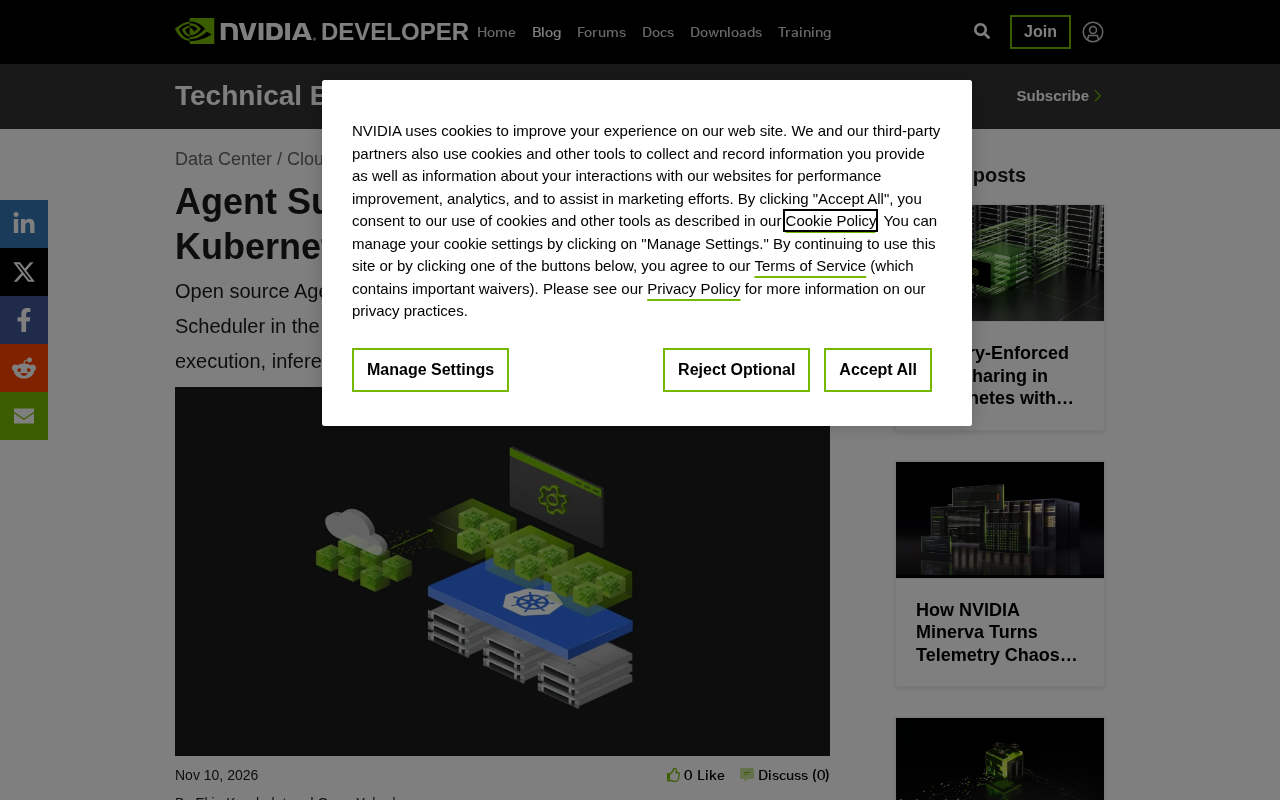
NVIDIA proposes Agent Substrate to adapt Kubernetes to the intermittent workloads of large-scale AI Agents.
The article introduces NVIDIA's Agent Substrate project, highlighting a fundamental conflict between Kubernetes orchestration assumptions and AI Agent behavior: Agents are idle most of the time, while Pods assume long-running workloads that continuously hold resources. The one-Pod-per-Agent mapping wastes resources and rigidifies scheduling at scale. Agent Substrate adds an Agent-lifecycle abstraction layer on Kubernetes, aligning scheduling with activity state rather than process existence and treating Agents as an independent workload type.
Agent Substrate: Rethinking Kubernetes for Large-Scale AI Agents
As the entire industry discusses how to make AI Agents run faster and smarter, a more fundamental question is surfacing: is the Agent's runtime environment itself designed wrong? The Agent Substrate project, recently published on the NVIDIA developer blog, takes aim at exactly this underlying assumption—it attempts to answer whether Kubernetes, an orchestration system built for long-running services, can and how it can be transformed into a runtime suitable for large-scale AI Agents.
Agent Workloads, Kubernetes' Blind Spot
The original article opens by pointing out a neglected fact: AI Agents spend most of their time idle, waiting for human prompts, tool results, or model responses. This fundamentally conflicts with Kubernetes' design assumptions.
Kubernetes' core abstraction is designed for continuously online service processes. Once a Pod is scheduled, it is assumed to occupy resources long-term, stay alive, and continuously serve external requests. But an Agent's execution pattern is completely different: it bursts with inference and tool calls in an instant, then sleeps for a long time while waiting for external input. If the practice of one Pod per Agent is continued, the cluster will accumulate large numbers of idle Pods that still occupy scheduling units and resource quotas, and the cost of horizontal scaling quickly spirals out of control.
This contradiction cannot be solved by tuning; it requires re-modeling the abstraction at the orchestration layer.
A Pod in Kubernetes is the smallest schedulable unit. A Pod typically encapsulates one or more containers that share a network namespace and storage volumes. After the scheduler (kube-scheduler) binds a Pod to a node, kubelet is responsible for maintaining its running state, while ResourceQuota and requests/limits mechanisms account for resources based on the Pod's continuous existence. This model is very natural for long-running processes such as web services and databases, but its implicit premise is that the workload lifecycle is basically consistent with the process lifecycle. The Agent's "burst—sleep" pattern breaks this premise: although the process exists, resource demands fluctuate dramatically over time, so static per-Pod accounting causes systematic waste.
In the Kubernetes ecosystem, some existing mechanisms already target intermittent or event-driven workloads, such as Horizontal Pod Autoscaler based on queue depth, KEDA's event-driven scaling, and Job/CronJob modeling for short-lived tasks. But these solutions mainly address scaling of "replica count" rather than "activity within a single Agent." The Agent challenge is this: the same logical entity consumes almost no compute when idle, yet at the moment it is woken up it needs low-latency access to inference resources. This is closer to a combination of "stateful session + elastic compute," which exceeds the comfort zone of native Deployment/ReplicaSet abstractions.
The Core Idea of Agent Substrate
Agent Substrate can be understood as adding a layer of abstraction specifically for the Agent lifecycle on top of Kubernetes, aligning scheduling granularity with the Agent's actual activity state rather than with the process's existence state.
The key clue given in the original article is "Running one Pod per..."—that is, the traditional mapping of one Pod carrying one Agent cannot be sustained at large scale. Agent Substrate aims to solve exactly the resource waste and scheduling rigidity caused by this mapping, enabling the cluster to carry tens of thousands of Agent instances in a way that better matches Agent behavior characteristics.
The significance of this idea is that it treats Agents as an independent workload type rather than forcing the operating model of ordinary microservices onto Agents. For teams that need to run multi-Agent systems in production, this directly determines unit cost and the scaling ceiling.
The reason the "one Pod per Agent" mapping fails at scale can be understood in orders of magnitude: if a cluster needs to run tens of thousands of Agents and each Agent's average active time share is only a few percent, then deploying them as resident Pods means the vast majority of scheduling units and memory reservations sit idle. More critically, Kubernetes scheduling and health checks (liveness/readiness probes) are all designed around "whether the process is healthy and alive," whereas an Agent's "health" should be defined as whether it can quickly obtain inference and tool-calling capability when needed. Aligning scheduling granularity with activity state essentially introduces a dynamic mapping from "logical Agent to physical execution unit" at the orchestration layer, allowing idle Agents to release compute resources and rebind when woken up.
Impact on the Competitive Landscape of Agent Infrastructure
For some time, innovation at the Agent framework layer has been very intense, but progress at the runtime and orchestration layer has lagged relatively. Agent Substrate pulls attention back to the infrastructure layer.
Its value lies not only in the technical solution itself, but also in proposing a clear problem framework: when Agents become the primary workload in a cluster, how should fundamental mechanisms such as scheduling, resource quotas, and lifecycle management be redesigned? Discussion around this question will directly affect enterprises' architecture choices for deploying multi-Agent systems—whether to continue patching general-purpose orchestration systems or to introduce a runtime layer designed specifically for Agents.
For engineering teams building large-scale Agent applications, what is worth watching is whether this direction can form reusable practice patterns. NVIDIA publishing the project in the form of a developer blog also means that more specific implementation details and integration paths may be released later.
The Agent framework layer (such as LangGraph, AutoGen, CrewAI, etc.) mainly addresses Agent orchestration logic, tool calling, and multi-Agent collaboration, running inside the application process; while the runtime and orchestration layer concerns how processes are scheduled, how resources are allocated, and how state is persisted. The boundary between the two has long been blurred, leading many teams to use application-layer code to compensate for infrastructure shortcomings—for example, implementing session queuing, idle reclamation, and concurrency throttling themselves. The significance of projects like Agent Substrate is to move these responsibilities, which should be borne by infrastructure, upward so that the framework layer can focus on Agent behavior itself. To judge whether this direction is mature, the key is whether it can provide stable API abstractions, compatibility with existing Kubernetes toolchains (such as Operator, CRD, and observability systems), and scheduling latency performance under real workloads.
Final Thoughts
What Agent Substrate touches on is an easily overlooked but unavoidable bottleneck: Agent intelligence is rapidly improving, but if the runtime that carries them is still designed in the style of traditional services, the cost and complexity of large-scale deployment will become the real ceiling on adoption. Transforming Kubernetes into a system truly suited to Agent workloads may be a key step in taking Agents from demos to production.
One-line Summary
NVIDIA proposes Agent Substrate, attempting to transform Kubernetes to suit the intermittent workloads of large-scale AI Agents.
Paragraph Summary
The article introduces the Agent Substrate project published on the NVIDIA developer blog, pointing out a fundamental conflict between current Kubernetes orchestration assumptions and the actual behavior of AI Agents: Agents spend most of their time idle and waiting, while Kubernetes' Pod abstraction assumes workloads are online long-term and continuously occupy resources. The traditional one-Pod-per-Agent mapping causes large amounts of idle resources and scheduling rigidity at scale. Agent Substrate's approach is to introduce an abstraction layer on top of Kubernetes oriented toward the Agent lifecycle, aligning scheduling granularity with the Agent's activity state rather than the process's existence state, thereby carrying Agents as an independent workload type. The article argues that this direction pulls attention back to the runtime and orchestration layer and will affect enterprises' architecture choices and large-scale deployment costs for multi-Agent systems.
Related articles

MIT PhD Takes You from Scratch to Build DeepSeek: A 25-Hour Hardcore Course
MIT PhD Raj Dandekar launches a 25+ hour Bilibili course building DeepSeek from scratch—MoE, MLA, GRPO, hand-written code plus math derivations, aiming to reproduce mini R1.
DeepSeek Harness in Practice: From Installation to Plugin Ecosystem, Building a Fully Automated AI Workflow
Based on a hardcore Bilibili tutorial, this guide systematically covers DeepSeek Harness installation, three plugin installation methods, and real-world use cases to help developers quickly build customizable AI Agent workflows.
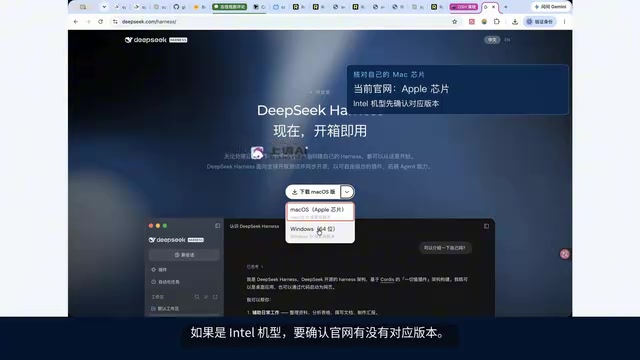
DeepSeek Harness in Practice: From Installation to Automated Workflows
Hands-on DeepSeek Harness tutorial covering Mac/Windows installation, login, workspace binding, model & permission setup, and minimal closed-loop verification for AI automation workflows.