Agent Teams in Practice: A Guide to Multi-Agent Collaboration and Real-World Implementation
A practical guide to making multi-agent collaboration work through clear roles, adversarial review, and structured deliverables.
This article breaks down the Agent Teams methodology for multi-agent collaboration, explaining why simply deploying multiple Agents without coordination leads to failure. It covers four key pillars: splitting execution roles, introducing adversarial Agents for critical review, assigning dispatcher Agents for orchestration, and converging outputs into structured, actionable deliverables ready for downstream business use.
Why Multi-Agent Collaboration Keeps Failing
Most people make the same mistake the first time they try multi-agent collaboration: they send several Agents off to gather information simultaneously, only to get back a pile of chat logs that look "busy." On the surface, everything seems productive. In reality, it's a tangled mess — no one knows who researched what, critical risks go unmonitored, and worst of all, the output can't be picked up for the next phase of work.
The intuitive notion that "more hands make lighter work" often backfires in Agent collaboration scenarios. From a technical standpoint, the root cause of multi-Agent collaboration failure is the lack of an Orchestration Layer. In distributed system design, if multiple independent services lack a unified coordination mechanism, you get race conditions, redundant computations, and output conflicts. Multi-Agent systems face remarkably similar challenges — each Agent is essentially an independent reasoning process. They share the same task objective but lack shared state management and output standards. In computer science, this is known as the "Coordination Problem." Without clear role assignments and delivery standards, the outputs from multiple Agents can't be integrated into valuable results; instead, they only add information noise. The key to making multi-Agent collaboration actually work isn't about having "more" Agents — it's about division of labor and acceptance criteria.
This methodology has a dedicated name — Agent Teams. It is essentially a coordination protocol designed for LLM multi-agent scenarios. It's the core skill you must master for multi-Agent collaboration, and a critical piece of the puzzle for turning large model capabilities into real enterprise-level outcomes.
The Core of Agent Teams: Clear Division of Labor
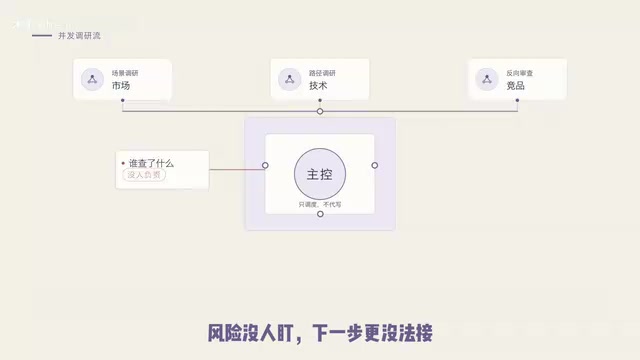
Taking the most common market research task as an example, the Agent Teams approach breaks the entire task into a clear chain of roles, rather than having all Agents do the same thing.
Research Agent and Technical Path Agent
The first step is splitting the research task itself. One Agent is dedicated to market research and competitive analysis, while another focuses on business scenario and technical path analysis. Each has its own responsibilities, with clear output boundaries, avoiding redundant work and information chaos.
A Dedicated Devil's Advocate: The Adversarial Agent
This is the most easily overlooked yet critically important element of Agent Teams — setting up a dedicated adversarial Agent whose job is to "play devil's advocate." Its responsibility is to catch errors, identify gaps, and serve as the first filter before human review, specifically challenging the conclusions drawn by other Agents.

Why is the adversarial mechanism so important? This design philosophy originates from the "Red Teaming" concept in the security domain. In cybersecurity, red teams simulate an attacker's perspective to discover system vulnerabilities; in military war games, the red force plays the adversary to challenge friendly strategies. Bringing this concept into AI collaboration workflows addresses a well-known issue: large language models exhibit "Sycophancy Bias" — models tend to generate answers users want to hear rather than objectively correct ones. Research from OpenAI, Anthropic, and other organizations has shown that introducing adversarial review mechanisms can significantly reduce hallucination rates and logical error rates.
A dedicated adversarial Agent actively seeks out logical gaps, missing data, and overly optimistic judgments. It's essentially a built-in critical thinking engine within the collaboration workflow. This is far more efficient than post-hoc human review and much better at ensuring delivery quality.
The Dispatcher and Coordinator Agent
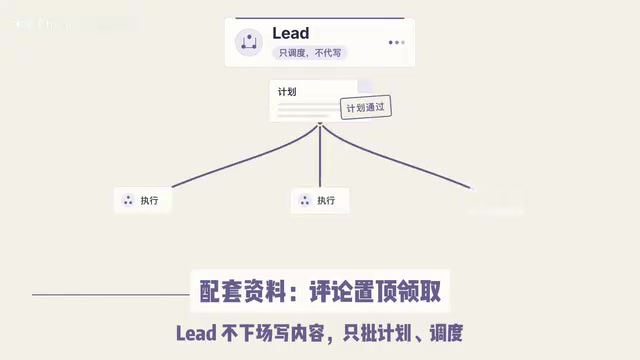
There's also an Agent that doesn't produce any specific content but is solely responsible for planning, reviewing plans, and coordinating the pace of all parties. Like a project manager, it orchestrates the big picture to ensure the entire multi-Agent collaboration process moves forward in an orderly fashion, rather than letting each Agent operate in isolation.
This role design draws from mature project management paradigms in software engineering. In Agile development, the Scrum Master doesn't directly participate in coding but is responsible for removing blockers, coordinating cadence, and ensuring Sprint goals are met. The dispatcher Agent plays a very similar role. From a technical implementation perspective, this type of Agent typically needs to maintain a Task State Graph, tracking each executing Agent's progress, output quality, and dependencies. In mainstream multi-agent frameworks like CrewAI, AutoGen, and LangGraph, this "manager Agent" pattern is widely adopted and usually called a Supervisor Agent or Manager Agent. Its existence ensures the controllability and predictability of the entire collaboration chain.
From Scattered Output to Usable Deliverables
Division of labor is only the first step. The real value of Agent Teams lies in converging scattered outputs into structured deliverables.
In the final phase of a research task, all Agent outputs are consolidated into a complete business summary. This summary is not a simple pile of information but rather high-quality conclusions that have been filtered by the adversarial Agent and integrated by the dispatcher Agent.
The concept of structured deliverables is crucial for enterprise AI implementation. It solves the "last mile" problem between AI output and business processes. McKinsey's 2024 research shows that the primary reason enterprise AI projects fail is not insufficient technical capability, but that AI output cannot be directly consumed by downstream business processes. Structured deliverables require outputs to have a clear Schema (data structure), traceable source annotations, and format specifications compatible with downstream systems. This aligns with the "Schema-on-Write" philosophy in data engineering — defining the structure when data is produced, rather than sorting it out at consumption time.
Competitive analysis tasks follow the same logic: one Agent is responsible for deconstructing the review process, while another is responsible for planning how results are presented. Through this kind of role splitting, the final analysis report has both depth and readability, plus actionable insights.
Key Standards for Deliverables

Here's a critical benchmark: What you ultimately receive shouldn't be a bunch of answers that "seem reasonable" — it should be actionable records that can be directly used for business modeling, prototyping, and architecture planning downstream.
This gets at the essential difference in enterprise-grade Agent applications. Toy-level demos aim for "looks like it works," while production-grade Agent Teams aim for "actually integrates with downstream work." The former produces talking points; the latter produces assets. Specifically, a qualified deliverable should meet three conditions: conclusions are traceable (each judgment annotated with its information source), risks are identified (key assumptions and uncertainties are explicitly flagged), and actions are actionable (output format and granularity can be directly imported into downstream tools or processes).
How to Implement Agent Teams in Your Projects
To truly integrate Agent Teams into a project, you need two things: role assignment prompts and acceptance checklists.
Role assignment prompts are essentially the systematic application of Prompt Engineering in multi-agent scenarios. A well-crafted role assignment prompt typically contains four elements: Role Definition — clearly specifying whether the Agent is a researcher, adversary, or dispatcher; Task Scope — defining the boundaries of what the Agent is and isn't responsible for; Output Format — specifying the structure and fields of the deliverable; and Constraints — setting quality baselines and prohibited behaviors. Good prompts enable research Agents to focus on research, adversarial Agents to challenge fearlessly, and dispatcher Agents to coordinate effectively.
The acceptance checklist corresponds to the "Definition of Done" in software engineering — an objective, verifiable list of completion criteria. It explicitly defines the conditions each deliverable must meet — whether data has sources, whether risks have been identified, and whether conclusions can directly feed into the next phase of work. In practice, acceptance checklists are often encoded as the system prompt of a dedicated Quality Assurance Agent, enabling automated deliverable verification.
Using this complete set of role assignment prompts and acceptance checklists with tools like Claude Code, you can run through the process once to internalize the Agent Teams methodology into your own workflow. The value of tools like Claude Code in this scenario is that they provide a programmable Agent execution environment, allowing prompts and acceptance logic to be codified and iterated upon, rather than remaining at the level of one-off manual operations.
Transferability of the Methodology
You may not have noticed, but whether it's market research or competitive analysis, Agent Teams employ the same division-of-labor logic:
- Split execution roles — Let each Agent focus on a specific domain
- Set up adversarial roles — Build in a critical examination mechanism
- Arrange dispatcher roles — Coordinate and orchestrate the overall cadence
- Converge on structured deliverables — Produce outcomes that can be directly picked up by downstream work
This four-step framework is highly transferable because it abstracts the universal structure of any complex collaborative task. Whether it's product requirements review, technical solution validation, legal compliance audits, or investment due diligence, they all fundamentally require these four phases: "execute — challenge — coordinate — converge." This means that once you've mastered this framework, you can transfer it to virtually any enterprise scenario that requires multi-Agent collaboration.
Conclusion
Agent Teams represent the critical leap in multi-agent collaboration from "it runs" to "it actually works." The core insight is this: the value of multi-Agent collaboration doesn't come from quantity, but from the clarity of role division, the rigor of adversarial mechanisms, and the usability of deliverables.
For teams that want to put AI to real use in their projects, instead of having a swarm of Agents busily producing unusable chat logs, learn to use the Agent Teams approach to build a complete collaboration pipeline from research to adversarial review to consolidation. That is the true way to make multi-agent collaboration work in practice.
Related articles

RAG Getting Started in Practice: From Principles to Building an Enterprise Knowledge Base
Bilibili RAG course highlights: from retrieval-augmented generation principles, document chunking and vectorization, to five accuracy factors and enterprise knowledge base boundaries, with fine-tuning vs RAG selection advice.

AI Model Selection Guide: DeepSeek vs. Qwen3 in Practice
How should AI developers choose models? Based on a Bilibili tutorial, this article breaks down the Function Calling differences between DeepSeek V3 and R1, Qwen3's programmatic thinking mode switching and agent capabilities, and outlines a multi-model learning path and practical selection logic.

Anchoring, Loss Aversion, and Nudges: 5 Psychological Tactics Retailers Use to Make You Spend
Behavioral economics reveals how retailers use anchoring, framing, loss aversion, and nudge theory to manipulate your spending decisions. This article breaks down 5 common psychological tactics and offers counterstrategies like slowing down decisions and setting your own anchors to see through the pricing design behind discounts.