Agent Tool Call Failures? Layered Fault Governance Is the Right Answer

A layered fault governance framework for handling Agent tool call failures in production.
Blind retries aren't enough for Agent tool call failures. This article breaks down a three-tier fault governance system: exponential backoff with circuit breaking for transient failures, structured error feedback loops for LLM output defects, and mandatory human intervention for high-risk operations — all backed by full observability.
Why This Interview Question Filters Out 90% of Candidates
When an interviewer asks, "What do you do when an Agent fails to call a tool?", if your only answer is "retry a few times, then surface the error to the user" — you've likely revealed that you've never actually shipped an Agent system to production.
As analyzed by Bilibili creator "默默" in his AI demystification series, tool call failures are the norm in production environments: interface timeouts, rate limiting, malformed model-generated parameters, and corrupted response data happen virtually every day. Industry data shows that multi-Agent systems fail at rates exceeding 40% in real-world business scenarios.
This high failure rate isn't coincidental — it stems from the inherent complexity of Agent architectures. Unlike a single LLM call, Agent systems typically involve sequential or parallel calls across multiple tools, cross-service dependencies, and state management. A failure at any single node can collapse the entire chain. According to production environment reports from cloud providers like AWS and Microsoft, tool call failure rates in complex workflows commonly range from 15% to 40%, and when a pipeline has more than five nodes, the overall success rate often falls below 60%. Such failure rates would be unacceptable in traditional software engineering, but they're the current reality for Agent systems.
This means fault tolerance isn't a nice-to-have for Agent systems — it's the line between shipping and not shipping. What this interview question truly evaluates is whether you can architect a fault management system built on "failure classification + autonomous recovery," not just a retry loop.

Blind Retries: The Biggest Misconception in Tool Call Failure Handling
Many engineers instinctively reach for retries when something fails, but different types of failures require completely different remediation strategies.
The Side Effects of Retrying
If a failure is caused by an interface timeout, hammering the downstream service with repeated requests only increases its load — potentially taking down a service that could have recovered on its own. And if the LLM generated parameters that are simply wrong, repeating the same call a hundred times will produce the same failure every time. The root cause isn't at the network layer; it's in the input itself.
The correct engineering practice is to wrap all tool calls in a unified exception-catching layer — but instead of immediately retrying, you must first classify the failure type, then apply the matching remediation strategy. Layered handling is effective fault tolerance; blind retries are worthless.
Three Categories of Agent Tool Call Failures and Their Dedicated Remediation Strategies
Agent tool call failures can be organized into three broad categories, each governed by a different set of handling principles.
Category 1: Transient Jitter Failures
This category includes network fluctuations, interface timeouts, and third-party rate limiting. The defining characteristic is that self-recovery within a short window is possible.
For these failures, exponential backoff retry is the recommended approach: progressively lengthen the wait interval between retries to give downstream services room to recover, while setting a maximum retry count to avoid infinite loops that drain resources.
Exponential Backoff is the standard algorithm for handling transient failures in distributed systems, first popularized by AWS in its SDKs. The core idea is that wait time grows exponentially with each retry (e.g., 1s, 2s, 4s, 8s), typically combined with random jitter to prevent a "thundering herd" effect where many requests retry simultaneously. AWS's recommended formula is: wait = min(cap, base × 2^attempt) + random_jitter. This is especially important in Agent scenarios — LLM API providers (such as OpenAI and Anthropic) universally employ token bucket rate limiting, and exponential backoff effectively prevents dense retries from triggering even stricter rate restrictions.
If a tool continues to fail across multiple consecutive attempts, a circuit breaker should trigger — temporarily taking the failing tool offline and switching to a fallback, preventing a single point of failure from bringing down the entire call chain while also avoiding wasteful consumption of tokens and API budget.
The circuit breaker pattern originates from Martin Fowler's 2014 Circuit Breaker Pattern, a core design pattern in microservice architecture for preventing cascading failures. A circuit breaker has three states: Closed (requests pass through normally), Open (requests are intercepted and a fallback response is returned immediately), and Half-Open (a small number of probe requests are allowed through to check if the service has recovered). In Agent tool calling, when a tool's consecutive failure count exceeds a threshold, the circuit breaker switches to "Open" state, and subsequent calls are routed directly to a fallback rather than attempting to call the failed tool. This not only protects downstream services but also conserves precious LLM token budget — every failed retry consumes context window space and API costs.

Category 2: Deterministic Logic Failures (Model Output Defects)
This category best showcases an Agent's self-healing capability. The root cause lies in defects in the LLM's own output: incorrect parameter formats, missing required fields, malformed JSON structures, and similar issues all fall here.

Retrying the same call does nothing for this category. The correct approach is to build a self-correction feedback loop:
- Feed a standardized, structured error message back to the LLM;
- Clearly indicate the specific location and reason for the previous error;
- Let the model regenerate the call parameters using the failure feedback.
An LLM's self-correction ability is grounded in its powerful in-context learning capability. When structured error information is fed back into the model's context, the model is essentially performing a form of few-shot reasoning — it can infer from the error description what the correct parameter format should look like. Research (such as Stanford's 2023 ReAct paper) shows that explicitly labeling the error type in the prompt (e.g., "JSON field missing: required field 'date' not found") achieves a 3–5× higher fix success rate compared to vague descriptions (e.g., "call failed").
Production experience confirms that the vast majority of format errors are resolved with a single correction pass. This also places demands on tool design: error messages from tools must be precise and structured, not just a vague "call failed" — otherwise the model has nothing actionable to work with, and ambiguous error messages cause the model to hallucinate during correction, generating parameters that look plausible but are still wrong. This "failure review + lesson reuse" loop is, at its core, an autonomous repair cycle.
Category 3: High-Risk Critical Failures
For this category, there is one guiding principle: prohibit the Agent from handling this autonomously — human intervention is mandatory.

Typical scenarios include: budget nearly exhausted, execution of irreversible high-risk operations required, or failures that persist after multiple remediation attempts.
This principle stems from the "Human-in-the-Loop" (HITL) design philosophy in AI safety. Safety frameworks from organizations like OpenAI and Anthropic explicitly state that autonomous AI systems must possess "Interruptibility" — at any moment, humans should be able to intervene, pause, or correct an Agent's behavior. For irreversible operations (such as deleting data, sending emails, or executing financial transactions), the industry broadly recommends a two-phase "confirm-then-execute" model: the Agent generates an action plan and pauses, waiting for human confirmation before proceeding. This design isn't just good engineering practice — it's a mandatory requirement for high-risk AI systems under current AI governance regulations (such as the EU AI Act).
The correct handling approach is: preserve the full task progress and context, terminate the automated workflow, and escalate the failure for human review. A mature Agent system must clearly define its authority boundaries and circuit breaker mechanisms, drawing a clear line between automated handling and human takeover, to prevent an out-of-control Agent from causing irreversible damage.
Observability: The Missing Piece of an Agent's Fault Tolerance System
The three-layer fault tolerance mechanisms described above also require accompanying log instrumentation and an observability platform.
Observability refers to the ability to infer a system's internal state from its external outputs, typically built on three pillars: Logs, Metrics, and Traces. In Agent systems, observability faces even greater challenges than in traditional microservices: LLM behavior is non-deterministic, and the same input may produce different tool call sequences, making issue reproduction extremely difficult. The industry has seen the emergence of observability tools specifically designed for LLM applications, such as LangSmith (from LangChain), Langfuse (open source), and Helicone. These tools can trace the complete prompt, response, token consumption, and latency of every LLM call, providing the data foundation for Agent system fault diagnosis.
The system should fully record every failure, retry, circuit break, and human escalation event to support future root-cause analysis and iterative improvement of fault mechanisms. A fault tolerance system without observability is like a plane without instruments — you'll never know where things break under real traffic, and you'll have no systematic way to improve your fault handling over time.
A Ready-to-Use Interview Answer Template
Here is a structured framework for answering the question "How do you handle Agent tool call failures?":
- Core stance: Tool call failures in production are common. The key to fault tolerance is categorization and scenario-specific handling — never apply a blanket retry strategy.
- Transient jitter failures: Exponential backoff retry with a maximum retry count; trigger circuit breaking to switch to a backup tool if failures persist.
- Deterministic model failures: Feed structured error messages back to the model to drive autonomous self-correction; most format issues are resolved in a single pass.
- High-risk critical failures: Preserve the full task state, pause the automated workflow, escalate to human review, and prevent uncontrollable losses.
- Supporting infrastructure: Build a full-chain observability system so every anomaly and remediation action is traceable and reviewable.
Conclusion: What's Being Tested Is Engineering Thinking, Not Retry Logic
This question was never really about whether you know how to "retry." It's about whether you possess the engineering mindset of layered fault governance: backoff retries for transient failures, autonomous correction for model errors, human handoff for high-risk failures — and full observability and traceability throughout.
When you can break down Agent tool call failures into distinct layers and propose targeted solutions for each, the interviewer can quickly conclude: you genuinely have hands-on experience handling real-world Agent failures in production. That's the answer this question is truly looking for.
Related articles
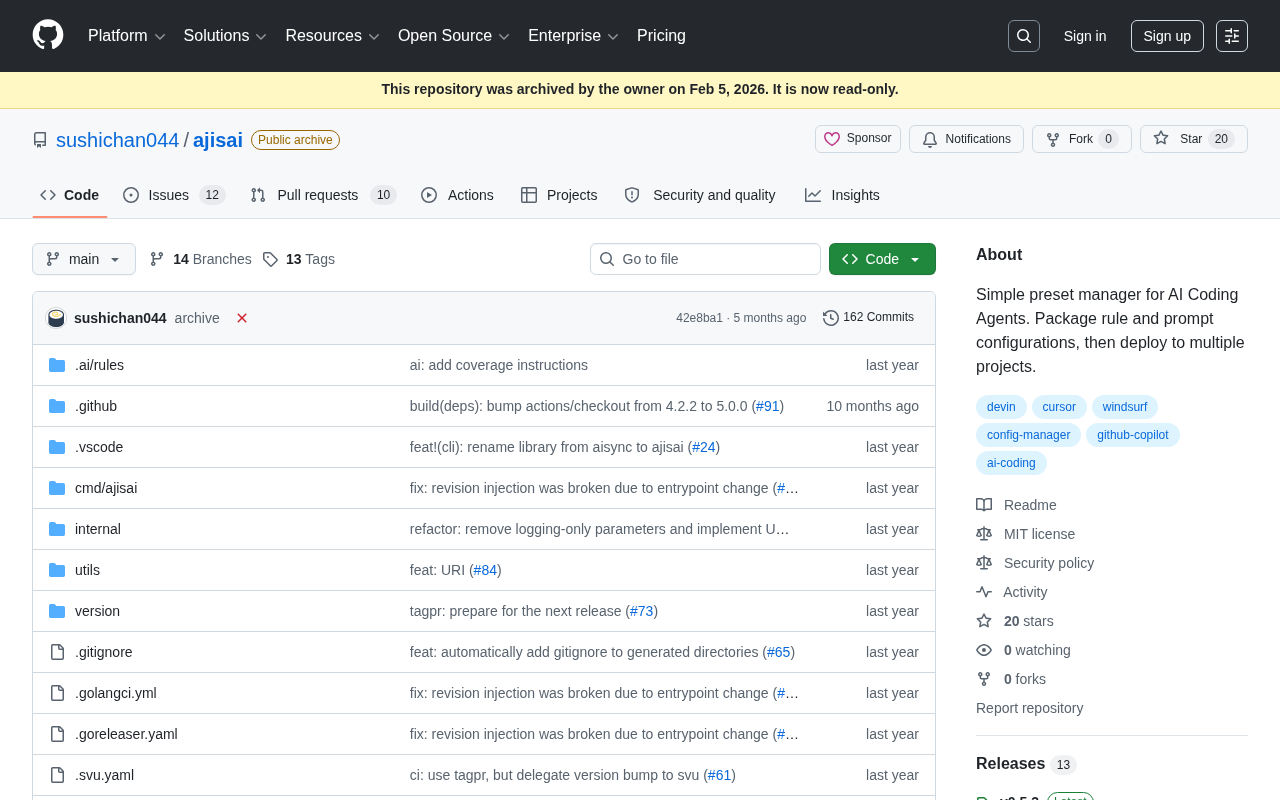
ajisai: A Preset Management Tool for Unifying Rules and Prompts Across AI Coding Assistants
ajisai is a Go-based preset manager for AI coding assistants like Cursor and Claude Code. Package rules and prompts once, deploy everywhere. Early-stage but promising.
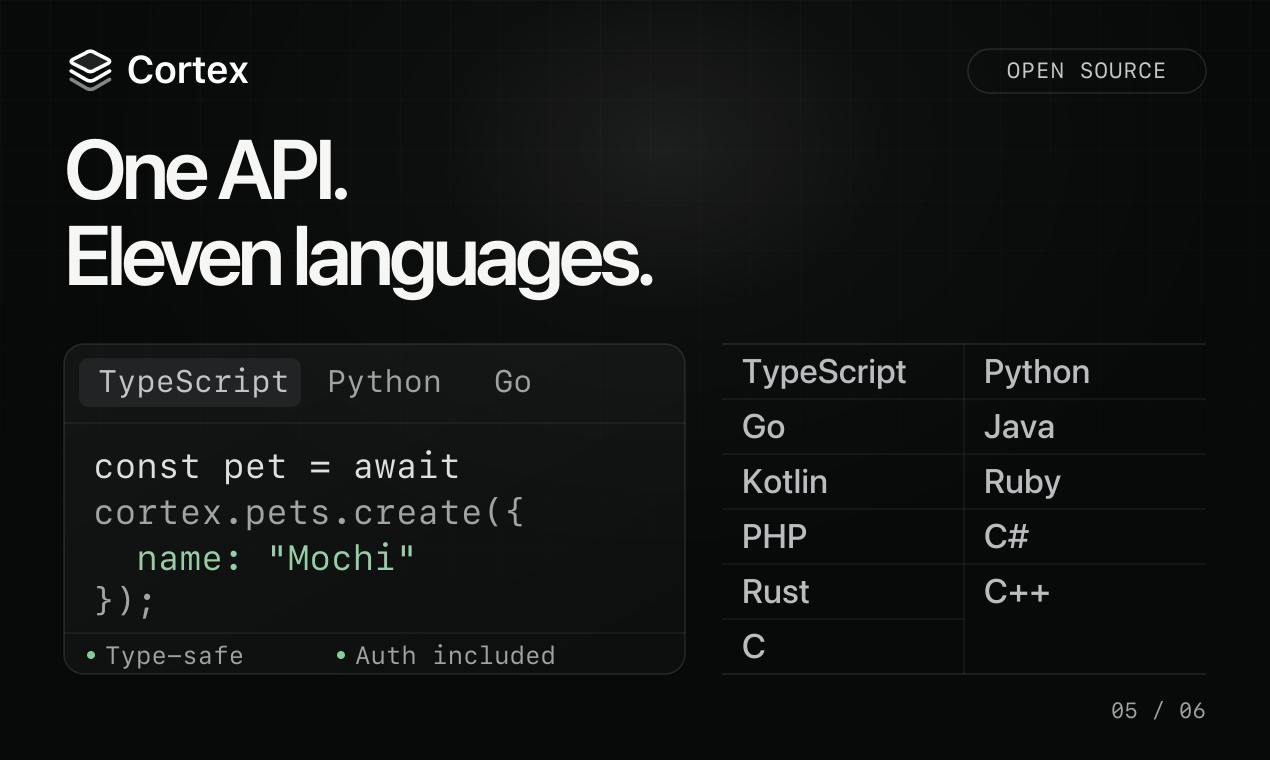
Cortex: Convert API Specs into Docs, SDKs, and MCP Servers in One Click
Cortex is an open-source tool that converts OpenAPI, GraphQL, gRPC and more into interactive docs, typed SDKs in 11 languages, and MCP servers for AI agents.

ABrush: An AI Studio Built for Digital Artists
ABrush is an AI studio for digital artists, ranked #4 on Product Hunt. It embeds leading AI models into existing workflows to remove repetitive tasks, speed up iteration, and keep artists in control.