Agent Tool Call Permission Control: Designing Allowlists by User, Role, and Task

Agent tool allowlists should be layered by user, role, and task, with default deny and full-chain auditing.
The article discusses the dimensions of Agent tool allowlists raised in a Reddit community thread, noting that tool permission control has become a default prerequisite for production Agents. It compares per-user, per-role, and per-task allowlists: user-level is most precise but costly to maintain at scale, role-level is manageable but inflexible, and task-level fits Agent workflows but depends on clearly defined task boundaries. The mainstream approach is layered combination—roles as baseline, tasks for context convergence, and user-level allowlists for exceptions—while adhering to default deny. It also highlights engineering details like tool description exposure, call chain propagation, audit observability, and dynamic authorization.
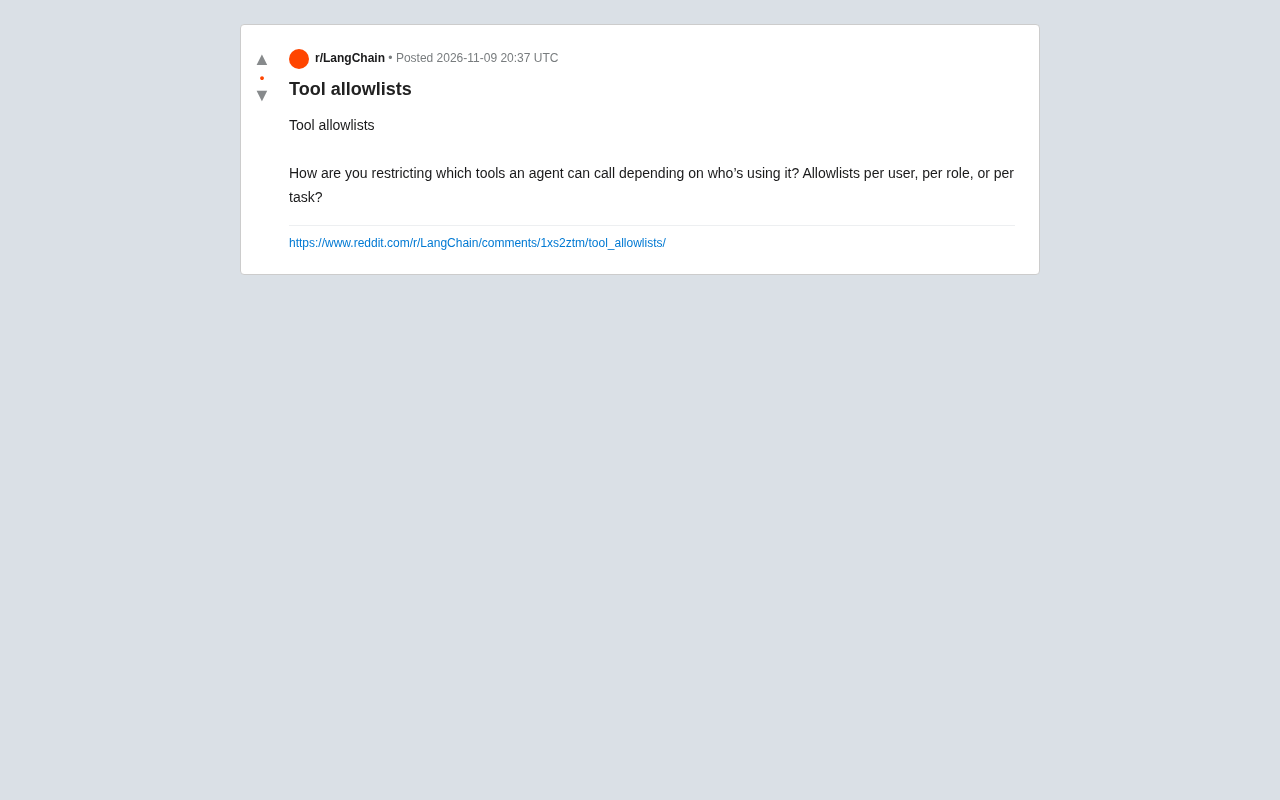
When an Agent moves from a demo to a production environment, an unavoidable question surfaces: how do you restrict it to calling only the "right" tools? A recent discussion thread in the Reddit community gets right to the core—do you set tool allowlists by user, by role, or by task? This question seems like a detail of permission configuration, but in reality it determines the security boundary and the usable ceiling of the Agent system.
Why tool allowlists are a hard threshold for Agent deployment
An Agent's capabilities come from tools, and its risks come from tools too. If a toolset that can call database queries, file writes, and external APIs treats all callers the same, the consequences can be catastrophic: ordinary users trigger admin-level delete operations, test scripts mistakenly call billing interfaces, or third-party integrations gain data access they shouldn't have.
The way the original Reddit post frames the question is very representative—it doesn't ask "should we do allowlists," but directly asks "by what dimension do you do them." This shows that among developers who already have Agent practice experience, tool permission control has shifted from optional to a default prerequisite. The debate has moved to control granularity and control strategy.
Three allowlist dimensions: user, role, task
The three options given in the original post correspond to three different levels of abstraction, with clearly different applicable scenarios.
Per user
The finest-grained control. Each user has an independent tool authorization list, and the system verifies whether the current user ID is in the allowlist before the Agent initiates a tool call.
The advantage of this approach is precision—differentiated authorization can be made based on an individual user's activation status, payment tier, and trust level. The downside is that maintenance cost grows linearly with user scale, and once the number of users reaches a certain magnitude, manual maintenance becomes nearly infeasible and must rely on automated provisioning processes.
Suitable scenarios: in B2B SaaS products, different customers purchase different feature modules; or in B2C products, premium members unlock additional automation tools.
Per role
Users are grouped into roles (such as admin, regular member, read-only guest), and the allowlist is bound to roles rather than individuals. This is an extension of the RBAC (role-based access control) approach to the Agent tool layer.
The role model shows better manageability as user scale grows—new users only need to be assigned a role, without configuring tools one by one. The cost is reduced flexibility: if a certain user needs "one more tool than others in the same role," you either create a new role or fall back to user-level overrides.
In the Reddit discussion, many practitioners favor using roles as the primary dimension, then using user-level allowlists for exceptions, forming a hybrid structure of "role defaults + user overrides."
RBAC (Role-Based Access Control) is a classic model in permission system design. Its core idea is to introduce "roles" as an intermediary layer between "users" and "permissions": permissions are granted to roles, and roles are then assigned to users. The benefit is that permission configuration is decoupled from user scale—as the number of users in an organization grows, administrators only need to maintain a limited number of role definitions rather than configuring permissions for each user individually. RBAC usually also includes mechanisms such as role inheritance (higher-privilege roles automatically possess all permissions of lower-privilege roles) and separation of duties (certain mutually exclusive permissions cannot be granted to the same role). In the context of Agent tool authorization, the mapping becomes "role → tool allowlist," but the special nature of the Agent scenario must be noted: traditional RBAC controls static resource access, whereas Agent tool calls are dynamic and compositional, and the role model needs to be combined with task context to express the full authorization intent.
Per task
The authorization unit shifts from "who is calling" to "what task is being executed." The same user can only call knowledge base retrieval in a customer service Q&A task, and only call code execution in a data processing task.
This is the most context-sensitive of the three dimensions, and it is closer to how an Agent actually works—the Agent's behavior is itself task-driven. The difficulty of per-task control lies in the need for task boundaries to be clearly defined and identified; otherwise, the allowlist has nothing to bind to. It is usually used in combination with workflow orchestration systems rather than as an isolated permission module.
Combined strategies in practice
Judging from the direction of the discussion, a single dimension can hardly cover all requirements. A more realistic architecture is layered verification:
- The first layer uses roles as the baseline, determining which tools a user can "in principle" use;
- The second layer uses tasks for context convergence, further narrowing the available toolset within the scope of the current task;
- The third layer uses user-level allowlists for exceptions, handling the few individuals who need to break through role restrictions.
The key to this layered structure is default deny: any tool call not explicitly authorized by any layer should be blocked. The essence of an allowlist is not "listing prohibited items" but "only letting through items confirmed safe." If the direction is reversed, the security model fails.
Design details that are easily overlooked
A tool allowlist is not just a permission table; it also involves several engineering realities.
The exposure surface of tool descriptions. If the entire tool list is passed to the model and then filtered, the names and descriptions of unauthorized tools have in fact already been leaked into the model context and could be exploited by suggestive prompts. A safer approach is to complete filtering before constructing the model request.
Propagation in the call chain. An Agent may nest calls to sub-Agents or external services, and the allowlist needs to be propagated along the entire call chain and narrowed at each level, rather than being verified only once at the entry point.
Auditing and observability. Every time a tool call is allowed or blocked, there should be a record. When anomalous behavior occurs, the allowlist logs are the first-hand material for locating the problem.
Dynamic authorization. Some scenarios require temporary privilege expansion at runtime (for example, allowing a sensitive operation once after explicit user confirmation). This requires the allowlist mechanism to support one-time, time-limited authorization credentials rather than static configuration files.
Default Deny is a basic principle in the field of access control, as opposed to "default allow": when no explicit authorization rule matches, the system should automatically deny the request rather than automatically allow it. This principle is widely adopted in security engineering because "default allow" means that any configuration omission, rule conflict, or parsing anomaly degrades to "allow everything," and the attack surface expands exponentially with system complexity; whereas the failure mode of "default deny" is "false denial," which is a usability issue rather than a security issue and carries controllable risk. Implementing default deny in Agent tool allowlists requires that the authorization decision logic adopt the form "allow only when allowlist matching succeeds," and that boundary cases such as rule loading failure, empty allowlist, and unrecognizable tool identifiers all be handled as denial. Alongside it is the "Principle of Least Privilege": each caller should receive only the minimal toolset necessary to complete the current task, and together the two form the baseline of the Agent permission model.
Summary
Behind this brief question on Reddit is a design decision that must be given a clear answer during Agent engineering. Per user, per role, and per task are not mutually exclusive options; production systems are more likely to be a layered combination of the three, with roles as the baseline, tasks as context, and users as exceptions, while adhering architecturally to default deny and full-chain auditing. If tool allowlists are done well, the Agent can be given free rein; if done poorly, they become the entry point for the next security incident.
One-line Summary
Agent tool allowlists should be layered by user, role, and task, while adhering to default deny and full-chain auditing.
Paragraph Summary
The article centers on a Reddit community discussion about the dimensions of Agent tool allowlists, noting that tool permission control has shifted from optional to a default prerequisite for putting Agents into production. It compares the pros, cons, and applicable scenarios of three allowlist dimensions—per user, per role, and per task: user-level is the most precise but maintenance cost grows linearly with scale; role-level is highly manageable but less flexible; task-level is closest to how Agents work but depends on clear definition of task boundaries. The mainstream approach in practice is layered combination—roles as the baseline, tasks for context convergence, and user-level allowlists for exceptions—while adhering to the default deny principle. The article also highlights easily overlooked engineering details such as tool description exposure, call chain propagation, audit observability, and dynamic authorization.
Related articles

Prompt Engineering for Beginners: From Writing Prompts to Engineering Thinking
Starting from the essence and four functions of prompts, this article systematically explains the six-step process, four success criteria, learning value, and practical limitations of prompt engineering to help you build a complete understanding.

Anthropic Launches Nasdaq IPO: AI Giant's Listing and Risk Disclosures
Anthropic officially launches its Nasdaq IPO under ticker ANT, with market valuation expected to potentially exceed SpaceX's record. The prospectus devotes nearly 100 pages to AI risks, while first-half revenue grew over 14x but net losses widened sharply, reigniting the AI bubble debate.

Rust cURL Clone Uses 4,832 unsafe Blocks—Is the Memory Safety Myth Broken?
A Rust cURL clone uses 4,832 unsafe keywords, challenging Rust's memory safety narrative. We analyze what unsafe really means, compare Fil-C, and examine rewrite motives.