Agentic AI and MCP Explained: From Generative AI to Autonomous Agents

A workshop walkthrough of Generative AI, Agentic AI, and MCP — with a live n8n RAG pipeline demo.
This article recaps an AI workshop for students and researchers led by Ajinkya, CTO of Ditto Security. He covered three layers: Generative AI (built on language modeling and RLHF), Agentic AI (automating repetitive tasks via platforms like Make, Zapier, and n8n), and MCP — described as a "USB-C port" that connects AI models to real-world tools and APIs. The hands-on segment walked through building a RAG Q&A workflow in n8n using Google Drive, Pinecone, and OpenAI Embedding. Tools recommended included Cursor AI, Claude Code, Hugging Face, and ElevenLabs.
Starting with Generative AI: Three Concepts You Must Understand
At a one-day workshop jointly organized by the Department of Computer Science at Annai Scholastica Arts and Science College and the Indian Association of R&D Professionals, Ajinkya — founder and CTO of Ditto Security — offered a systematic breakdown of the three hottest layers in AI today: Generative AI, Agentic AI, and MCP (Model Context Protocol). His core message was direct: Generative AI is no longer the cutting edge. The areas truly worth researchers' attention are Agentic AI and MCP.
To explain Generative AI, he broke it into two parts: "Generative" and "Artificial Intelligence." He stressed that Generative AI is "not rocket science" — it's built on two foundational technologies: Language Modeling and Reinforcement Learning from Human Feedback (RLHF). Language modeling is the process by which a system predicts what comes next based on context — like when you type "I want to play cricket" in a browser and it auto-completes the sentence. RLHF ensures that model outputs align with how humans think and communicate.
Built on these two technologies, Generative AI enables a range of applications: text-to-text, text-to-speech, text-to-video, and more. This represents the AI capability boundary most people are familiar with today.
A closer look at RLHF: RLHF (Reinforcement Learning from Human Feedback) is a critical step in training today's leading large language models. The basic process: the model generates multiple candidate outputs, human annotators rank them by quality, those rankings train a "reward model," and the reward model's scores are then used as reinforcement learning signals to continuously improve the main model. This mechanism makes model outputs more aligned with human preferences — more polite, more accurate, less harmful. Commercial models like ChatGPT and Claude rely heavily on RLHF or its variants (such as RLAIF) for alignment training. Understanding RLHF helps explain why two models sharing the same underlying architecture can feel dramatically different after different levels of alignment training.
Agentic AI: Letting Automation Replace Repetitive Work
The presenter argued that the capabilities of Generative AI are already "becoming outdated," giving way to the automation paradigm of Agentic AI. He used a relatable example: if you want to run a LinkedIn content operation, you used to have to post manually every day — but an agent can handle the entire workflow for you. "It's not you executing the task — it's your agent."
He highlighted three mainstream automation platforms: Make, Zapier, and n8n (which he later demonstrated in depth). In his view, many industries are already shifting toward automation, with AI receptionists and AI customer service teams gradually replacing human roles. This is a somewhat bold claim — statements like "we truly won't need humans in the future" reflect a personal viewpoint, and readers should take a measured view. Automation is better understood as an augmentation tool rather than a full replacement.
MCP: The "USB-C Port" for AI Systems
The central concept of the workshop was MCP (Model Context Protocol). The presenter broke it down into three keywords:
- Model: The underlying language model — could be ChatGPT, LangChain, or others;
- Context: Additional information. For example, asking ChatGPT "Who am I?" out of nowhere won't get a useful answer, but providing identity context enables a tailored response;
- Protocol: A set of state rules.
The fundamental difference between MCP and both Generative AI and Agentic AI lies in action capability. He illustrated this: if you type "Book me a flight from Chennai to London" into ChatGPT, a standard conversational model can't do it — but through an MCP Server, you can not only book the ticket but also check flight status. He described MCP as "a simple USB-C port" — through it, AI can connect to multiple servers and APIs, enabling genuine integration with real-world tools, data, and applications.
A closer look at MCP: MCP (Model Context Protocol) was released and open-sourced by Anthropic in late 2024, with the goal of establishing a unified standard for interactions between AI models and external tools and data sources. Before MCP, every AI application that needed to call an external service — a database, calendar, or code execution environment — required developers to write custom integration logic, with wildly inconsistent interfaces and high maintenance costs. MCP defines two roles — "MCP Server" and "MCP Client" — encapsulating external capabilities into standardized interfaces. MCP Servers expose Tools, Resources, and Prompt templates; MCP Clients (typically AI assistants or agent frameworks) call these capabilities through a unified protocol. This mirrors the design philosophy of USB-C: no matter what device you connect, the interface spec stays the same, dramatically reducing the complexity of ecosystem integration. A growing number of third-party services now offer official MCP Servers, including GitHub, Google Maps, and various database drivers.
Hands-On Demo: Building a RAG Knowledge Base Q&A Workflow with n8n
The hands-on portion of the workshop focused on building a RAG (Retrieval Augmented Generation) chatbot using the n8n platform. The essence of RAG is enabling AI to generate answers based on the online and offline data you provide, rather than generating output from nothing.
Here's the workflow construction walkthrough the presenter demonstrated:
- Google Drive node: Select "on changes involving a specific folder" to monitor a specific folder for changes — this handles the folder creation role;
- Download file node: Call Google Drive again using the "download file" function to retrieve PDF files uploaded to the folder;
- Pinecone vector database: Select "add document to the vector store" — Pinecone handles document classification and vector storage;
- OpenAI Embedding: Choose OpenAI for the embedding step — the presenter noted he picked it because of the free tier;
- Default Data Loader: Set the data type to binary and the text settings to custom.
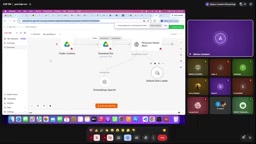
- Recursive Character Text Splitter: Used to split text into chunks for vector processing.
The presenter flagged a few key operational notes: your Google Drive account and Pinecone account must use the same email address, or the workflow won't run. On the right side, you'll also need to add a Chat Trigger node to enable interactive Q&A with the documents.
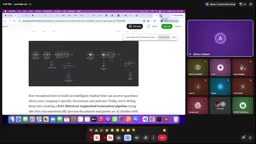
For the demo, he downloaded a policy and FAQ document from page five of an AI automation community's documentation as the knowledge base source material, then uploaded it to a Google Drive folder named "FAQ." He promised to share a complete step-by-step document after the session and recommended the "RAG pipeline chatbot" article on Medium as a reference. According to him, n8n's template library offers over 10,000 ready-made templates covering scenarios like restaurant apps, WhatsApp agents, and AI voice assistants.
A closer look at RAG: RAG (Retrieval Augmented Generation) addresses two core weaknesses of large language models: knowledge cutoffs and hallucinations. A purely generative model's knowledge is frozen at training time — it can't access real-time or private information, and when uncertain, it tends to "make things up." RAG's approach: send the user's question to a retrieval system first, pull the most semantically relevant document chunks from an external knowledge base (typically a vector database), then feed those chunks as context to the model so it can generate answers grounded in actual evidence. The vector database (like Pinecone in this demo) is the core storage layer of any RAG pipeline — documents are converted into high-dimensional vectors by an embedding model and stored there, then retrieved at query time by calculating vector similarity rather than relying on traditional keyword matching. The chunking step is equally critical: document chunks that are too long exceed the model's context window, while chunks that are too short lose semantic coherence. The recursive character text splitter balances this tradeoff by attempting to split at natural boundaries like paragraphs and sentences.
Tool Recommendations for Students and Researchers
At the end of the session, the presenter shared a practical toolkit for students, educators, and researchers to explore:
- Cursor AI / Claude Code: He stated bluntly that "VS Code is outdated" and recommended switching to Cursor AI. Claude Code received particular emphasis as a teaching assistant — useful for writing documentation, generating proposals, authoring course materials, and creating design documents;
- Hugging Face: Positioned as a product platform where AI developers integrate LLM applications, supporting use cases from text-to-text to text-to-video;
- Cohere: An API platform for building text-based applications;
- Jenny: A tool aimed at researchers, capable of generating abstracts and research papers;
- ElevenLabs / Retell AI: Recommended platforms for building AI voice agents.
The presenter's overall conclusion: whether you're a student, educator, or researcher, you should dive in and explore all three — Agentic AI, Generative AI, and MCP Servers. "The future belongs to MCP Servers." That said, claims like "VS Code is outdated" or "humans will be replaced" represent the presenter's personal perspective, and technology choices should always be evaluated rationally against your own specific needs.
Related articles

Chain of Thought Isn't Just for AI: How Humans Can Use CoT to Improve Thinking Quality
Chain of Thought isn't just a prompt trick for large models. Starting from a Hacker News discussion, this article analyzes why CoT works for human thinking too, breaks down actionable ways to transfer it, and highlights the key differences between human CoT and machine CoT.
Cloudflare Teams Up with OpenAI: Closi…
Cloudflare Teams Up with OpenAI: Closing the Loop from Vulnerability Discovery to Defense with AI
Cloudflare uses OpenAI Daybreak to investigate security vulnerabilities and generate reviewable remediation plans, while developers use Codex to boost coding efficiency and quality.

Orca Multi-Agent Orchestration in Practice: A Guide to Parallel Collaboration with Claude and Codex
Orca is Stable AI's free open-source agent workbench supporting 34 agents like Claude Code and Codex in parallel. Learn its Git worktree isolation, multi-model orchestration, and mobile management.