Agentic AI Reimagines Cloud Migration: A Deep Dive into AWS Bedrock AgentCore

AWS uses a multi-agent framework to compress enterprise cloud migration IaC development from weeks to minutes.
AWS Professional Services has built a multi-agent framework on Amazon Bedrock AgentCore to automate enterprise cloud migration end-to-end. The framework splits complex migration tasks across four types of purpose-built agents: workload discovery and assessment, automated IaC generation, portfolio-level governance, and post-migration operations. The most striking efficiency gain is IaC development time dropping from weeks to minutes. This case exemplifies a key agentic AI pattern — rather than relying on a single general-purpose model, purpose-built agents with clear responsibilities are composed into an end-to-end workflow via an orchestration layer. As generation capabilities improve dramatically, the human role shifts from executor to reviewer, making output quality and security assurance the new central challenge.
Cloud Migration's Old Challenges, Met with a New Agentic AI Approach
Enterprise cloud migration has long been a time-consuming, complex, and heavily expertise-dependent endeavor. From asset discovery and architecture design to writing infrastructure-as-code (IaC) and managing post-migration operations, every stage can become a bottleneck that slows the entire project. AWS Professional Services has built a multi-agent framework on Amazon Bedrock AgentCore, aiming to automate this entire chain end-to-end using "agentic AI."
The most immediately tangible gain is in infrastructure code generation efficiency. According to AWS, IaC development time has been compressed from "weeks" down to "minutes" — a magnitude of improvement that could fundamentally reshape the delivery pace of migration projects.
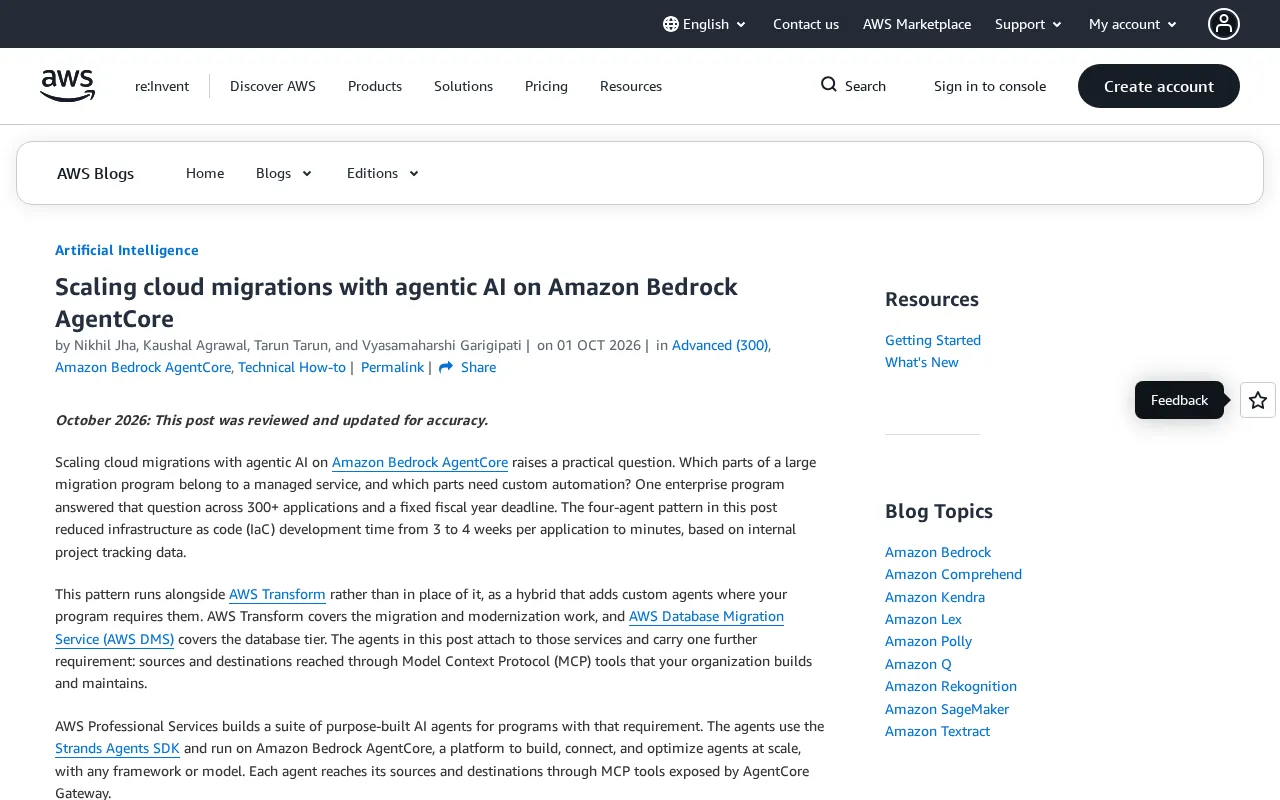
How the Multi-Agent Framework Divides the Work
The core idea behind this solution is to replace a single general-purpose model with "purpose-built AI agents," each focused on a specific responsibility within the migration workflow. The division of labor falls into four broad areas:
Discovery and Assessment
The first step of any migration is taking stock of what you have. Discovery agents automatically identify existing workloads, dependencies, and resource configurations, providing the data foundation for subsequent migration decisions. Compared to manual inventorying, automated discovery significantly reduces the risk of omissions and mismatches.
Infrastructure as Code Generation
This is where the framework delivers its most dramatic gains. Based on the results from the discovery phase, agents automatically generate deployable infrastructure-as-code. AWS emphasizes that this step cuts the development cycle from weeks to minutes, freeing engineers from repetitive template writing so they can focus on higher-value architecture review and optimization.
What is Infrastructure as Code (IaC)? IaC is a core practice in modern cloud operations — it means defining and managing cloud resources through declarative or imperative code files rather than manual clicks in a console. Popular tools include HashiCorp Terraform (cloud-agnostic) and AWS CloudFormation / CDK (AWS-native). The core value of IaC lies in repeatability (the same code deploys consistent infrastructure across environments), version control (changes are traceable and reversible), and CI/CD pipeline integration. That said, manually writing IaC is typically the most time-consuming part of a cloud migration — a mid-sized enterprise application can involve dozens to hundreds of resource modules that engineers must translate one by one. This is precisely where agent-generated IaC delivers value, though the security review of generated outputs (e.g., least-privilege IAM policies, network isolation strategies) still requires human oversight.
Portfolio Governance
When an enterprise needs to migrate a large portfolio of applications simultaneously, governance becomes the key to operating at scale. Governance agents handle unified oversight at the portfolio level, ensuring the migration process adheres to compliance, security, and cost constraints — preventing the chaos that comes from teams each "doing their own thing."
Post-Migration Operations
Migration isn't the finish line. Operations agents take over monitoring, optimization, and ongoing management after migration is complete, forming a closed loop from migration through to steady-state operations.
Why Multi-Agent Systems vs. a Single Large Model? The fundamental difference between a multi-agent system and a single LLM lies in substituting "specialization" for "generalization." A single general-purpose model faces two key challenges with long-horizon tasks like cloud migration: first, context window limitations — a complete enterprise asset inventory and architecture documentation often exceeds what a single inference pass can handle; second, reliability and focus — asking the same model to excel simultaneously at asset discovery, code generation, and compliance review leads to uneven output quality. Multi-agent architecture addresses this by splitting responsibilities, allowing each agent to maintain higher output quality within a narrower task domain, while an orchestration layer manages information passing and task dependencies across agents. This design pattern is rapidly becoming the dominant paradigm for enterprise AI deployment, commonly referred to as an "agentic workflow" or "agentic AI."
Why Bedrock AgentCore as the Foundation
Amazon Bedrock AgentCore provides the runtime and orchestration infrastructure for this multi-agent system. Rather than building agent scheduling and tool-calling mechanisms from scratch, AgentCore enables multiple purpose-built agents to collaborate within a unified runtime environment, handling complex concerns like task decomposition, context passing, and tool integration.
For a team like AWS Professional Services — which serves large numbers of enterprise clients — this kind of reusable, scalable framework means migration methodology can be codified into standardized engineering assets, rather than rebuilt from scratch for every project.
What is Amazon Bedrock AgentCore? Launched by AWS in 2025, Amazon Bedrock AgentCore is a managed service designed for running and orchestrating AI agents in production environments. It provides several key foundational capabilities: a secure code execution sandbox (allowing agents to safely run generated code snippets), long-term memory storage (enabling agents to maintain context across sessions in long-running workflows), a built-in tool integration layer (connecting to browsers, databases, external APIs, etc.), and a multi-agent collaboration protocol (defining how agents hand off tasks and results to one another). Compared to open-source orchestration frameworks like LangChain or AutoGen, AgentCore is positioned as a fully managed, enterprise-production-grade solution, offering more complete out-of-the-box support for security auditing, permission isolation, and observability — at the cost of deeper lock-in to the AWS ecosystem.
Implications for Enterprises and Practitioners
This case represents a typical pattern for deploying agentic AI in enterprise engineering contexts: rather than chasing a single all-knowing model, it decomposes a complex workflow into agents with clearly defined responsibilities, then composes them into an end-to-end workflow through an orchestration layer.
For cloud architects and DevOps teams, what's worth paying attention to isn't just the "weeks to minutes" efficiency figure — it's the underlying shift in how work gets done. The human role is gradually moving from "executor" to "reviewer and decision-maker." When IaC can be generated in seconds, ensuring the quality, security, and maintainability of that generated output becomes the new core competency.
One important caveat: this content comes from AWS and inherently carries a product promotion angle. The efficiency figures cited are based on official claims, and real-world results will vary depending on the complexity of an organization's existing environment, data quality, and the reliability of agent outputs. Before introducing this framework into a production environment, establishing robust validation and human review mechanisms remains essential.
Related articles

Chain of Thought Isn't Just for AI: How Humans Can Use CoT to Improve Thinking Quality
Chain of Thought isn't just a prompt trick for large models. Starting from a Hacker News discussion, this article analyzes why CoT works for human thinking too, breaks down actionable ways to transfer it, and highlights the key differences between human CoT and machine CoT.
Cloudflare Teams Up with OpenAI: Closi…
Cloudflare Teams Up with OpenAI: Closing the Loop from Vulnerability Discovery to Defense with AI
Cloudflare uses OpenAI Daybreak to investigate security vulnerabilities and generate reviewable remediation plans, while developers use Codex to boost coding efficiency and quality.

Orca Multi-Agent Orchestration in Practice: A Guide to Parallel Collaboration with Claude and Codex
Orca is Stable AI's free open-source agent workbench supporting 34 agents like Claude Code and Codex in parallel. Learn its Git worktree isolation, multi-model orchestration, and mobile management.