Agentic CUDA Kernel Optimizer: A New Attempt at AI-Driven Auto-Tuning

An AI agent that iteratively optimizes CUDA kernel performance, aiming to automate GPU-level tuning.
The Agentic CUDA Kernel Optimizer is an open-source project that attempts to replace manual GPU low-level code tuning with an AI agent. CUDA kernel optimization traditionally requires engineers to deeply understand GPU architecture and endure a time-consuming modify-compile-benchmark loop. By integrating a large language model into this closed loop — analyzing bottlenecks, generating optimizations, compiling automatically, and iterating based on real measurements — the tool could significantly lower the barrier to high-performance GPU programming. The scenario also has a natural advantage: execution speed is a clear, quantifiable objective that provides clean reward signals for the agent. However, the project is still in early-stage demonstration, lacking measured speedup data and comparisons with mature frameworks like TVM and Triton, so its production value remains to be proven.
What Is the Agentic CUDA Kernel Optimizer?
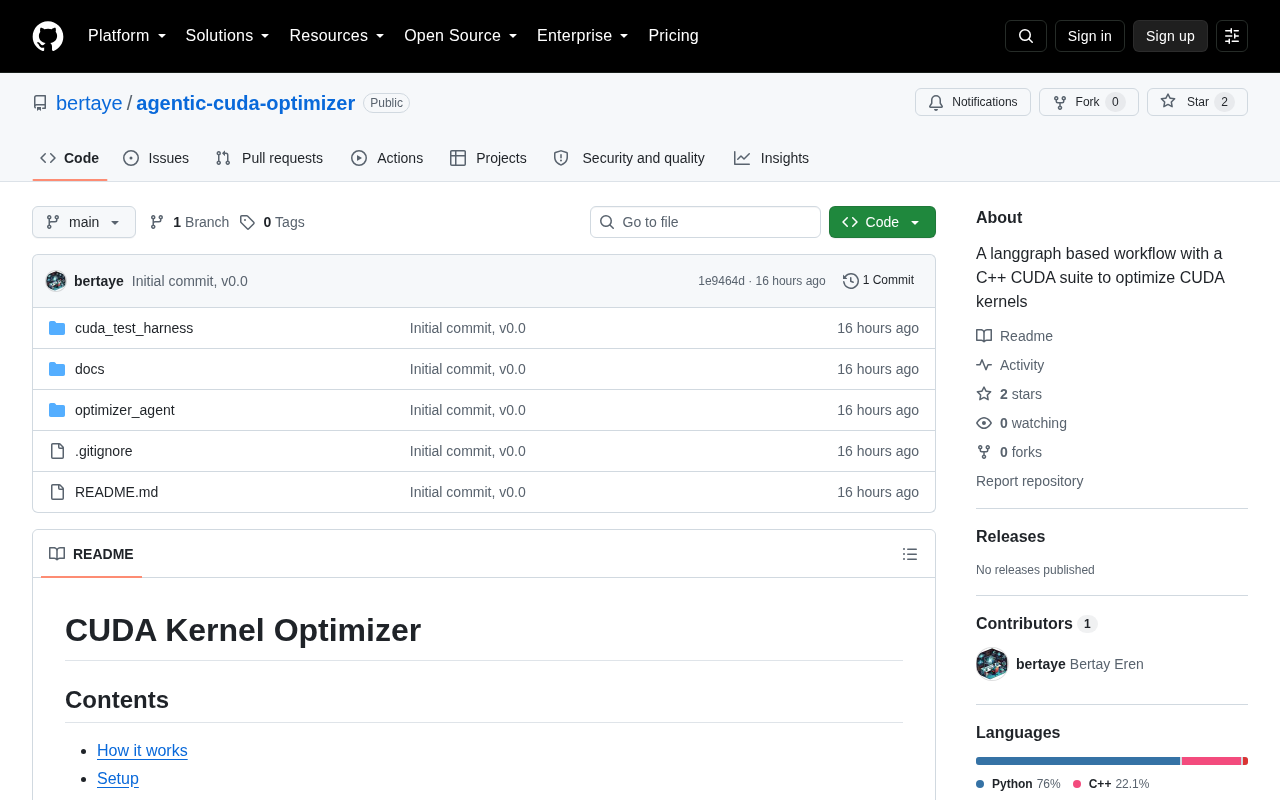
A project called "Agentic CUDA Kernel Optimizer" recently appeared on the Show HN section of Hacker News. As the name suggests, it's a tool that attempts to use an AI agent to automatically optimize CUDA kernel performance. While community engagement remains limited at this early stage (few upvotes, no comments yet), the direction it points toward — letting AI handle low-level GPU code tuning automatically — is a genuine pain point in high-performance computing and AI infrastructure.
CUDA is NVIDIA's parallel computing platform and programming model, and it serves as the computational backbone of virtually all modern deep learning training and inference. Manually optimizing CUDA kernels has long been considered highly specialized and time-consuming work, requiring engineers to deeply understand GPU hardware architecture, memory hierarchy, thread scheduling, and much more. Automating this process carries considerable practical value.
CUDA kernels are functions that execute in parallel on the GPU, run by thousands of threads simultaneously. During training or inference, a typical deep learning model repeatedly invokes operators like matrix multiplication, convolution, and normalization — each backed by one or more CUDA kernel implementations. Kernel performance directly determines the throughput and latency of the entire model. Optimizing a kernel means tuning the compute-to-memory-access ratio for a specific GPU architecture (such as the Ampere architecture on the A100 or Hopper on the H100), leveraging specialized hardware units like Tensor Cores, and avoiding common performance pitfalls like warp divergence and memory bank conflicts. Even experienced GPU engineers can spend days or weeks iterating to bring a naive implementation close to peak theoretical hardware performance.
Why Kernel Optimization Is a Good Fit for Agents
CUDA kernel optimization is fundamentally a massive search-and-trial space. Engineers must repeatedly adjust thread block sizes, shared memory usage, loop unrolling strategies, memory access patterns, and other parameters — measuring performance on real hardware at each step — to approach an optimal solution. This "modify → compile → benchmark → modify" loop maps naturally onto the agentic workflow.
The "agentic" approach refers to giving a large language model not just one-shot code generation capability, but a closed-loop ability to plan, execute, observe feedback, and iteratively refine. In the context of kernel optimization, an agent can:
- Analyze existing kernel code to identify potential performance bottlenecks
- Generate candidate optimizations and automatically compile them
- Run benchmarks to collect real-world performance data
- Use measurement results to determine the next optimization step
This autonomous iteration model can, in theory, progressively approach expert-level optimization results without human intervention — significantly lowering the barrier to high-performance GPU programming.
The Technical Significance of This Direction
Applying AI agents to low-level code optimization is an imaginative research direction that has gained momentum in recent years. Compared to general-purpose code generation tasks, kernel optimization has a natural advantage: it has a clear, quantifiable objective function — execution speed. This means every decision an agent makes receives objective performance feedback, forming a clean reward signal that is highly conducive to automated iteration and result verification.
Given today's soaring AI training costs, even a few percentage points of improvement at the kernel level can translate into significant cost savings when aggregated across large-scale clusters. This is why topics like automatic kernel generation, compiler optimization, and operator fusion continue to attract sustained investment from both academia and industry.
Current State and Observations
To be objective, based on publicly available information, this project is still in an early demonstration phase. The Hacker News post has only 7 upvotes and no comments, and it lacks key data on implementation details, supported hardware, and measured speedup ratios. It is therefore difficult to fully assess its real-world effectiveness at this point.
For developers following this space, the value of Show HN projects like this lies more in the conceptual signal they provide: they confirm that the idea of "using agents to automatically optimize low-level code" is being put into practice by an increasing number of independent developers. As the coding capabilities of large language models continue to improve, we can expect more vertically focused agent tools targeting specific optimization scenarios to emerge.
An Open-Source Exploration Worth Watching
If tools like this are open-sourced and accumulate real performance benchmark data, they can provide genuine value to the community. Interested readers are encouraged to follow the project's future iterations — particularly its measured speedups on real workloads, and how it compares against manual optimization and existing auto-tuning frameworks such as TVM and Triton. That data is the core criterion for judging whether a kernel optimization tool has production-ready value.
Overall, the Agentic CUDA Kernel Optimizer represents a cutting-edge angle on AI-assisted systems programming. Despite limited information at this stage, the direction it points toward — automated GPU performance optimization — is worth sustained attention from developers and researchers alike.
TVM is an end-to-end deep learning compiler led by Tianqi Chen and others, capable of compiling model computation graphs to multiple hardware backends and searching for optimal scheduling strategies through auto-tuning modules like AutoTVM or Ansor. Triton is an open-source GPU programming language and compiler from OpenAI, designed to write efficient kernels at a higher abstraction level than CUDA while retaining explicit control over key performance parameters; PyTorch 2.0's torch.compile backend heavily relies on Triton-generated kernels. Compared to these two frameworks — both widely deployed in industry — the biggest distinction of LLM-based agentic optimization is that it does not rely on predefined search spaces or scheduling templates. Instead, it leverages the model's code understanding and generation capabilities to explore a more open-ended optimization landscape. This is both a potential advantage and the root reason why the reliability of this approach has yet to be fully validated.
Related articles

WorkBuddy Full Guide: How an AI Coworker Takes Over Workplace Automation
What is WorkBuddy? This article analyzes the core capabilities of this full-scenario AI agent: autonomous execution with deliverable results, local file processing, multi-agent parallelism, and workplace automation workflows, helping you judge its essential difference from ordinary AI chat tools.

The Truth About AI Agents: A Hundred Lines of Code + an LLM, Deconstructing the Agent's Underlying Logic
AI agents aren't a new AI species—just a language model plus tools, a loop, and a goal. Here's the underlying logic: how 100 lines of Python hit a 75% fix rate, why the harness beats the model, and Gartner's "agent washing."

AI Agent Deployment: Three Things Developers Should Do
AI Agent deployment doesn't require rushing into multi-agent systems. This article outlines an actionable deployment path and engineering acceptance thresholds for developers, covering human baselines, bounded single-agent scope, and a controlled code-modification loop.