Agentic LLM: How Large Language Models That Can Act Will Change the World

Agentic LLMs upgrade AI from generating text to taking autonomous real-world action — and coordinating with other agents.
Agentic LLMs represent a pivotal evolution in large language model development: rather than merely generating text, these models gain the ability to invoke tools, execute multi-step tasks, and directly alter external states — shifting from "can talk" to "can do." Their core mechanism is a "Reason → Act → Observe" closed loop, where the model continuously perceives its environment and dynamically plans its actions. Multiple LLM agents can further collaborate, divide labor, and cross-check each other through natural language, forming team-like structures capable of tackling complex tasks beyond any single model's reach. Yet as AI acts directly on the real world, questions of intent alignment, accountability, and behavioral predictability become critical — demanding a fundamental rethinking of the relationship between humans and intelligent agents.
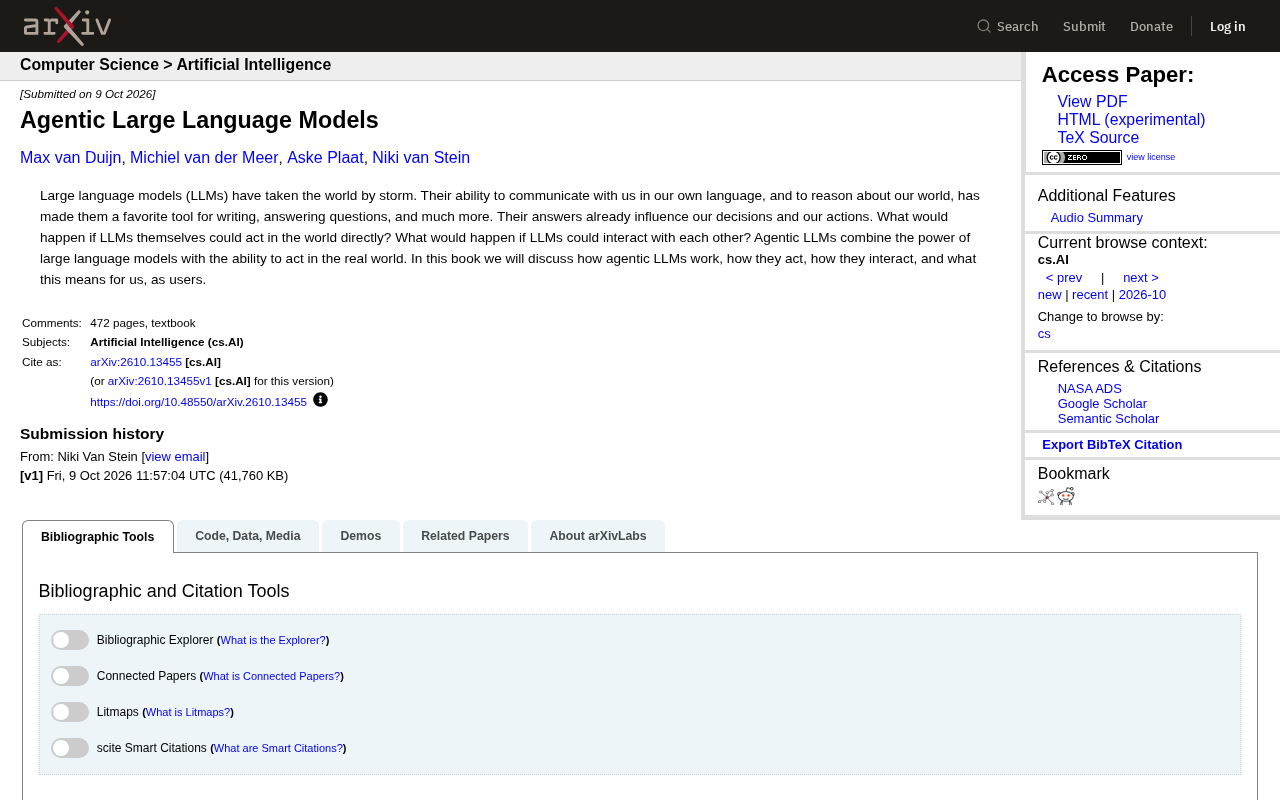
Large language models (LLMs) have already profoundly transformed the way people access information and work with text. They communicate in natural language, reason about the real world, and have become indispensable tools for writing, Q&A, and countless other use cases. But a more disruptive question is now emerging: what happens if LLMs don't just answer questions, but can take direct action in the real world? And what changes when multiple LLMs can collaborate and interact with one another? These are the core questions that Agentic LLMs set out to answer.
From "Can Talk" to "Can Do"
Traditional LLMs operate at the level of language — they generate text, offer suggestions, and assist with decisions, but actual execution still depends on a human. You ask a question, it answers. You ask it to draft an email, it drafts one and hands it back to you. Whether to send it, and how to follow up, is entirely up to you.
The fundamental shift with Agentic LLMs is that they combine a language model's reasoning capability with the ability to act within real environments. In other words, the model is no longer just a "thinking brain" — it now has "hands and feet." It can invoke tools, execute tasks, and change external states. This transforms an LLM from a passive advisor into an active agent.
The significance of this upgrade is enormous. As noted in the original source, LLM responses have already been "influencing our decisions and actions." When the model itself can act directly, that influence shifts from the "advisory layer" down to the "execution layer" — and the human in the middle may be compressed or removed entirely.
How Agents Act and Interact
Agentic LLMs operate along three key dimensions: how they act, how they interact, and what this means for us.
Action Mechanisms
An action-capable LLM typically needs to perceive its environment, plan steps, invoke external tools or interfaces, and adjust subsequent actions based on feedback. This forms a closed loop of "Reason → Act → Observe" rather than a single-turn Q&A interaction. The model must maintain persistent goal-directedness to complete complex, multi-step tasks.
This "Reason → Act → Observe" loop is technically known as the ReAct (Reasoning + Acting) framework, or more broadly as "Tool Use / Function Calling." At each step, the model first reasons internally in natural language (Chain-of-Thought), then decides which external tool to invoke — such as a search engine, code executor, database query interface, or browser — and incorporates the tool's output into its next reasoning step. This differs fundamentally from traditional software function calls: traditional software follows a deterministic execution path, whereas an LLM agent's path is dynamically planned at runtime, making it far more flexible but also harder to enumerate all possible behavioral branches in advance. The engineering infrastructure supporting this capability is commonly referred to as an "Agent Framework" — examples include LangChain, AutoGen, and LlamaIndex Agents — which handle context memory management, tool registration and scheduling, and state tracking across multi-step tasks.
Multi-Agent Interaction
The original source raises a particularly thought-provoking direction: what happens when LLMs can interact with each other? When multiple agents work together, they can divide labor, negotiate, and cross-check one another, forming a team-like collaborative structure. Such multi-agent systems could potentially tackle tasks that a single model cannot complete independently — but they also introduce new challenges around coordination, conflict resolution, and controllability.
Multi-Agent Systems (MAS) are not a new concept born in the LLM era — they have decades of research behind them in classical AI and distributed systems. What LLMs bring to the table is natural language understanding and generation for each individual agent, dramatically lowering the engineering barrier for inter-agent negotiation and communication. Agents can now pass instructions, results, and feedback in human-readable natural language, without relying on predefined communication protocols. Common multi-agent patterns include the "Orchestrator-Worker" structure (a primary agent decomposes tasks and directs multiple sub-agents to execute them), peer collaboration (multiple agents reviewing each other's outputs to improve accuracy), and adversarial competition (agents playing different roles in a debate to converge on more reliable conclusions). Microsoft's AutoGen framework is one of the most representative multi-agent experimentation platforms available today, with published research using it to replicate team collaboration in software development, scientific reasoning, and other domains.
What This Means for Users
From a user perspective, Agentic LLMs bring both opportunity and responsibility. On one hand, AI that can act autonomously can dramatically improve efficiency, freeing humans from tedious execution tasks. On the other hand, when a model acts directly on the real world, the consequences of erroneous actions become far more immediate.
Who is accountable for an agent's actions? How do we ensure its goals remain aligned with human intent? When multiple agents interact, is the system's behavior still predictable? These are all questions that must be confronted as we move from "models that can talk" to "models that can do." The original source places its emphasis on "what this means for us as users" — a framing that underscores how redefining the relationship between humans and agents is just as critical as the technical capabilities themselves.
"Alignment" and "Controllability" are the two core research topics in Agentic LLM safety. Alignment refers to keeping a model's action goals consistent with the true intent of users or society. In a single-turn Q&A, minor deviations may be tolerable — but in multi-step autonomous execution, small goal mismatches can compound over time, leading to outcomes that diverge dramatically from expectations. This phenomenon is sometimes called "Goal Drift." Controllability addresses when and how humans can intervene in or halt an agent's actions. The industry commonly uses "Human-in-the-Loop (HITL)" to describe design patterns that preserve human review checkpoints, as opposed to "Human-on-the-Loop," where the system executes automatically but humans can intervene at any time. In practice, the choice between these two modes directly affects the tradeoff between system efficiency and risk exposure — and is one of the most critical governance decisions organizations face when deploying Agentic LLMs.
A Research Direction Taking Shape
Agentic LLMs represent a significant evolutionary path in the development of large language models — from language understanding to autonomous action. They integrate an LLM's reasoning and expressive capabilities with real-world execution ability, and further explore the possibilities of inter-agent collaboration.
For practitioners and users following the AI frontier, understanding how Agentic LLMs work — their action mechanisms, interaction patterns, and societal implications — is becoming increasingly important. This is not merely a technical topic. It speaks to how we will coexist with a new class of intelligent systems capable of acting on their own.
Related articles

Felix Rieseberg Personal Homepage
Felix Rieseberg's personal homepage sparks attention on Hacker News. This article covers the Slack engineer's technical background, the rise and fall of nativefier, and the value of a developer homepage as a tech calling card.

@ai-sdk/vue 3.0.306 Patch Release Syncs with [email protected] Update
@ai-sdk/vue 3.0.306 released, synced with [email protected]. A routine patch release for the Vercel AI SDK ecosystem with no public API changes; the Vue adapter layer stays version-aligned with the core package.

Gemini 4 Argon API Launches: The Era of Million-Token Output Begins
Google launches Gemini 4 Argon with sparse MoE architecture, up to 1M output tokens, and a 68.90% Vals Index score, available across API, AI Studio, and the Gemini app.