Agentic SOAR vs. Traditional SOAR with a Chatbot: The Real Difference in Security Response

Agentic SOAR vs. SOAR with a chatbot: does AI change what the machine executes, or just what analysts see?
This article examines a core debate in security operations: are products marketed as "Agentic SOAR" simply traditional SOAR platforms with an LLM layer bolted on? It clarifies the key distinction — traditional SOAR runs deterministic playbooks while LLM add-ons only summarize and advise after the fact; true Agentic SOAR embeds agents within the execution chain to reason dynamically beyond playbook coverage. The article also provides four actionable questions to help evaluators cut through vendor marketing and verify what has actually changed at the execution level.
A Sharp Question from the Security Operations Frontline
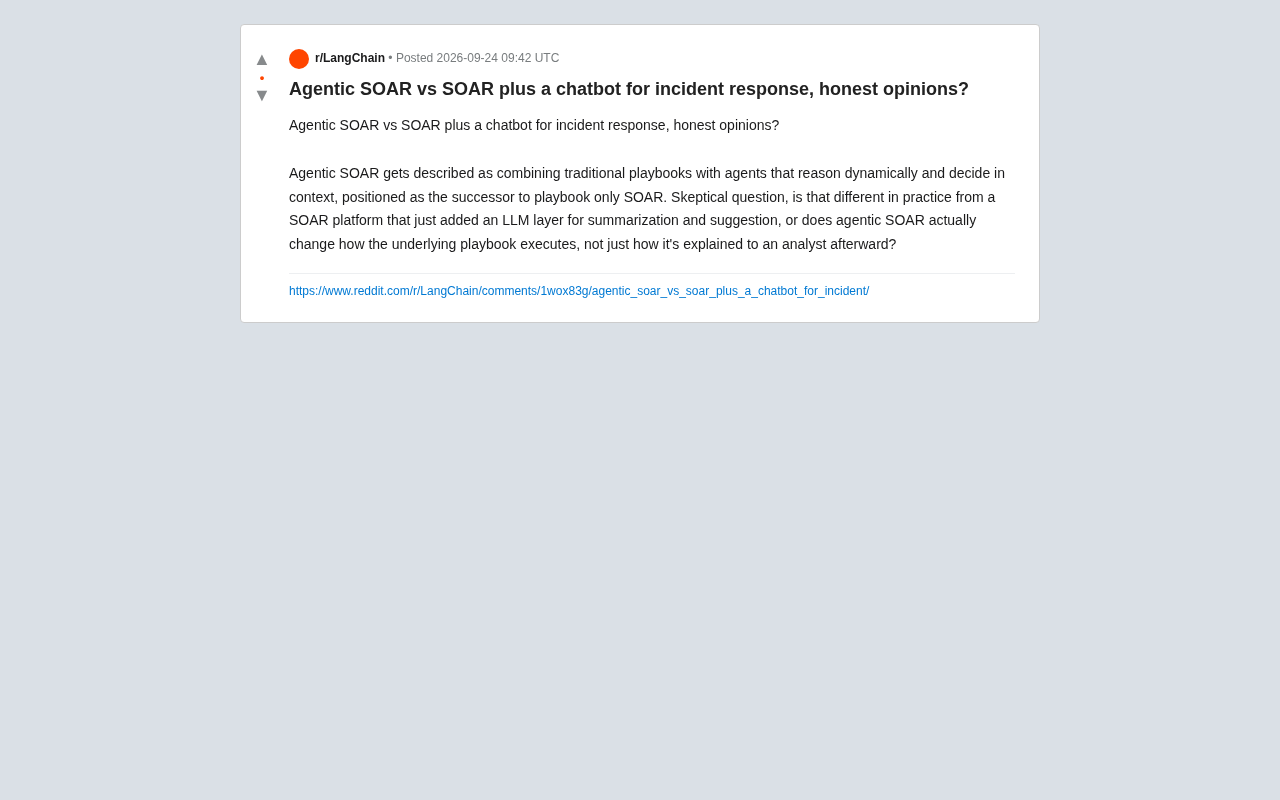
A debate is brewing in the Security Operations (SecOps) community over incident response tooling. A practitioner on Reddit posed a pointed question: Does so-called Agentic SOAR (Agentic Security Orchestration, Automation and Response) actually differ in any meaningful way from "a traditional SOAR platform bolted onto an LLM chatbot"?
The question cuts deep because vendor marketing consistently blurs the line between the two. Agentic SOAR is pitched as "combining traditional playbooks with agents capable of dynamic reasoning and contextual decision-making" — positioned as the successor to "playbook-only SOAR." It sounds compelling. But frontline analysts want to know: is this a genuine upgrade to how the system executes, or is it just a prettier post-hoc explanation for analysts?
Clearing Up Two Easily Confused Concepts
Answering this question requires understanding what SOAR actually is. Traditional SOAR (Security Orchestration, Automation and Response) is built around predefined playbooks: when a certain alert fires, the system follows a fixed, human-authored workflow — querying threat intelligence, isolating a host, blocking an IP, creating a ticket. The logic is deterministic and linear, following an if-then decision tree.
What "SOAR + Chatbot" Actually Means
In this model, the underlying playbook execution doesn't change at all. The LLM layer typically does three things:
- Summarization: Compressing alert logs and event data into human-readable summaries
- Suggestions: Prompting analysts with "what you might want to do next"
- Q&A: Letting analysts query incident details in natural language
The critical point is that the LLM here is a spectator. It reads the output of playbook execution and translates the results for human consumption — but it doesn't participate in or alter how the playbook runs. The playbook executes exactly as it always did; the AI is simply a "narrator" layered on top.
What "Agentic SOAR" Actually Promises
A genuinely Agentic SOAR should, in theory, have the agent embedded within the execution chain itself. That means the agent isn't summarizing after the playbook finishes — it's actively involved during incident handling:
- Dynamically selecting the next action based on real-time context, rather than rigidly following preset branches
- Autonomously reasoning through response paths in scenarios the playbook doesn't cover
- Calling tools, evaluating results, and deciding on next steps — forming a closed decision loop
In other words, the core distinction is: Did the AI change how the playbook executes, or did it only change how the execution is explained to analysts? That is the essence of the original question.
SOAR platforms emerged around 2015, originally designed to address the "alert fatigue" problem facing SOC teams — among tens of thousands of daily security alerts, a large proportion are repetitive, low-value noise, draining analyst energy on mechanical query and triage tasks. Early products included Phantom (later acquired by Splunk), Demisto (later acquired by Palo Alto Networks and rebranded as XSOAR), and Swimlane. The core value of these platforms lay in "orchestration" — connecting operations scattered across firewalls, EDR, threat intelligence platforms, ticketing systems, and other tools into automated workflows via API integrations. However, authoring and maintaining playbooks requires significant manual effort, and coverage of attack scenarios is inherently lagged — the very contradiction that Agentic approaches attempt to resolve.
In AI, an "Agent" specifically refers to an autonomous system capable of perceiving its environment, planning actions, calling tools, and iterating based on feedback — distinct from a standard single-input/output LLM call. The underlying architecture typically relies on frameworks like ReAct (Reasoning + Acting) or Plan-and-Execute, enabling the model to reason, act, and observe results in each step, forming multi-turn loops. In security response contexts, this means agents must maintain contextual state across steps, invoke external tools like sandbox analysis or threat intelligence, and revise decision paths as new information arrives. Current mainstream implementations include OpenAI Function Calling, LangChain Agents, and proprietary tool-calling frameworks built by major security vendors. This architecture differs from "LLM reads a log and outputs a summary" by orders of magnitude in engineering complexity.
Why This Distinction Matters
For Security Operations Centers (SOCs), this isn't a semantic debate. If AI is only providing post-hoc narration, then when facing novel attacks the playbook never anticipated, the system will still stall — it can't handle situations that were never scripted. Analysts receive a more readable report, but the actual burden of response decisions still falls entirely on human shoulders.
If AI is truly embedded in the execution layer, it can theoretically handle long-tail scenarios, reduce "playbook blind spots," and extend automation to a broader range of incident types. But this also introduces new challenges: the auditability and controllability of autonomous agent decision-making. Security response often involves isolating production systems and locking accounts. The risk of a "black box" agent acting autonomously may keep SOC teams up at night more than a rigid playbook ever did.
Auditability and Human-in-the-Loop are two core compliance requirements in security automation, particularly prominent in regulated industries like finance, healthcare, and critical infrastructure. Standards such as the NIST Cybersecurity Framework and SOC 2 require complete decision trails for security operations. For agentic systems, this means recording not just "what actions were taken" but also "what reasoning led to that decision" — the agent's Chain of Thought must be included in audit logs. The industry currently lacks unified audit standards for AI-driven security response, which is a key institutional reason (beyond pure technical trust) why many SOC teams remain cautious about Agentic SOAR.
How to Cut Through Vendor Hype
Faced with the proliferation of "Agentic" labels in the market, a few questions can quickly reality-check any vendor claim during procurement or evaluation:
- Probe the execution layer: When the system encounters a situation the playbook doesn't define, does it stop and wait for a human — or can it reason through a course of action autonomously? If it's the former, it's fundamentally still traditional SOAR.
- Decision traceability: Is every decision the agent makes traceable and replayable? Or is there only a summary of the final outcome?
- Human intervention points: Does the agent execute fully autonomously, or does it require human approval before critical actions (human-in-the-loop)? This determines its actual degree of autonomy.
- Playbook dependency: Can the system function at all without predefined playbooks? If it's entirely playbook-dependent and AI is just a wrapper, it's a reskin — not a reinvention.
If a vendor can only show you prettier alert summaries and a natural language Q&A interface, but can't clearly explain what changed in the underlying execution logic, it's almost certainly "SOAR with a chatbot added" — not genuine Agentic SOAR.
A Pragmatic Assessment
From the perspective of the discussion sparked by the original post, there is a clear gap between marketing and engineering reality in this space. "Agentic" is the hottest marketing term of the moment, but many products' agentic components go no deeper than surface-level LLM summarization and recommendations. Systems where agents genuinely participate in execution decisions — while remaining controllable and auditable — carry a far higher bar for engineering complexity and trust.
For teams currently evaluating incident response tooling, the pragmatic stance is: don't let narratives like "successor" or "next-generation" dictate your thinking. Instead, go back to the execution layer and verify — is the AI actually changing what the machine does, or is it only changing what humans see? That single line is the litmus test for distinguishing a true agentic system from a chatbot bolted onto the side.
Related articles

Chain of Thought Isn't Just for AI: How Humans Can Use CoT to Improve Thinking Quality
Chain of Thought isn't just a prompt trick for large models. Starting from a Hacker News discussion, this article analyzes why CoT works for human thinking too, breaks down actionable ways to transfer it, and highlights the key differences between human CoT and machine CoT.
Cloudflare Teams Up with OpenAI: Closi…
Cloudflare Teams Up with OpenAI: Closing the Loop from Vulnerability Discovery to Defense with AI
Cloudflare uses OpenAI Daybreak to investigate security vulnerabilities and generate reviewable remediation plans, while developers use Codex to boost coding efficiency and quality.

Orca Multi-Agent Orchestration in Practice: A Guide to Parallel Collaboration with Claude and Codex
Orca is Stable AI's free open-source agent workbench supporting 34 agents like Claude Code and Codex in parallel. Learn its Git worktree isolation, multi-model orchestration, and mobile management.