Agentica Open-Source Framework Review: A Lightweight Async AI Agent Development Alternative

Agentica is a lightweight, async-first Python open-source framework for AI Agent development
Agentica is a lightweight Python AI Agent framework built by developer shibing624, featuring an async-first architecture with support for tool calling, RAG (Retrieval-Augmented Generation), multi-agent collaboration, and MCP protocol. Compared to heavyweight frameworks like LangChain, it stands out for its simplicity, gentle learning curve, and Chinese language friendliness, making it ideal for rapid prototyping and small-to-medium project development.
What Is Agentica? A Lightweight AI Agent Framework Worth Watching
In today's flourishing landscape of AI Agent frameworks, an open-source project called Agentica is quietly gaining traction on GitHub. Built by shibing624, a well-known developer in the NLP field, it's a lightweight, async-first Python framework specifically designed for building AI agents.
The framework supports tool calling, RAG (Retrieval-Augmented Generation), multi-agent collaboration, and MCP (Model Context Protocol)—the most essential capabilities in modern AI Agent development. While it currently has only 296 stars, its precise feature positioning and clean design philosophy have carved out a unique niche among heavyweight frameworks like LangChain and AutoGen.
Core Features of Agentica in Detail
Async-First Architecture: Built for High-Concurrency Scenarios
Agentica's most prominent design philosophy is async-first. In real-world AI Agent operations, a large number of tasks involve network requests, model inference, tool calls, and other I/O-intensive operations. Traditional synchronous frameworks waste significant computational resources due to blocking while handling these tasks.
Agentica is built from the ground up around Python's asyncio ecosystem, enabling developers to easily implement:
- Concurrent tool calls with multiple external APIs requested simultaneously
- Parallel multi-agent collaboration with different agents working in sync
- Efficient streaming response handling for improved user experience
Technical Background: Python's asyncio is a standard library introduced in Python 3.4, based on Event Loop and Coroutine mechanisms that allow efficient handling of massive concurrent I/O operations within a single thread. In AI Agent scenarios, a complete inference chain might involve calling LLM APIs (taking several seconds), querying vector databases, and requesting external search engines—multiple network operations. With synchronous execution, these can only run sequentially, with total latency being the sum of all steps. With async execution, multiple I/O operations can be interleaved, bringing total latency close to that of the slowest individual operation. For Agent systems that need to orchestrate multi-step, multi-tool calls, this can yield performance improvements of several times over. Many early frameworks (such as early versions of LangChain) were designed synchronously, and while async interfaces were added later, architectural limitations prevent them from fully leveraging async advantages.
This native async design is critical for building production-grade AI applications and represents Agentica's key advantage over many "sync-to-async" frameworks.
Tool Calling: Connecting Agents to the Real World
Tool calling is a core capability of modern AI Agents. Agentica supports wrapping external functions and API endpoints as tools that large language models can invoke on demand during reasoning.
Technical Evolution: The concept of Tool Calling/Function Calling gained widespread adoption in 2023 when OpenAI released GPT-4's Function Calling feature. The core principle is that when generating responses, LLMs can output not only natural language text but also structured function call instructions (typically in JSON format), specifying the function name and parameters to invoke. The framework layer receives these instructions, executes the corresponding external functions, and returns results to the model for the next round of reasoning. This mechanism essentially grants LLMs the ability to "act," transforming them from passive text generators into proactive task executors. Currently, major model providers (OpenAI, Anthropic, Google, and Chinese providers like Zhipu and Baidu) all support native tool calling capabilities, though API formats vary slightly. One key value of Agent frameworks is abstracting away these differences and providing unified tool registration and invocation interfaces.
With this capability, Agents are no longer limited to pure text generation—they can interact with the real world through database queries, search engine calls, code execution, file system operations, and more.
RAG (Retrieval-Augmented Generation): Solving LLM Knowledge Limitations
Retrieval-Augmented Generation (RAG) is a key technology for addressing LLMs' knowledge timeliness and domain-specific knowledge gaps. Agentica includes built-in RAG support, allowing developers to use private knowledge bases and enterprise documents as retrieval sources, enabling Agents to reference the most current and accurate information when answering questions.
How It Works and Its Challenges: RAG was proposed by Meta AI in 2020. Its core idea is to retrieve relevant document fragments from external knowledge bases before the LLM generates an answer, injecting them as context into the model's prompt. A typical RAG pipeline includes: Document Chunking → Embedding → Storage in a vector database (such as Milvus, Pinecone, or ChromaDB) → Semantic retrieval when users ask questions → Concatenating Top-K relevant fragments with the question before sending to the LLM for answer generation. RAG addresses three core pain points of LLMs: knowledge cutoff date limitations (training data has a time boundary), insufficient domain knowledge (general models lack vertical industry depth), and hallucination problems (models may fabricate nonexistent information). However, RAG also faces technical challenges including retrieval quality, document chunking strategies, and context window limitations—high-quality RAG implementations require careful tuning across these dimensions.
This feature is particularly important in enterprise applications, significantly improving AI assistant answer quality and reliability while mitigating LLM hallucination issues.
Multi-Agent Collaboration: A Powerful Tool for Decomposing Complex Tasks
Complex tasks often require multiple specialized Agents working together. Agentica provides multi-agent orchestration capabilities, supporting task allocation, information passing, and result aggregation between different Agents.
Design Patterns: The concept of multi-agent systems originates from distributed artificial intelligence and has experienced a renaissance in AI applications as LLM capabilities have improved. Current mainstream multi-agent orchestration patterns include: Sequential Pipeline mode, where Agents process in fixed order; Hierarchical Delegation mode, where a supervisor Agent assigns tasks to subordinate Agents; Debate mode, where multiple Agents provide different perspectives on the same problem before synthesizing a decision; and Collaborative mode, where Agents dynamically coordinate through message passing. Stanford's "Generative Agents" paper and Microsoft's AutoGen project are important milestones in this field. Core challenges of multi-agent systems include communication protocol design, task decomposition strategies, conflict resolution mechanisms, and avoiding infinite loops.
A typical use case: a Research Agent handles information gathering, an Analysis Agent processes data, and a Summary Agent generates the final report. This division-of-labor approach can significantly improve the handling of complex tasks.
MCP Protocol Support: Embracing Open Ecosystem Standards
MCP (Model Context Protocol) is an open protocol standard proposed by Anthropic, designed to unify how AI models interact with external data sources and tools. Agentica's support for MCP means it can seamlessly connect to any MCP-compliant tools and services, greatly expanding the framework's ecosystem compatibility and extensibility.
Industry Significance: MCP was officially released by Anthropic in late 2024. Its design inspiration is similar to what USB-C does for hardware devices—providing a unified standard that allows AI models to connect to various external data sources and tools in a consistent manner. Before MCP, every AI application needed custom integration code for each data source, creating an M×N complexity problem (M applications × N data sources). MCP simplifies this to an M+N problem: applications only need to implement an MCP client, and data sources only need to implement an MCP server. The MCP protocol defines three core capabilities: Resources (reading files or data), Tools (executable operations), and Prompts (prompt templates). A large number of open-source MCP Servers have already emerged, covering common scenarios like GitHub, Slack, databases, and file systems. Frameworks that support MCP can directly leverage these ecosystem resources.
Agentica vs. Mainstream Frameworks like LangChain
In the current AI Agent framework landscape, projects like LangChain, AutoGen, and CrewAI dominate. Agentica's differentiated advantages are primarily reflected in the following aspects:
| Comparison Dimension | Agentica | LangChain | AutoGen |
|---|---|---|---|
| Framework Size | Lightweight & Lean | Large & Comprehensive | Medium |
| Async Support | Native Async | Added Later | Partial Support |
| Learning Curve | Gentle | Steep | Medium |
| Chinese Language Support | Friendly | Average | Average |
| Ecosystem Richness | Growing | Mature | Mature |
For small-to-medium projects or scenarios requiring rapid prototyping, Agentica may be more suitable than heavyweight frameworks like LangChain. Rather than trying to be all-encompassing, it focuses on core Agent capabilities, avoiding the complexity that comes with over-abstraction.
It's worth noting that LangChain, as the most popular AI application development framework today, has its core advantages in a rich integration ecosystem and comprehensive documentation, but has also been criticized by the community for over-abstraction and frequent API changes. AutoGen, Microsoft's multi-agent conversation framework, excels at building conversational collaboration between Agents but offers relatively limited flexibility in tool calling and RAG. CrewAI focuses on role-playing style multi-Agent collaboration, emphasizing Agent "roles" and "goals" definitions. Each framework has its optimal use case, and developers should choose based on specific requirements.
What Development Scenarios Is Agentica Best Suited For?
Agentica is suitable for the following types of developers and use cases:
- Rapidly building AI conversational assistants: Leveraging tool calling and RAG capabilities to quickly set up intelligent customer service or Q&A systems with domain expertise
- Automating business workflows: Using multi-agent collaboration to automate complex business processes
- AI Agent learning and research: With moderate code volume and clear structure, it's excellent for learning core AI Agent principles and implementation approaches
- MCP ecosystem project integration: Development projects that need to connect with MCP-standard tool chains
- High-concurrency AI applications: The native async architecture is naturally suited for production environments that need to handle large volumes of concurrent requests
Conclusion: A Promising Choice in Lightweight AI Agent Frameworks
While Agentica can't yet compete with top-tier frameworks in community size, its "lightweight + async-first" design philosophy addresses real pain points for many developers. Against the backdrop of AI Agent frameworks trending toward bloat and complexity, a clean, efficient, and easy-to-adopt framework may actually win more developer mindshare.
Notably, developer shibing624 has an extensive track record in the NLP open-source community. Their text2vec project is a Chinese text vectorization tool supporting multiple Embedding models, widely used for semantic search and text similarity computation. pycorrector is a Chinese text correction tool supporting both rule-based and deep learning approaches. similarities is a text similarity computation library. These projects share common traits: practical focus, clean code, and optimization for Chinese language scenarios—a development style that carries through to Agentica. A project maintained by a developer with a consistent output record typically means more reliable long-term support and higher code quality standards.
As AI Agent application scenarios continue to explode, Agentica is well-positioned to claim a place in the lightweight Agent framework segment. If you're looking for a clean and efficient Python AI Agent development framework, consider following the Agentica project and experiencing firsthand the development efficiency gains from its async-first design.
Related articles
 Product Reviews
The Programmer's Desk Setup Guide: Building a Workspace That Feels Like Home
Discover how programmers build productive, comfortable workspaces. From multi-monitor setups to ergonomic design, explore the desk philosophy that drives focus and flow.
 Product Reviews
Qoder vs Cursor Real-World Comparison: Which $20/Month AI IDE Is Better?
Hands-on comparison of Qoder vs Cursor AI IDEs: Agent autonomy, human interaction count, and architecture decisions. Qoder needed only 2 interactions vs Cursor's 8.
 Product Reviews
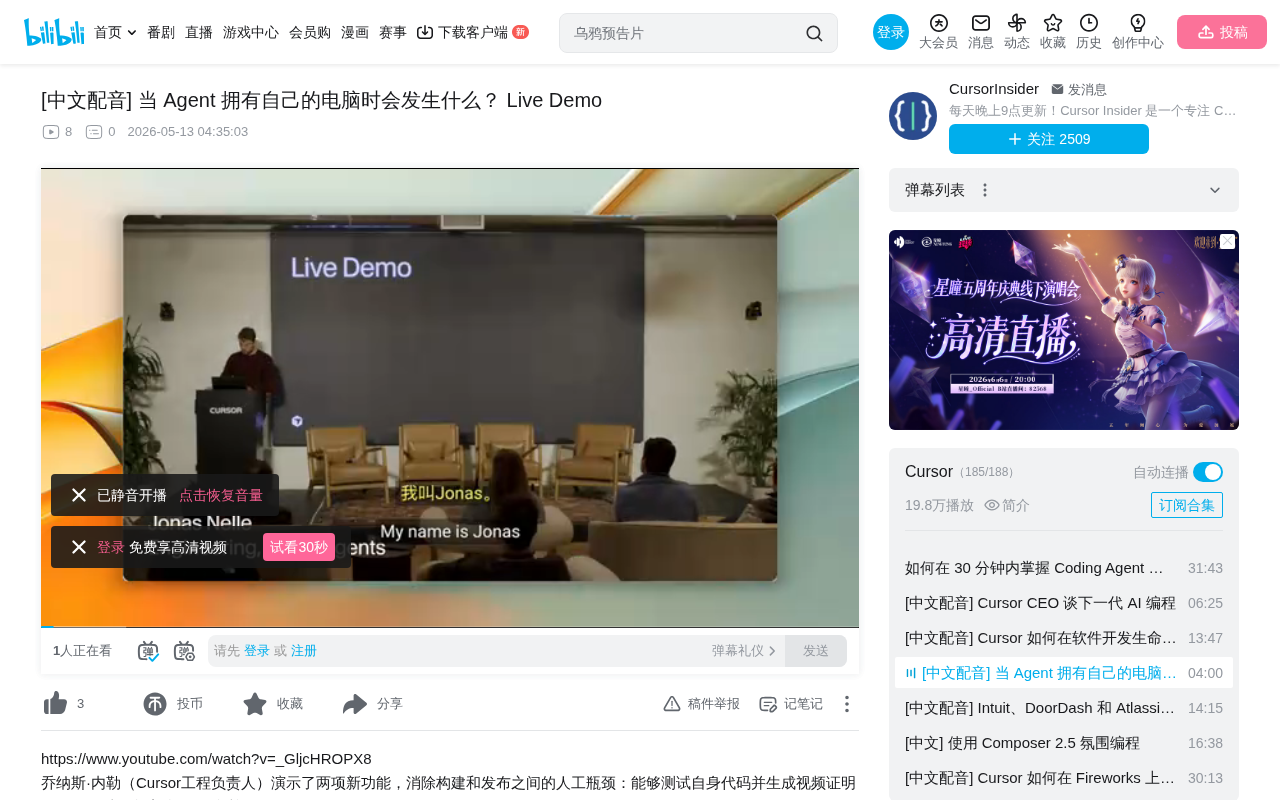
Cursor Cloud Agent Demo: Eliminating Bottlenecks Across the Entire Software Development Lifecycle
Deep analysis of Cursor's Cloud Agent demo showing how cloud VMs, automated test artifacts, and a full-chain control plane systematically eliminate human bottlenecks across the software development lifecycle.